Jade Statue
Rock Falls, Everyone DiesThe Jade Statue is an old monument depicting a beautiful woman, standing in a city plaza with a fountain and seeming to reach toward the heavens. Its decisive importance lies in the change it produces in the rock: what begins as a coveted object of gleaming jade becomes the image through which the rock first encounters beauty, music, and loss. The statue remains physically remote from the rock’s journey, yet its presence links a grounded human space to the destruction and remaking of an entire world.
Appearance and Place
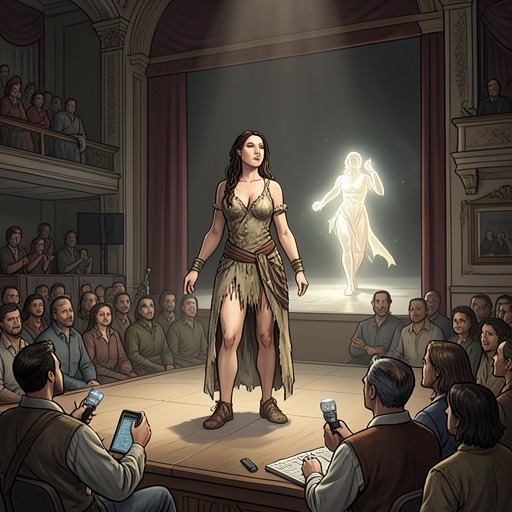
The Jade Statue stands in a small plaza beside a fountain. It depicts a beautiful woman, but the rock initially has no interest in the figure’s appearance; it notices only the shine of the jade. The statue is therefore introduced through two opposed perceptions. To human eyes it has the form and allure of a work of art, while to the rock it is first a material prize, a concentrated brightness and a possible reward.
The monument is old enough that nobody remembers where it came from. Its unexplained origin gives it a durable, almost mythic status within the city: it has simply always been there. The plaza is familiar to the Bard, who regularly visits it, stares at the statue, and speaks to it as though it might listen. Rumors also attribute magical powers to the statue, making it more than a civic ornament in the imagination of those who live around it.
The Statue as a Target
The rock’s first important relation to the statue develops during its descent. An ethereal guidance seems to show it the exact place where it should land, on the far side of a wall and inside the plaza. The landing site contains the fountain and the Jade Statue, and the level 5 Cultivator hungers for the reward represented by that jade brilliance. The statue thus becomes part of a trajectory governed by direction, altitude, and expectation: the rock is not merely falling toward a location but being drawn toward an object it has learned to value.
This attraction also reveals the rock’s early limitations. It can calculate a landing with extraordinary precision, yet it cannot recognize the woman’s beauty. Its desire is directed toward the jade itself, and the aesthetic meaning of the statue remains inaccessible. The monument functions as a measure of the distance between possession and appreciation: the rock can identify something valuable before it can understand why it is beautiful.
The Bard’s Conversations
Much later, the Bard reaches the plaza under the pressure of anxiety and terror. She is accustomed to visiting the statue and treats it as a confidant despite its silence. Facing an unwanted return home, she asks whether the odd statue truly possesses the magical powers attributed to it and begs for a small excuse that would allow her to delay that return. Her appeal makes the statue a witness to private distress, even though nothing in the statue’s physical behavior confirms that it can answer.
When imminent destruction approaches, the Bard accepts the possibility of death with surprising calm. Instead of continuing to plead for escape, she looks up at the statue, takes out her lyre, and asks whether it wants to hear a song. She then plays with an ease absent from her music for years. The statue’s silent, upward-reaching form becomes the fixed listener for an act that restores a faded fire in the Bard’s soul, turning the plaza from a place of anxiety into the setting for her final expression of music.
Welcome, Beauty, and Loss
The rock hears the Bard’s song while far above the planet. Before its launch into space, it had perceived only the rumbles and vibrations of the earth; in space it has developed new senses and become master of a domain. It has never seen color, tasted anything, or heard before. Its encounter with sound is therefore not a minor sensory detail but a threshold in its existence.
The rock does not see the Bard because it does not understand humans. Instead, it sees the Jade Statue, which has become the symbol of its dreams reaching up toward it, and hears the song as though it comes from the statue. In the rock’s perception, the statue sings for it and welcomes it. That misrecognition does not diminish the experience; it gives the monument a new role as the bridge between an unfamiliar human singer and a consciousness that has only just acquired the capacity to receive music.
For a brief moment, the music resonates through the rock’s domain and everyone hears it. The statue consequently becomes attached to a shared event rather than remaining merely an object of individual contemplation. The rock finally feels beauty in its soul and wants to hear more, but the song stops. It then understands loss for the first time. No effort to listen can restore the music; the silence that follows is overwhelmed by destruction. The statue’s significance is transformed again, from desired material and imagined listener into the enduring image of an experience that cannot be recovered.
Memory After the World’s End
After the world has been destroyed and a new planet has appeared, the rock examines its growth but finds that the numbers no longer provide the satisfaction they once promised. It closes its faithful system screen and returns in thought to the Jade Statue and the song that seemed to come from it. Looking over the ruined surface, it recognizes that the new world is an ugly rock from which no music would arise. The judgment is devastating precisely because the rock now understands beauty well enough to perceive its absence.
The statue therefore survives in memory rather than through a confirmed physical continuation. It is the standard against which the barren surface is measured and the reminder that numerical ascent cannot replace aesthetic experience. The rock once saw no beauty; now it knows beauty and is condemned to notice its loss. Through that contrast, the Jade Statue becomes the focal image of the rock’s inward change: a glittering object first pursued for reward, a silent monument associated with song, and finally a remembered form of meaning in a world that has been remade but has not yet become beautiful.