Pariwara no hito
Rock Falls, Everyone DiesThe Jade People are a species of living jade beings created by the rock after the destruction of Planet Dirt and the creation of a new Planet. Their origin is inseparable from the rock’s memory of the Bard and the song that awakened its understanding of beauty: unable to recover that lost music directly, the rock creates a people capable of bringing song back into the world. They therefore represent not merely a new population, but the rock’s attempt to preserve and recreate an experience that had become its first true attachment.
Creation from the Rock’s Body
The Jade People arise when the newly reforged Planet has already begun to generate music through its natural features, yet remains incomplete because it lacks voices. The rock recognizes that wind and trees can produce melodies, but singing requires people. It searches its Natural Selection and Origin of Species skills while remembering the jade beauty associated with the Bard’s final song, intending to reproduce at least an impression of that form.
The process is literal rather than symbolic. The rock reaches deep into itself, draws out veins of jade, and sculpts them into living figures. The first results are clumps of jade that rise as small, cragged forms, far removed from the idealized bodies the rock had imagined. Instead of abandoning the project, the rock guides their development by making gradual adjustments. Over time, the figures evolve and begin shaping themselves into forms beyond anything the rock had anticipated.
Appearance and Material Culture
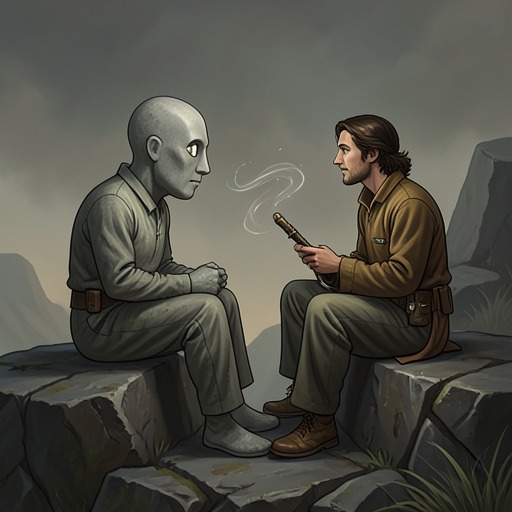
The Jade People remain visibly connected to their mineral origin. They are described as beautiful beings resembling living Jade statues, with jade skin that can be polished until it gleams in the sun. Their beauty is not imposed entirely from above: as they develop, they participate in forming their own bodies and identities. Their evolution thus combines the rock’s intervention with autonomous self-sculpting, making their appearance a collaborative product of creation, adaptation, and material self-fashioning.
Their adornment extends the same aesthetic principle. They craft their hair from the finest gemstones and polish their jade surfaces, turning geological material into personal presentation. The result is a culture in which beauty is not separate from matter. Stone, gemstone, body, and ornament occupy a continuous field, so that physical substance becomes both the basis of life and the medium through which the people express themselves.
The rock does not organize them around human sexual distinctions. The account states that it knows nothing of men and women or of the differences between them, and the Jade People are consequently presented as a united people rather than a society divided along those categories. Their social form reflects the creator’s limited understanding as much as its desire for harmony: they are made collectively, perceived collectively, and initially imagined without the divisions familiar to human beings.
Music and the Growth of a People
The rock does not need to teach the Jade People how to sing. Observing the world around them, they begin singing on their own. This independence is crucial to their role in the new Planet. They are not instruments programmed merely to reproduce the lost song; they become living participants in an expanding musical ecology, discovering voices through contact with the world that surrounds them.
Their emergence accompanies the gradual filling of the Planet with life. People, animals, plants, mountains, lakes, and forests appear in increasing numbers, while songs multiply across the landscape. The Jade People provide the vocal dimension that the world’s trees and wind could not supply alone. Their singing allows the Planet to become not just inhabited but responsive, with the rock listening to the many songs and turning its rings in time with each tune.
The Jade People’s music also establishes a continuity with the Bard’s earlier performance. The rock once heard a song through the Jade statue and understood that the statue was singing to welcome it; when the music stopped, it learned loss. The later creation of jade singers transforms that private bereavement into a planetary culture. The lost voice does not return as the same individual, but its aesthetic impulse survives in a people who make song a permanent feature of the world.
Relations with Jerome Smith and the New World
By the time Jerome Smith lives among them, the Jade People have become the companions and inhabitants of the restored Planet rather than unfinished creations. Jerome initially finds their ways strange. Their resemblance to living Jade statues makes them beautiful to him, but their bodies also unsettle his human expectations: he is shocked that they have nothing between their legs and that they appear permanently confined to the Stone Age. His reaction marks the cultural distance between human assumptions and the Jade People’s nonhuman form of embodiment and social development.
Jerome nevertheless adjusts to their differences. He comes to regard them as friends and companions in the village, and their survival becomes part of what he defends when he fights the demon threat. The Jade People are therefore not a decorative population placed in the background of the new world. Their village, their continued existence, and their distinctive society give Jerome a concrete reason to protect the Planet. His growing attraction to one of the Jade beauties further shows that his relationship with them develops from wary observation toward personal interest, even though the narrative preserves the comic awkwardness of that cross-cultural encounter.
Narrative Significance
The Jade People complete the rock’s movement from inert matter toward relational consciousness. The rock begins as a gneiss pebble with no senses beyond the physical vibrations of its surroundings. Much later, music gives it an awareness of beauty and loss; after Planet Dirt is destroyed, the creation of the Jade People becomes an answer to that loss. The rock cannot restore the original performance, but it can create conditions in which music continues, evolves, and belongs to an entire community.
Their bodies also crystallize the story’s broader claim that everything is fundamentally rock, differing only in scale and power. The Jade People are literally drawn from the rock’s substance, yet they become living, self-directing beings who sculpt themselves, sing without instruction, and populate a world with further life. Matter is not treated as passive raw material. It becomes lineage, body, culture, and creative agency at once.
The final image of the new Planet places the Jade People within a larger chorus: gemstone trees sing in the wind, three rings dance around the world, and the people add their own voices. Jerome looks over this beautiful world and loves it, while the Jade People stand among the companions whose lives make that beauty worth defending. Their decisive function is thus both biological and artistic. They are the population that turns a rebuilt Planet into a living song.