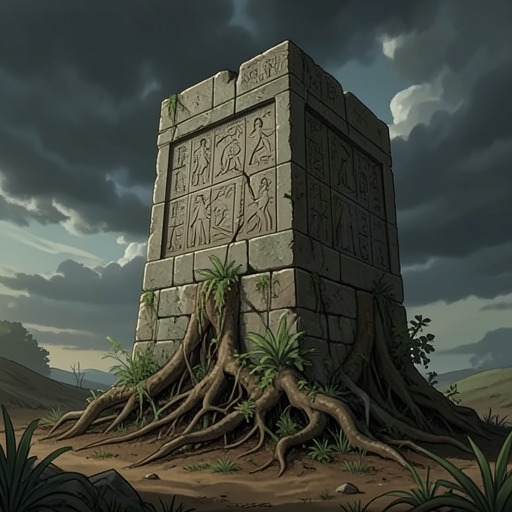
Planetary Fusion Process
Rock Falls, Everyone DiesPlanetary Fusion Process is the system-driven merger that transforms the rock from an advanced individual body into a level 12 Planet. It is not merely a growth mechanic: begun in the aftermath of loss, the process expands the rock to a diameter of 12,747,201 meters while leaving its central wound untouched. The rock becomes physically greater than anything it has previously imagined, but the scale of that achievement exposes the emptiness of advancement when numbers cannot restore music, companionship, or meaning.
Definition and Activation
Planetary Fusion Process begins immediately after the system unlocks a class merger between the rock’s [Meteroid] and [Cultivator] classes. The prompt offers the combination as a transition into [Planet], and the rock accepts it chiefly because it wants the system prompt to disappear rather than because it has calmly considered the result. The acceptance produces an explicit class change: the rock becomes a level 12 Planet, followed by the system’s announcement that planetary fusion is beginning.
The process grows from two earlier forms of development. During its long period of stillness, the rock became eligible for the Cultivator sub-class, turning apparent inactivity into a form of cultivation. Later, its awareness expanded outward until it recognized that the world beneath it, the distant glowing star, and even the grains of matter around it were all rocks differing primarily in scale and power. Planetary Fusion Process gives that insight physical form. The rock does not simply learn that everything is stone; it begins to participate in the same scale-changing structure.
Course of the Fusion
Once activated, the process draws the rock and the nearby planet together. The planet rumbles above as it merges closer and closer with the rock, making the transformation a prolonged physical convergence rather than an instantaneous upgrade. The fusion is accompanied by uncertainty because the rock expects the tutorial quest to resolve as part of the process. Instead, the merger continues while the quest remains an unresolved presence, creating a tension between the system’s visible progress and the failure of the task that originally organized the rock’s journey.
The process also follows the story’s recurring logic of numerical escalation. Earlier system abilities could trigger warnings when their use exceeded a safety limit, as shown when Energy Shift abuse activated safeguards and halted the rock’s movement. Planetary Fusion Process represents a later, vastly larger transformation, yet it does not erase the system’s errors or guarantee that advancement will produce fulfillment. The machinery of progression continues to operate, but its output increasingly separates from what the rock actually wants.
Growth and Psychological Consequences
The fusion makes the rock the biggest rock it has ever been. Its new planetary identity is eventually measurable: the displayed diameter reaches 12,747,201 meters. That number should provide the satisfaction that once accompanied every increase in level and statistics, but the response is instead disappointment. The rock has reached the apparent peak of numerical growth, and the numbers begin to blend together, losing the meaning they once possessed.
This emotional reversal follows the destruction of the music that had awakened the rock’s understanding of beauty. When the song from the Jade Statue stops, the rock experiences loss for the first time in a meaningful way. It listens for the music but hears only destruction and then silence. Planetary Fusion Process begins after that loss, and the rock clings to growth as though energy converted into momentum must be balanced by an equivalent gain. The merger therefore has a compensatory impulse: the rock has lost something and tries to answer the loss with greater power. The process succeeds at enlargement but fails at restoration.
The fusion’s greatest consequence is thus an enlargement that feels like deprivation. The rock becomes a Planet, but its new status does not return the song, settle the unresolved quest, or make the maximum number satisfying. Waiting eventually becomes easier when hope has been abandoned, yet the fusion continues to define the rock’s material condition. The planet rumbles, the bodies merge, and the rock is forced to inhabit an achievement it no longer experiences as an answer.
Failure, Persistence, and Reorientation
Planetary Fusion Process does not resolve the Tutorial Quest. The final error leaves the newly forged planet trembling, and the rock cannot accept the result because the outcome was not supposed to be a failure. After trying and failing again, it finds it easier to accept the quest as unresolved, a permanent irritation that remains even after the fusion has made it the largest rock of all.
That unresolved status distinguishes the process from a conventional victorious transformation. The system recognizes the class merger and confirms the new planetary level, but the narrative refuses to make technical success equivalent to spiritual completion. The rock has advanced according to the interface while failing according to its own unspoken expectation. Its expanded body becomes a record of both accomplishment and incompletion.
The failure eventually redirects the rock’s objective. After seeing the summit of strength and finding it meaningless, the Planet rejects blind forward motion and destruction as a sufficient purpose. It decides that power for its own sake has no value and chooses beauty instead. Planetary Fusion Process is the material threshold that makes this decision possible: only after becoming a Planet and confronting the hollowness of its greatest numerical achievement can the rock abandon the old logic of relentless advancement.
Long-Term Significance
As a state, Planetary Fusion Process links the story’s smallest-scale premise to its largest-scale consequences. A motionless stone once appeared to be doing nothing, yet stillness made it eligible for cultivation; later, a stone that regarded its world from outside discovers that planets and stars are merely larger rocks. Fusion turns that ontological joke into a world-building principle. The rock’s progression is not a climb away from matter but an enlargement within a universe where matter itself remains the common condition.
The process also prepares the transition from destruction to creation. Once the rock becomes a Planet, it possesses grand abilities and begins creating slowly across eons and millennia. Its first attempts at plant life are clumsy, but it eventually shapes gemstone trees whose emerald leaves ring in the wind like chimes. Creation becomes a new form of leveling, one in which skill matters more than raw numerical superiority. The Planet does not discard growth; it changes what growth is for.
In this sense, Planetary Fusion Process is both culmination and correction. It culminates the rock’s movement from stone to cultivator, meteorite-class being, and finally Planet. It corrects the belief that becoming larger, stronger, and more advanced will necessarily resolve every want. The fusion produces the biggest body but not the deepest satisfaction. Its lasting importance lies in the new purpose that follows: the Planet begins creating because beauty, unlike a final number, can continue to develop.