Rock and Music
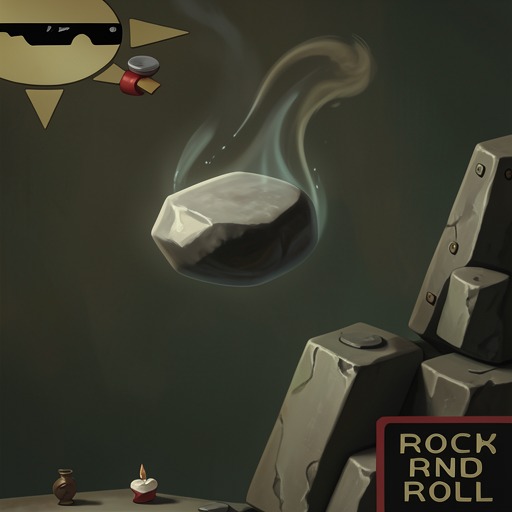
Rock Falls, Everyone DiesRock and Roll names the evolving relationship between the rock and music: a relationship that begins in absolute sensory limitation, becomes the decisive emotional event of the rock’s existence, and finally turns into a principle of creation. Music does not merely accompany the rock’s story. It changes what the rock can perceive, teaches it beauty and loss, and redirects its enormous power away from blind destruction toward the making of a living world.
From Silence to Hearing
At the beginning of this arc, the rock exists in a world without sound. Its perception is restricted to the rumbles and vibrations of the earth, and its fall through the air is described as entirely silent. Even when its senses reach outward with something resembling excitement, the feeling remains incomplete because the rock does not yet truly feel. Its condition is therefore more than solitude: it is an existence without the sensory categories through which music, beauty, and shared emotion might become intelligible.
The transition begins after the rock’s launch into space. There, it grows and develops until it becomes master of a domain, gaining capacities that were impossible while it remained bound to the earth. At a great altitude, it hears something entirely new: sound, specifically a song. The discovery is presented as a sensory birth. The rock has no ears in the human sense and has never heard anything before, yet its expanded existence now allows it to receive what was previously outside its world model.
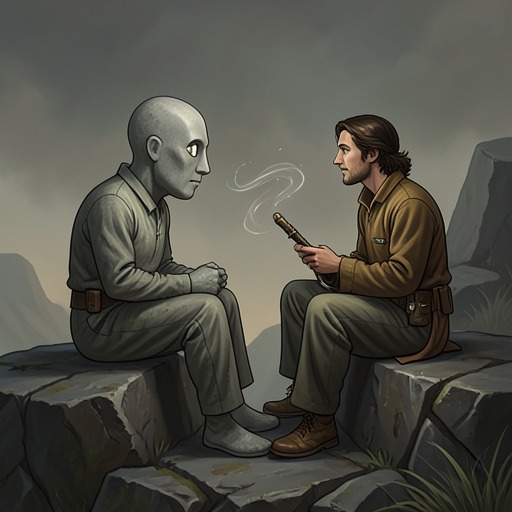
This new hearing is set against the rock’s continuing limitations. It has never seen color, only shades of grey, and it has never tasted. It does not understand humans, so it cannot identify the Bard as a person in the ordinary human sense. Instead, it perceives the Jade Statue reaching toward it and hears the song coming from that figure. Music thus becomes the first bridge between the rock’s nonhuman consciousness and a world of living beings.
The Bard’s Song and Recognition
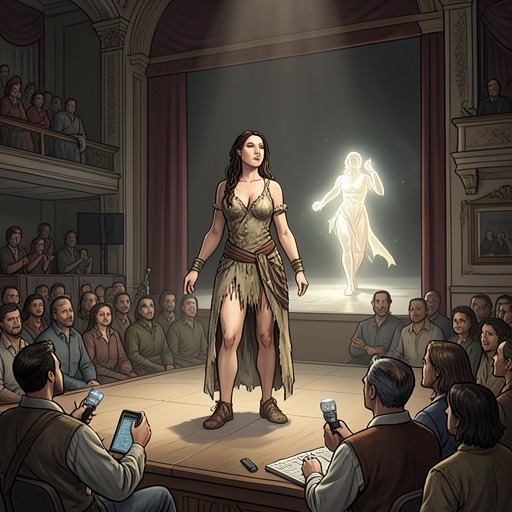
The encounter begins when the Bard, facing imminent destruction, looks up at the Jade Statue and asks whether it wants to hear a song. She takes up her lyre and begins to play. The performance comes more easily than it has in years, and the faded fire in her soul brightens as she sings toward the approaching doom. Her gesture transforms the scene from a final confrontation into an act of address: the song is offered specifically to the statue that symbolizes the rock’s dream of reaching beyond itself.
The rock initially understands only the external arrangement. It sees the Jade Statue and hears music issuing from it. Then the relation changes. The Jade Statue is not simply producing sound; it is singing for the rock and welcoming it. In that moment, as the Bard looks toward destruction with glowing eyes, the rock finally understands beauty. It wants the music to continue. This is the first clearly articulated desire that is not based on movement, survival, advancement, or force.
The music briefly resonates through the rock’s domain, and everyone hears it. Its effect reaches beyond the two participants. The hero raises his head, sorrow leaves him, and he stands beside the villain; together they face the end while holding hands. Music therefore acts as a temporary common language across divisions that had seemed fundamental. It does not defeat the approaching catastrophe, but it alters the emotional and social meaning of the final moment, replacing opposition with shared recognition.
Silence, Loss, and the Reversal of Purpose
The song ends, and the cessation becomes the rock’s second great sensory revelation. It understands loss because the music does not return, no matter how intently it listens. What follows is not merely quiet but the brutal symphony of destruction and then silence. The contrast establishes music as a presence that can be mourned. The rock had never truly lost anything before; now it has experienced attachment, absence, and the pain of an irretrievable past.
The destruction continues above, but the rock distinguishes it from what it longs for. Its expanding domain registers shattered earth and sundered mountains, yet it recognizes that these sounds are not the music. It wants the song, and it retreats deeper toward the center of the planet in search of distance from the devastation. The attempt produces more silence rather than recovery. The rock’s movement inward is therefore both physical and emotional: it withdraws from a world defined by destruction while carrying the vanished song inside its memory.
That memory survives even after the rock accepts that its quest has remained unresolved. Waiting becomes easier when hope has been abandoned, but the absence of the song remains one of the two great things the rock has lost. The other is the completed quest. The distinction matters because music gives the rock a value that the system’s numbers cannot measure. Levels, statistics, and growth remain available, but advancement alone can no longer answer what the rock has learned to desire.
From Remembered Song to Created Music
After becoming the biggest rock of all, the rock experiments with gravity. It gathers other rocks into three rings, making them spin and dance in the sky. The motion first resembles a pattern, then begins to feel faintly beautiful, almost rhythmic, as though the rings were following a song still playing in the rock’s mind. This is the first transformation of memory into invention. The rock cannot restore the original performance, but it can translate its remembered structure into movement, scale, and form.
As the dance continues, the song in the rock’s mind changes into something new, something it has never heard before. The planet stirs, and the rock begins to wonder whether it can create beauty as well as recognize it. Even the mountain it has carved becomes newly legible: not simply a product of power, but a clumsy beginning of artistry. This recognition overturns the purpose that had governed its earlier existence. Strength for its own sake has no meaning if it leaves only destruction behind, so the rock abandons blind forward motion and chooses beauty as its new goal.
Creation proceeds over eons and millennia through experimentation, failure, learning, and leveling. The first attempts at plant life are misshapen forms resembling melted candlesticks, but the rock eventually sculpts trees from gemstones. Their emerald leaves ring in the wind like chimes. It shapes mountains around them so that the wind passes through their labyrinthine peaks with the right force and reaches the trees, turning the landscape itself into an instrument. The trees then begin to play a song, while the three rings continue their increasingly complex dance above them.
The rock’s creative music also becomes biological and communal. Clumps of Jade rise into rough figures, and the rock guides their development until they can sculpt themselves into forms it never imagined. Their gemstone hair and polished jade skin express a specifically rocky conception of beauty, while their unity reflects the rock’s lack of interest in human gender divisions. Most importantly, the people do not need to be taught to sing. They see the world around them and begin singing on their own. Life, in this new world, is not merely arranged by the rock; it becomes an independent source of sound.
A World Organized by Song
The completed world is defined by the coexistence of many songs. People, animals, plants, mountains, lakes, and forests fill the planet, and the rock listens to the music of all of them. The rings move around the planet to each tune, converting the heavens into a visible response to terrestrial life. The original song remains part of the rock’s inner history, but it no longer functions only as an object of mourning. It has become a generative pattern from which other songs can emerge.
The result is a reversal of the rock’s earlier relation to power. Once, its growth enlarged the scale of impact and made destruction ever more consequential. After the encounter with the Bard, the same capacity for shaping gravity and matter becomes an artistic instrument. The rock still possesses immense strength, but it judges that strength by what it makes possible for others: wind that plays through gemstone leaves, people who sing without instruction, and rings that dance to the life below.
The world’s music also preserves the original act of welcome. Far in the future, Jerome Smith looks over the planet he loves and sees the three brilliant rings dancing their eternal waltz to the song. The gemstone trees sing in the wind, their bell-like leaves producing a soft melody. For him, the beauty of the world includes its people and companions, but the music gives that beauty a unifying form. What began as one Bard singing to an approaching rock has become the atmosphere of an entire civilization and the audible signature of a planet.
Rock and Roll therefore marks the rock’s passage from being an object that falls silently through the world to becoming a creator of resonant worlds. The Bard’s song cannot be recovered, and the rock’s first experience of music remains inseparable from destruction and loss. Yet that loss does not end the musical relationship. It forces the rock to carry the song forward, alter it, and make new songs possible. In the final movement, beauty is no longer something the rock receives from another being; it is something the rock patiently builds for others to hear.