Roll out
Rock Falls, Everyone Dies“Roll out” is the tutorial quest that converts a motionless stone into the protagonist of an expanding cycle of adventure, growth, destruction, and renewal. Its apparently modest objective—to reach the bottom of the mountain—becomes a durable command that outlasts worlds, bodies, and even the stone’s original identity. What begins as a descent therefore develops into the book’s central mechanism for movement and succession.
Assignment and Initial Objective
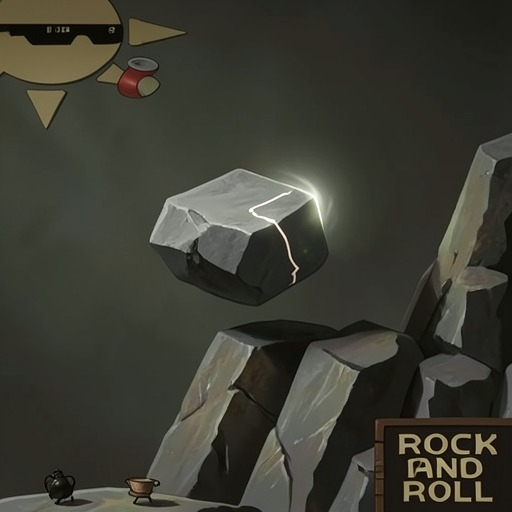
The quest first appears after the stone has awakened and formed the desire to become the best of all stones. A new system screen assigns “Roll out” and states its condition plainly: reach the bottom of the mountain. The starting altitude is 10,000 meters, while the difficulty is classified as Legendary. The contrast between the ordinary wording of the task and the extreme difficulty immediately establishes the quest’s absurd scale: the system treats a mountain descent as a tutorial, even though completing it will expose the stone to battlefields, monsters, supernatural powers, and forces far beyond its initial understanding.
The quest also supplies the stone with its first direction. Before the assignment, the stone’s existence is defined by stillness and inward aspiration; afterward, progress requires physical movement. Rolling is not merely a means of travel but the first form through which the stone can act upon the world. The tutorial thus makes motion an obligation, while simultaneously giving the newly awakened subject a path toward experience, encounters, and power.
A Quest That Creates an Adventurer
The stone’s descent carries it into networks of action it could never have entered by remaining in place. On a battlefield, goblins notice that it is not an ordinary stone and rush to pick it up, treating it as a potentially valuable weapon. Elsewhere, the stone becomes entangled with the Bone Core and the Bone Zone when its invasion of the dungeon refuses to stop. A dragon later seizes it with its tail because it needs a weapon, recalling the years when it threw stones at adventurers who entered its lair seeking the golden hoard. In each case, the quest’s demand for movement allows other beings to carry, redirect, weaponize, or oppose the stone.
These episodes broaden the meaning of “reach the bottom.” The stone does not simply travel through a fixed landscape; it repeatedly becomes an object within other actors’ plans. Goblins, dungeon powers, dragons, magic, gravity, and system rules all become temporary forces in the quest’s network. Yet the stone’s continued motion also reverses the usual hierarchy between person and object. Those who pick it up or attempt to use it believe they control a tool, while the quest gives the stone a continuity of purpose that exceeds theirs.
The system’s rewards reinforce this transformation. During the early descent, the stone receives credit for assisting in the defeat of Demon Lord Diablos, earning 500,000 assist experience and the title Enemy of Demons. The quest is therefore not a neutral travel instruction. It turns incidental contact with major conflicts into measurable advancement, converting the stone’s passage through the world into a game-like chain of assistance, experience, titles, and increasingly ambitious capabilities.
From Mountain Descent to Cosmic Trajectory
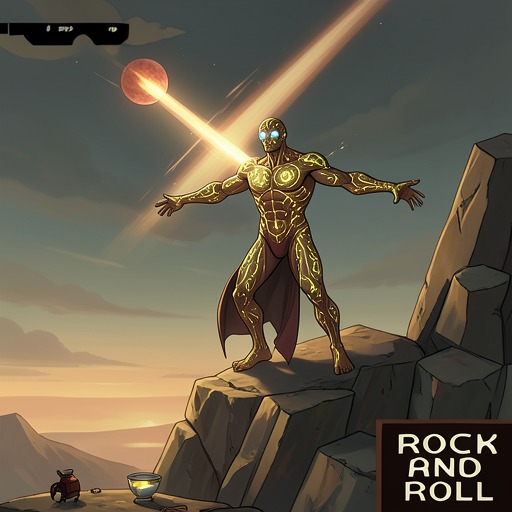
The quest remains active even after the stone’s scale has changed beyond recognition. At one stage, it records a current altitude of 370,200,123 meters. Rather than continuing toward a conventional mountain floor, the stone releases itself from the Orbital Slingshot and uses Energy Shift to change Qi into momentum, accelerating away from its home world toward a distant gathering of rocks. The language of altitude survives, but the physical meaning of the quest has expanded from a terrestrial descent into a cosmic itinerary.
This reversal gives “Roll out” its distinctive irony. The original command points downward, yet the stone’s development repeatedly sends it upward and outward: beyond the mountain, above the planet, through the starry sky, and toward other bodies of stone. The quest’s persistence makes the system appear both literal and strangely indifferent to context. It continues to demand completion even when the protagonist has become capable of orbital travel and planetary-scale action.
The recurring quest also turns return into a long-term objective. After leaving its home world, the stone decides not to hurry and instead gathers a greater following of rocks, intending to grow larger before returning. Its journey is no longer only about satisfying the system; it becomes preparation for a renewed confrontation with the horrible man who had once defeated or obstructed it. The tutorial’s simple endpoint consequently acquires the emotional force of deferred revenge and a promise that the old route may be attempted again under transformed conditions.
Persistence Through Destruction and Genesis
“Roll out” survives the destruction of the world that originally gave it meaning. When the stone is eventually positioned at the center of a planet, deep beneath the earth, the tutorial prompt reappears and begins resolving. It again reads “Roll out” and again states the objective of reaching the bottom of the mountain. The repetition follows the planetary catastrophe and the emergence of a new world, making the quest a bridge between destruction and genesis.
At this point, the mountain is no longer simply the mountain from the opening. The old environment has been replaced by a planetary condition, yet the command returns unchanged. The result is not ordinary continuity but recursive continuity: the system carries the same initiation ritual into a new cosmological setting. A quest that once launched the first stone now waits at the center of a world, ready to define another cycle of movement.
The quest’s persistence also exposes the difference between numerical progression and narrative completion. The stone has crossed enormous distances, accumulated power, gathered other rocks, survived enemies, and participated in events on a planetary scale, but the tutorial remains unresolved until its conditions are reproduced. Progress can therefore be immense without being final. The system recognizes a specific pattern of completion, not merely the magnitude of what the stone has achieved.
Transfer to the Next Pebble
The final significance of “Roll out” lies in its transfer. The old stone eventually succeeds in replicating the conditions closely enough to pass the quest forward. This is described as difficult: fulfilling every requirement for transferring it demands careful imitation of the original circumstances. Once accomplished, the quest is no longer exclusively the old stone’s burden or privilege. It becomes an inheritance awaiting a younger hero.
The old stone then watches the new beginning from a position of concealed influence. It expects the young hero to find the offered opportunity and set out on an adventure, while recognizing that the youngster may believe it is master of its own fate. The old stone has provided the first push forward and may occasionally place itself on the scales to help if the young hero becomes stuck, though it intends to intervene only lightly so as not to provoke the system’s anger. The transfer thus preserves both agency and assistance: the successor must act, but the predecessor has arranged the conditions under which action can begin.
The quest’s displayed altitude has reset to 9,662 meters for the new pebble, close to but distinct from the original 10,000-meter starting point. That numerical variation matters because it shows that transfer is reproduction rather than perfect duplication. The tutorial remains recognizable, but it now belongs to a different stone and a new unfolding future. “Roll out” ends not with a final descent but with a handoff, turning the command into a generational cycle whose promised goal is still waiting to be reached.