Supreme Grand Magus Oldivar
Rock Falls, Everyone DiesSupreme Grand Magus Oldivar is the city’s principal magical defender and, later, the world’s last organized answer to the Doomsday Meteor. He first confronts the Rolling Stone from the city wall, attempting to prevent its landing with a precisely timed spell, and then reappears in a planetary crisis as the newly elected Supreme Grand Magus entrusted with channeling the world’s mana. Across both episodes, Oldivar embodies institutional magical power: formidable, coordinated, and capable of spectacular intervention, yet unable to overcome the physical and systemic forces that make the stone’s progress inevitable.
Identity and Position
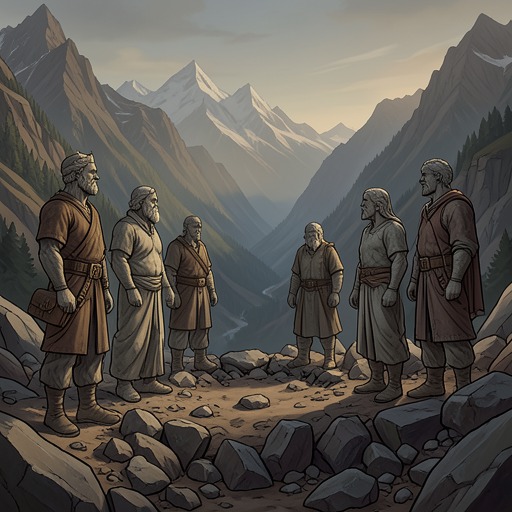
Oldivar is introduced as a withered old man in a huge, billowing wizard’s cloak, leading the terrified citizens gathered on the city walls. His veins thrum with energy, and he looks disdainfully toward the advancing Rolling Stone. The city lies beneath a great mountain and is accustomed to dragons flying overhead, so it possesses defenses and a population familiar with extraordinary threats. Oldivar stands at the visible center of that defensive response, a figure whose age and magical intensity mark him as an established authority rather than an ordinary combatant.
His authority later expands beyond one city. When the Doomsday Meteor is predicted to strike Planet Dirt in 230 years, the Galactic Defender alert frames the threat as a world-level emergency. Much later, after an emergency broadcast announces that the world will end in 60 minutes, the mages of the world gather in a hurried remote conference. They argue over who should receive the glory of saving their home, but practicality prevails: Oldivar, the newly elected Supreme Grand Magus of the city associated with the jade statue, is chosen because his people had foretold the meteor’s landing zone. His selection therefore rests on both political authority and specialized knowledge.
Confrontation with the Rolling Stone
Oldivar’s first major action against the stone occurs after its rapid advance carries it across a moat toward the city walls. The stone is focused on the numerical progress of its quest rather than on the old wizard himself, but Oldivar points a finger and begins casting. At the moment the stone reaches an altitude of 78 meters, Oldivar’s intervention forces it to launch upward, spending all its stored energy to pivot into a leap over the wall. The sequence turns the city’s defensive boundary into a contest between the wizard’s control of magical force and the stone’s quest-driven momentum.
The stone sees the far side of the wall and identifies a small plaza containing a fountain and a jade statue of a beautiful woman. It does not respond to the statue’s beauty; it notices the shine of the jade and hungers for the reward represented by the landing. Oldivar continues gathering energy while the stone descends through successive altitude readings. At 25 meters he begins speaking, and at 20 meters he casts Greater Reverse Gravity. The spell delivers a sudden jolt that flings the stone upward, changing the direction of its motion just as its desired landing seems close.
The reversal does not defeat the stone. It rises to 60 meters, sees the ground shrinking beneath it, and uses every available ability and every remaining portion of its energy to reach the plaza. Even Pivot cannot overcome the spell. The confrontation momentarily appears to be the system’s vengeance against the stone, but the upward displacement also exposes a larger possibility: from above, the stone can see the curvature of the world’s surface and recognize that much of its former understanding was an illusion. In that sense, Oldivar’s spell succeeds as a disruption while accidentally opening the path toward the stone’s next transformation. Something answers the stone’s desperate plea, and Class Advancement becomes available.
The Meteor Crisis
Oldivar’s later appearance places him at the center of a far greater defense. After the world receives the warning that it will end in 60 minutes, every mage’s attention turns to the meteor’s predicted landing zone. All the mana of the world is sent to Oldivar through remote connections and ancient treasures. For a brief moment, he holds the power of the entire world at his fingertips, transforming him from a local guardian into the conduit for a civilization-wide magical effort.
The casting takes place high atop his tower. Using magnification spells, Oldivar gazes at the approaching meteor while mana crackles across his skin. He is barely able to hold himself together, but still raises his arms and releases the grand spell prepared by the world’s mages: Supreme Greater Anti Gravity Grand Magic. The attack is designed to make a rock go away, and it represents the most concentrated magical response the world can assemble under emergency conditions.
The spell nevertheless meets an opponent uniquely suited to resist it. The Rolling Stone has learned to perceive gravity more clearly than anything else on Planet Dirt because a stone is gravity’s natural child: its defining movement is not ordinary rolling but falling. Oldivar’s attack therefore strikes at the very force through which the stone understands its existence, yet that same relationship gives the stone an advantage. The scene converts Oldivar’s supreme magical office into an instrument of collective desperation, while the meteor’s material nature turns the world’s strongest spell into an incomplete solution.
Limits and Consequences
Oldivar’s failure is not presented as a simple lack of strength. The world’s mightiest defenders attack the stone with grand spells and abilities, and a Hero’s sword later cuts through 1,000 meters of rock while 9,000 more remain. The stone repairs the damage with Qi. Even if the mages succeeded in blasting it into pieces, those pieces would still fall; even if they sent it upward, a continuous meteor shower would follow. The stone would eventually return, larger than before. Oldivar’s intervention thus belongs to a broader pattern in which conventional victory conditions collapse because the threat is not merely an enemy that can be killed or repelled, but an object governed by persistent physical consequence.
The contrast between Oldivar and the stone also reveals a shift in narrative power. Oldivar commands citizens, towers, mana networks, ancient treasures, and coordinated magical institutions. The stone possesses none of those social structures, yet its movement exploits a rule that institutional power cannot abolish. At the city wall, Oldivar can redirect the stone’s trajectory; during the planetary crisis, he can marshal the world’s mana; in neither case can he make gravity cease to matter. His authority is therefore immense within the world’s political and magical order but limited by the material logic that the stone gradually learns to inhabit.
Narrative Role
Oldivar functions as both threshold guardian and emblem of the established order. At the city, he stands between the Rolling Stone and the coveted jade statue, using a spectacular reversal to deny the stone its expected landing. Later, as the selected Supreme Grand Magus, he becomes the collective defender of Planet Dirt itself. These roles resemble the mentor or guardian figures of heroic quest narratives, but the pattern is inverted: Oldivar does not initiate the stone’s journey or guide its advancement. His opposition instead pushes it into a wider realm of perception and eventually toward class advancement.
His importance lies in the scale of the forces he represents and in the clarity of his defeat. The old wizard is not insignificant; the world chooses him, feeds him its mana, and entrusts him with the prepared spell capable of making a rock disappear. Yet the attempt fails because the stone’s quest, gravity, resilience, and system-mediated development operate on terms that the wizard cannot fully control. By the end of the larger arc, the old world’s champions have failed to stop the stone, while the stone’s own quest can be transferred forward to a young hero. Oldivar’s confrontations therefore help establish the story’s central inversion: recognized power may resist the journey, but it cannot determine its final direction.