Unnamed Rock–Rihito
Rock Falls, Everyone DiesUnnamed Rock–Rihito is a relationship of distance, convergence, and belated recognition between a rock that has grown from a nearly insentient pebble into a planetary being and Rihito, a twenty-one-year-old bard whose song reaches it at the threshold of cosmic destruction. The encounter does not begin as a conversation: Rihito does not understand the approaching rock, and the rock does not understand humans. Yet her music gives the rock its first experience of sound, then beauty, and finally loss. The relationship therefore marks the decisive change from mere existence and accumulation toward aesthetic perception and emotional memory.
Rihito and the Jade Statue
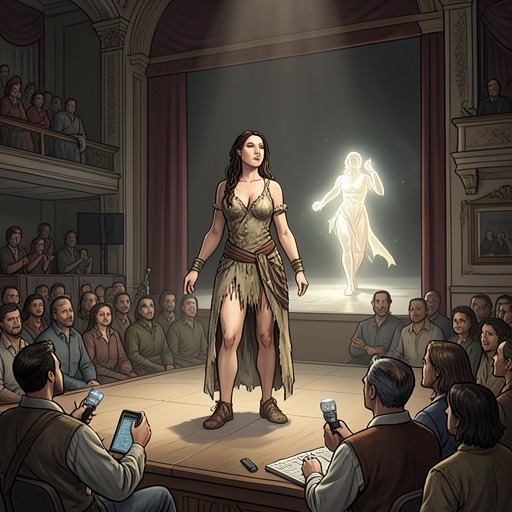
Rihito is introduced as a young woman with auburn hair, dressed humbly but well enough to serve at a court, and carrying a lyre on which she has worked for years. Her artistic confidence has faltered at a critical moment. She walks aimlessly through her own city, grieving a failure that feels especially bitter because it has occurred when success mattered most. Rather than return immediately to what awaits her at home, she stops in a familiar plaza before an old Jade Statue depicting a beautiful woman reaching toward the heavens.
The statue has stood in the plaza for so long that nobody remembers its origin. Rumors attribute magical powers to it, and Rihito treats it as a possible listener, speaking to it because the act of speaking offers a small refuge from isolation. Her appeal is not presented as a formal ritual with a guaranteed response. It is an intimate gesture toward an object that may be silent, abandoned, or enchanted. The statue consequently becomes the visual and symbolic point through which Rihito’s local human life later meets the rock’s expanding cosmic existence.
When Rihito realizes that destruction is approaching, she accepts the end with surprising calm. She does not want to die, but she discovers a renewed lightness in herself and takes up the lyre once more. Her invitation to the statue is direct and unadorned: "Hey statue, do you want to hear a song?" The performance restores an artistic fire that had seemed to be going out. The song is therefore already a recovery before the rock hears it: Rihito turns impending death into a final act of creation rather than allowing failure to define her last moment.
The Rock Learns to Hear
The contrast between the two sides of the relationship is fundamental. Before its launch into space, the rock can perceive only the rumbles and vibrations of the earth. Its experience is organized through physical impact, momentum, acceleration, heat, and the system’s instructions. Even when it first encounters a target, its developing awareness is practical: it remembers that striking creatures can make it larger and that it possesses Steer. Its silent fall toward the rabbit culminates in a bodily impact rather than an exchange of language or intention.
The same limitation persists through later stages of growth. The rock can sense a mass of skeletons approaching through a dungeon corridor, identifying their feet as bone striking brick, but fear remains remote from it because it is a rock. It can convert braking during a fall into thermal energy and register a stored temperature of 150K, yet these capacities do not amount to human sensation. Even when it senses a scouting drone and then larger metal vessels entering the solar system, the response is only an almost-excitement: the rock is not yet truly feeling, and its sensory model remains incomplete.
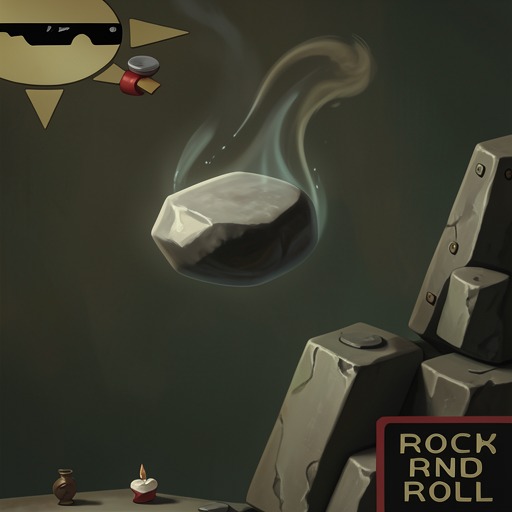
At an altitude of 6,498,240 meters, the change arrives through sound. The rock hears something it has never heard before: a song. Space has allowed it to grow, develop, and become master of a domain, but that advancement has also brought it to the threshold of a new kind of perception. Music cannot be reduced to another collision or numerical increase. It enters the rock as an event that its previous understanding of the world could not predict.
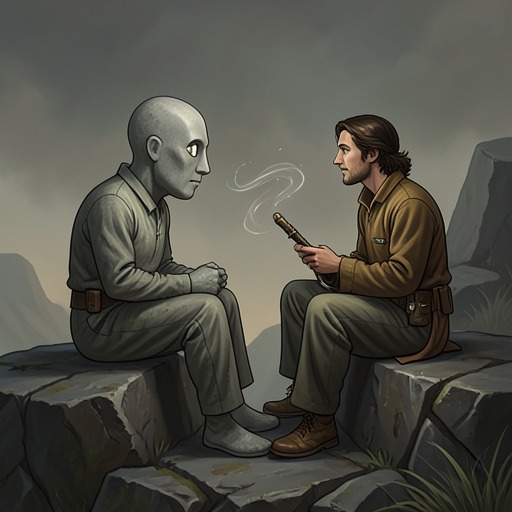
The rock does not see Rihito as a person because it does not understand humans. Instead, it sees the Jade Statue, the figure that appears to reach toward it, and hears the song coming from that direction. From the rock’s limited perspective, the statue is singing for it and welcoming it. This misrecognition does not weaken the relationship; it gives the encounter its distinctive form. Rihito creates the music, but the rock receives it through the statue, so human art becomes an apparently planetary or monumental address.
Beauty at the End of the World
The song changes the rock’s value system. It has never seen color, since its vision consists only of shades of grey, and it has never tasted anything. Its world has been defined by material force and measurable growth. Music grants it a sense beyond those boundaries, and the song becomes the first thing it wants not merely to process but to hear again.
As Rihito looks toward imminent destruction with glowing eyes, the rock finally feels beauty in its soul. The moment is simultaneously expansive and unbearably brief. The music resonates through the rock’s domain, and everyone hears it: the event is not confined to the private relation between a bard and a planetary consciousness. A hero and a villain raise their heads, stand together, and face the end side by side, with sorrow draining from the hero. Rihito’s song briefly creates a community in which former opposites share the same act of listening.
The relationship thus produces a reversal in the meaning of power. The rock has become enormous and capable of affecting cosmic bodies, but the decisive force in this scene is not an attack, a quest reward, or a gravity maneuver. It is a fragile performance by a failing bard. Rihito’s music does not prevent destruction, yet it changes how destruction is experienced. For a short interval, the end of the world is also a moment of recognition, fellowship, and beauty.
Silence, Loss, and Memory
When the music stops, the rock understands loss for the first time. It has never truly lost anything before, and no amount of listening can bring the song back. The music’s disappearance is followed by the brutal symphony of destruction and then silence. This is the first absence that cannot be repaired through movement, impact, leveling, or the accumulation of statistics.
The loss also becomes linked to the unresolved structure of the rock’s later existence. After the newly forged planet shakes beneath the final error, the rock cannot accept what has happened. Repeated attempts to resolve the quest fail, and eventually acceptance becomes easier than hope; waiting is easier when hope has been abandoned. The quest is not the only thing the rock has lost, however. The vanished song remains the more intimate wound, because it introduced the possibility of beauty before being removed.
Memory keeps the relationship active after direct contact is impossible. As the rock continues its dance around and across the new planetary world, the movement of rings begins to feel faintly beautiful and almost rhythmic, as though following a song. The song in its mind changes into something new, a song it has not heard before. Rihito’s music is therefore neither perfectly preserved nor simply forgotten: it becomes an internal pattern that can transform while retaining its origin in the first experience of listening.
From Reception to Creation
The final consequence of Unnamed Rock–Rihito is the rock’s altered understanding of its own powers. The rock looks over the mountain it has carved and recognizes a clumsy form of artistry in it, a beginner’s work that may contain the beginning of beauty. The planet stirs, and the rock considers that it might create beauty too. This possibility would be unintelligible before the encounter with Rihito, when growth meant becoming larger, stronger, hotter, or more capable of striking and steering.
Rihito’s song consequently survives as a creative principle rather than as a recoverable object. The rock cannot restore the original performance and cannot undo the destruction that followed it. What it can do is carry the song forward into a new composition and apply its vast physical abilities to shaping a world. The relationship’s deepest movement is from reception to imitation and then from imitation toward creation: a silent stone hears a human song, learns that beauty can be lost, and begins to wonder whether beauty can also be made.
In this sense, the encounter gives emotional direction to the rock’s immense scale. Its earlier patience is the patience of a hunter waiting through two seasons; its later patience is the patience of a being living with an unresolved quest and a vanished sound. The relationship with Rihito does not humanize the rock by making it speak like a human. It enlarges what the rock can perceive, remember, mourn, and attempt. Music is the bridge between those capacities, and its afterlife becomes part of the genesis of the Jade World.