Unnamed Rock–System
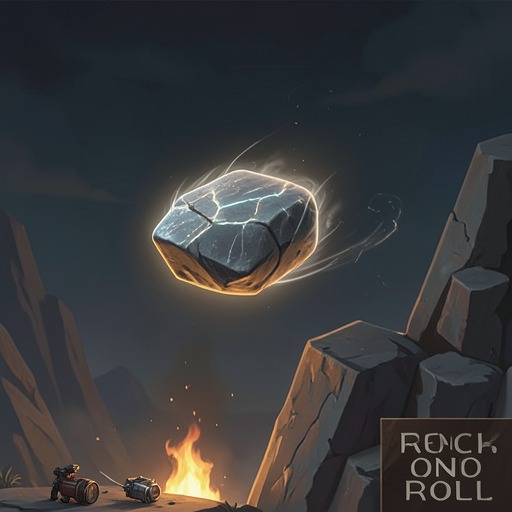
Rock Falls, Everyone DiesUnnamed Rock–System defines the central tension between Unnamed and the invisible rule structure that attempts to turn its existence into a measurable progression. The system gives a once-inanimate gneiss pebble sentience, abilities, quests, and advancement, but it also misreads the subject from the beginning. Unnamed’s growth therefore proceeds through repeated encounters between rigid calculations and a consciousness that learns by violating the assumptions built into them.
Awakening Under a Faulty Interface
The relationship begins with a fundamental configuration error. By a stroke of fate, a stone gains sentience and sets out on a grand quest to touch grass, yet the system has forgotten to convert its statistics from generic metric values into the appropriate strength, intelligence, and dexterity values. Unnamed is thus granted the appearance of a game-shaped identity without being correctly translated into that system’s expected categories. The mistake is not cosmetic: it establishes the mismatch between a physical object and a framework designed to describe a conventional living protagonist.
When Unnamed first becomes aware on a violently shaking mountaintop, it is still only a small, attractive gneiss pebble, the sort of stone a child might carry because of its shape and coloring. It has no established history beyond a long period of comfortable silence, no familiar account of how thought could belong to it, and no sensory world broad enough to support ordinary action. Its irritation at the racket nearby unexpectedly becomes a wish for peace and quiet, and that wish reveals awareness before the system has supplied a coherent explanation of what Unnamed is. The interface may assign values and objectives, but consciousness arrives as an event the stone itself must interpret.
Rules, Skills, and the First Contradictions
Unnamed’s limited perception repeatedly exposes the distance between system logic and material reality. While steering toward a seemingly motionless rabbit, it subtly alters its acceleration vector and treats the creature as an inferior opponent. It does not understand smell, taste, or sound, and it cannot anticipate the rabbit’s response. The rabbit’s twitch and dodge leave Unnamed lodged between two boulders above a chasm: momentum, targeting, and intention are not enough when the system’s agent lacks the senses required to predict another body.
The same collision between game mechanics and physical circumstance appears in combat. Goblins notice that the pebble is unusual and try to use it as an enchanted weapon. Kabab the mighty, having observed what happened to the previous thrower, avoids simply reaching for Unnamed and instead activates a boomerang-throw skill. The system can register a skill and redirect the stone’s motion, but the result remains a contest among hands, shields, impacts, and trajectories. The rule that makes Unnamed a weapon also leaves it exposed to the intentions of whoever happens to seize it.
Energy Shift gives the relation a more explicit experimental form. The skill allows energy to change from one form into another, and Unnamed begins testing it with the methodical patience of a boulder. It senses the energy involved when heat is gathered and then lost through cooling, discovering a domain beyond the kinetic energy associated with mass and velocity. The mountain’s slow seasonal changes had concealed that distinction; confinement in a chamber of horrors makes it perceptible. Unnamed’s understanding therefore grows not from a tutorial explanation but from observing a physical process the system has reduced to an available ability.
The experiments soon threaten the system’s assumptions. As Unnamed realizes that heat can be shifted into motion, it considers reversing the operation and converting motion back into heat. While bounding down the mountain at a velocity of 22.7 meters per second, it tests the possibility. The attempt drives movement to an extreme, and the ever-present force suddenly stops the stone before it has traveled even one meter farther. The system responds with the explicit warning ERROR_ABILITY_ABUSE_DETECTED: SAFEGUARDS ACTIVATED and identifies Energy Shift as having exceeded its safety limit. This is the first clear assertion of institutional control: experimentation is tolerated only until the user discovers a consequence the designers did not intend.
Leveling Failure and Escalating Defiance
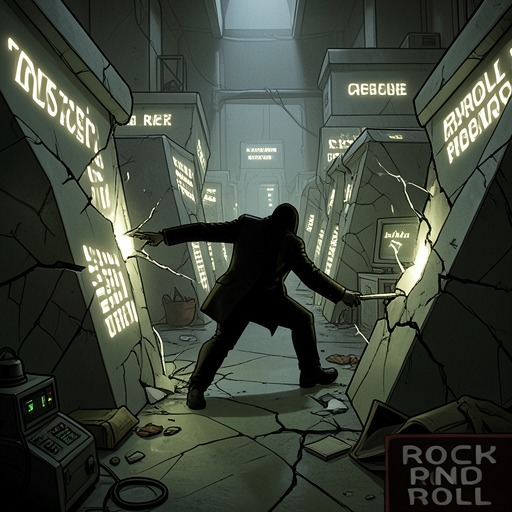
The system’s authority becomes still more unstable when it tries to apply a cultivation mechanic. An invisible hand descends on Unnamed to grant abilities for feats and experience, but the process detects that something is wrong. Unnamed has increased in mass even though it has not leveled, despite the system’s assumption that mass is intrinsically tied to level and should grow according to a fixed formula. The result is ERROR_LEVELING_FORMULA_BROKEN. Unnamed is not merely exploiting a loophole in the interface; its existence has produced a physical change that the progression model cannot account for.
This contradiction transforms the system from a neutral aid into an increasingly reactive opponent. It can issue skills, assess experience, enforce safety limits, and attempt to maintain a numerical relation between level and body, but Unnamed’s stone nature keeps generating outcomes outside those categories. Its mass can change without the expected level increase, and its movement can be amplified through energy conversion until safeguards intervene. Each error both restrains Unnamed and teaches it more about the hidden architecture governing its world.
The system’s failures also become visible through the responses of other powers. Deep inside a mountain, the Bone Core panics because the intruder in its Bone Zone simply will not stop. Elsewhere, a dragon seizes Unnamed with its tail because it needs a weapon and remembers throwing stones at adventurers who enter its lair to covet its golden hoard. These beings treat the stone through familiar roles—invader, projectile, tool, or treasure threat—while the system attempts to treat it as a leveling entity. Unnamed’s unusual persistence destabilizes both interpretations, making its body a point where local power and abstract rules repeatedly collide.
Scale, Perception, and the System’s Openings
Unnamed’s ascent produces a change in scale that the system cannot prevent and may even help formalize. At an altitude of 15,000 meters, the mountain of its origin becomes only one small feature among many along the continent’s spine. The stone sees how tiny it truly is and falls still, waiting for another opportunity. Yet the same height also reveals the curvature of the world’s surface and turns previous certainties into illusions. The system’s quest structure, which first seemed to confine Unnamed to a local adventure, becomes the mechanism through which it reaches a planetary and eventually cosmic perspective.
At that point, an answer appears to its desperate plea: Class Advancement unlocked, with the conditions fulfilled. The advancement reads as a reward, but it also shows the system responding belatedly to a subject that has already exceeded the conceptual scale of its original setup. Unnamed’s progress is not a clean ascent through predetermined ranks. It is an accumulation of unforeseen states that the interface later names, legitimizes, or converts into new numerical possibilities.
From space, Unnamed formulates the most consequential ontological conclusion in the relationship. Looking toward the brilliant orange orb, it recognizes that everything is fundamentally rock: the planet below, the grains of sand beside it, and the glowing body in the distance differ only in scale and power. This insight undermines the hierarchy implied by the system’s categories. A pebble is not categorically separate from a planet; it is a smaller participant in the same material continuum. The system can assign levels and classes, but Unnamed’s growing awareness supplies a broader definition of identity than those labels can contain.
Its sensory development confirms that advancement is not limited to numerical display. Before launch into space, Unnamed could perceive only the earth’s rumbles and vibrations because it had no ears. In space, it develops a new mastery of its domain and hears a song for the first time: soft, sorrowful, and energetic. The experience expands the meaning of perception itself. A system that began by mishandling Unnamed’s attributes is confronted with a subject whose capacities emerge through changing environments rather than through orderly allocation of predefined stats.
Quest Persistence and Transfer Beyond the Original Subject
Even after years, the system’s quest remains the unresolved center of the relationship. Unnamed still wants the quest completed, wants to know its result, and becomes more restless as its contentment with beauty grows. The quest initially seems possible to ignore, but its continued presence acts like a hook that cannot easily be removed. The system’s most durable power is therefore not any single skill or warning; it is the ability to preserve an unanswered demand across transformations in location, scale, perception, and identity.
The relation ultimately extends beyond Unnamed itself. The old stone eventually transfers the quest forward to a young hero, painstakingly reproducing the conditions required for the transfer. The young hero may believe that the first movement toward adventure belongs entirely to personal choice, but Unnamed has arranged the initial push and now waits to discover what the hero will do and what reward lies at the end of the quest. It may occasionally place itself on the scales to help if the hero becomes stuck, while remaining careful not to interfere so heavily that the system’s anger is awakened again.
This ending changes the conflict from simple resistance into strategic coexistence. Unnamed has not destroyed the system or escaped its rules; instead, it has learned to work at their edges, exploiting their permitted pathways while preserving the quest’s uncertainty. The system remains an authority capable of issuing errors, applying safeguards, and enforcing consequences, yet it also becomes a medium through which an old stone can transmit purpose to a new protagonist. Unnamed–System is therefore a relation of misclassification, correction, and negotiated continuation: the system tries to make the stone legible, while the stone’s persistent material existence keeps expanding what the system must recognize.