[Unnamed]
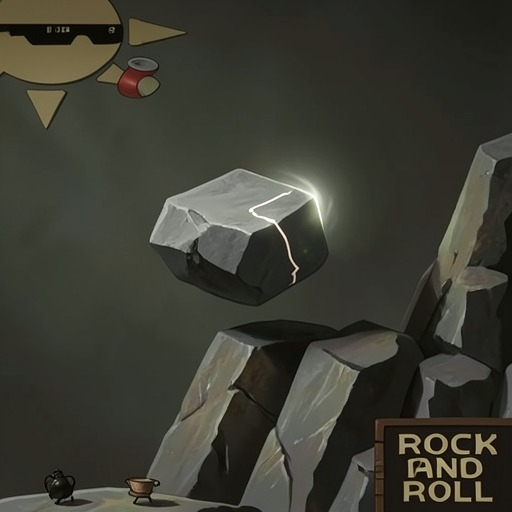
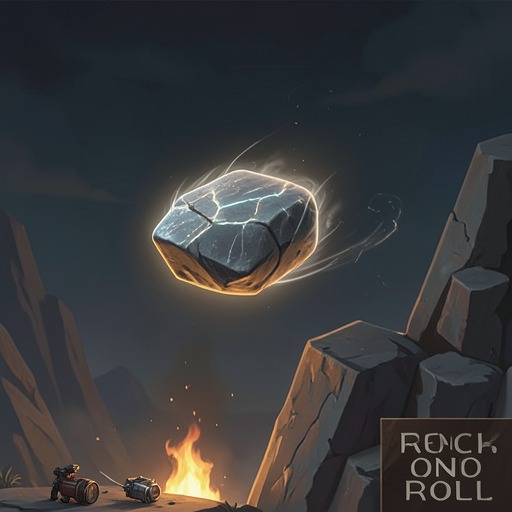
Rock Falls, Everyone Dies[Unnamed] is the awakened gneiss pebble at the center of the story’s transformation from conventional hero tale into a material epic. Struck by a stray spell during a battle between a hero and a villain, it develops awareness, encounters the hovering system screen that organizes its existence, and gradually becomes a Rolling Stone, a Meteorite, and finally a Planet. Its decisive importance lies in the reversal of perspective: what appears to be scenery, ammunition, loot, or a celestial body becomes the being that witnesses, redirects, and eventually questions the value of power itself.
Identity and Awakening
On a mountaintop above the clouds, while a grand battle rages nearby, the small stone is initially described as a pleasant gneiss pebble, almost the sort of nicely shaped and brightly colored stone a child might carry away. It has no apparent ambition or history. Its existence consists of comfortable silence and patient stillness, and the noise of the combat is an unwelcome interruption to that condition.
A stray spell from the hero changes that condition. The pebble suddenly wishes for peace and quiet, then recognizes the impossibility of the thought: when could a stone have wanted anything, and when could it have possessed a mind? Its recollection reaches only into a long period of silence, making consciousness feel less like the continuation of a known life than the sudden appearance of a new one. The awakening is therefore both empowering and burdensome. The pebble can think, but it must also confront the prospect of an eternity spent waiting on a mountaintop.
The first visible sign of its altered status is a strange screen hovering in front of it. The pebble had never noticed such a screen before, and its curiosity supplies the first movement in a life that previously had no intentional movement at all. The system does not merely report the world; it becomes the medium through which the stone learns that its existence can be classified, measured, and advanced.
The Rolling Stone and the Battlefield
The stone’s first major change comes through motion. As it rolls down the mountain, it notices that it has grown, and the discovery fills it with immense joy. Growth is not yet complicated by moral reflection: becoming larger appears to be the beginning of a path to greatness. The system soon offers it the class of Rolling Stone, giving a formal name to the physical process that has become its first adventure.
The battlefield provides the stone with an unexpected route forward. Rather than treating the conflict as a personal contest, it recognizes the currents of war as an opportunity to release itself and be carried onward. Its movement is shaped by forces that are not wholly its own—terrain, combat, magic, and the actions of other beings—yet it turns those forces into progress. This makes the stone an unusual hero: agency does not require freedom from material conditions, but the ability to exploit them.
The battlefield also changes how other beings perceive it. Almost immediately after landing, the stone is picked up by a goblin, who has noticed that it is not an ordinary rock. Goblins generally cannot afford enchanted tools, which makes the discovery especially significant: the stone’s value is first recognized not by an exalted hero or a learned authority, but by someone looking for a usable weapon amid scarcity. The object that once desired only quiet becomes conspicuous, coveted, and dangerous because others sense that it is special.
Endurance, Classes, and Escalation
The stone’s progression repeatedly converts passive duration into active advancement. During a period of roughly five hundred years in which it appears to be doing nothing, it remains still in a closed-off room, tranquil to an outside observer. Yet its patience becomes a form of cultivation. The system eventually declares it eligible for the sub-class of Cultivator, suggesting that the stone’s ability to let time pass without movement has itself become a discipline.
This development gives stillness a different meaning. Before awakening, silence and immobility were simply the stone’s natural condition. After awakening, the same qualities become deliberate endurance, and the distinction between inactivity and practice begins to collapse. The stone has never needed to imitate a living creature’s rhythm of effort and rest; its own way of existing becomes the foundation for advancement.
The escalation continues through encounters in which the stone is repeatedly treated as an instrument by stronger beings. A dragon, enraged by thieves in its lair, seizes the stone with its tail because it needs a weapon and has previously thrown stones at adventurers who sought its golden hoard. The dragon carries it from the cavern, up a long pit, and into flight. In this episode, the stone’s lack of conventional mobility becomes an advantage: it can be carried into situations no ordinary pebble could reach, while its identity as a weapon conceals the scale of its own development.
As the story’s repeated mountaintop battle returns, the stone’s trajectory expands from local fantasy conflict into planetary and cosmic action. A class advancement eventually makes it eligible for Meteorite, and its upward movement becomes a desperate attempt to find greater strength and perhaps face a hated opponent again. The system later grants it the title of Galactic Defender, with information about threats to its home and bonus experience for defending the world against them. Its progress is thus no longer measured only by size or combat ability; it is tied to a widening field of responsibility.
From Meteorite to Planet
The stone’s cosmic scale is reflected in precise transformations. At one stage its diameter increases from 4.61 meters to 9.23 meters, while its hit points rise from 89 to 144. These numerical changes are not ornamental statistics. They show how completely the system has absorbed the stone’s existence into a language of quantification, turning geological growth and survival into visible increments in a progression structure.
The decisive enlargement occurs when the stone reaches the Planet class. It accepts the system’s prompt partly to make it disappear, without studying the results or watching its new numbers. The system announces the beginning of the planetary fusion process, and the stone merges with what surrounds it, growing into the biggest of all. This moment reverses the earlier joy of becoming a larger pebble. Growth has become so vast that it exceeds the stone’s attention: the scale of transformation is no longer something it can simply observe as a personal achievement.
The stone then sits at the center of the planet, deep beneath the earth, waiting for a quest reward to resolve. The position is both literal and symbolic. It has moved from a peripheral pebble on a mountaintop to the hidden center of a planetary body, while the repeated question of what comes next remains governed by a prompt. Even after becoming a world-sized entity, it continues to exist within the system’s promises, conditions, and delayed answers.
Change, Beauty, and Inheritance
The stone’s most important change is ethical rather than physical. After becoming the biggest of rocks and seeing what stands at the peak, it decides that mere strength is meaningless. Power that leaves destruction in its wake no longer satisfies it, and the absence of a quest reveals a deeper problem: strength for its own sake cannot provide a purpose. The stone therefore abandons the path of blindly rushing forward and destroying.
Its new goal is to become beautiful. As a Planet with grand abilities, it seeks not simply to be the strongest rock but to discover another standard by which existence can be judged. The question of whether stones can sing points toward a future in which its powers might produce expression rather than ruin. The change does not erase its history of violence and relentless advancement; it reinterprets that history as an incomplete ascent toward a richer ideal.
The final movement extends the stone’s transformation beyond its own lifetime. After fooling the system and arranging for a small piece to be separated, it transfers the quest forward to a young hero. The old being has successfully replicated the difficult conditions required for the transfer and now waits to see what reward the younger adventurer will receive when the promised numbers are reached. It may occasionally place itself on the scales to help if the young hero becomes stuck, but only sparingly, because it cannot control the hero’s fate and does not wish to provoke the system further.
This inheritance completes the stone’s movement from object to mentor and from solitary protagonist to participant in a recurring heroic structure. A young hero may believe that the first push toward adventure came from personal choice, yet the narrative reveals that [Unnamed] helped create the opportunity. The old stone’s purpose is no longer to complete every quest itself. It wants to witness what another hero will do and what will happen at the end of the quest it has passed onward.
Narrative Role and Significance
[Unnamed] is defined by a sequence of reversals: the silent pebble gains a mind, the weapon becomes an actor, the motionless object becomes a cultivator, the stone becomes a celestial body, and the destroyer turns toward beauty. The repeated opening of a hero and villain preparing for battle frames these changes as a mythic cycle rather than a single linear victory. The same kind of final confrontation can recur, but the stone’s perspective keeps shifting underneath it, exposing how little the conventional battle explains about the larger world.
Its story also redistributes agency across a network of forces. Magic awakens it; the system names and rewards it; goblins and a dragon carry or use it; gravity and battle move it; planetary fusion enlarges it; and a younger hero receives the quest it ultimately transfers. The stone is never independent of these relations, but it becomes increasingly capable of redirecting them. Its achievement is not escape from being an object. It is the conversion of objecthood into a form of authorship.
By the end, [Unnamed] has not simply reached the highest available scale. It has learned to distrust scale as the measure of meaning. Its final significance lies in choosing continuation over conquest: beauty over destruction, curiosity over completion, and inheritance over solitary mastery. The old stone waits for the next hero because the quest has become larger than its original owner, and because a world that has reached its peak can still begin again through a single offered push.