A Rolling Stone Gathers No Moss
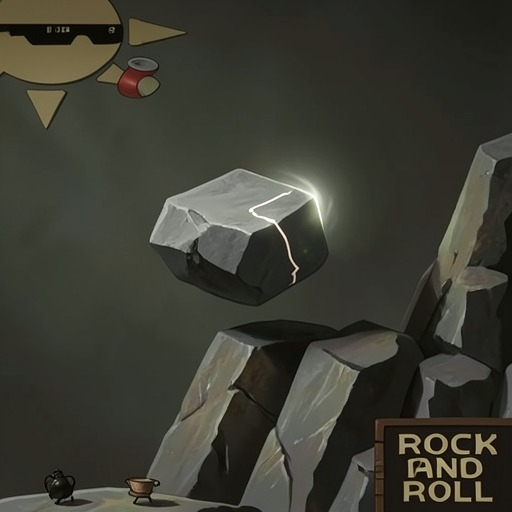
Rock Falls, Everyone Dies“A Rolling Stone Gathers No Moss” names the story’s governing image: a stone that remains in motion cannot settle into passive obscurity. In the narrative, the expression becomes more than a proverb. It describes the protagonist’s literal descent from a mountaintop, its continuing passage through danger and space, and the way motion gradually carries it beyond the limits of ordinary stonehood toward sensation, loss, and creative power.
Title and First Appearance
“A Rolling Stone Gathers No Moss” appears as the title of Chapter 1, which opens on a mountaintop above the clouds during a battle between a hero and a villain. The elevated fantasy setting initially suggests a conventional heroic tale, but the chapter’s decisive subject is not either combatant. The title redirects attention toward the stone and establishes the contrast between spectacular action and the humble object that will actually carry the narrative forward.
The expression also supplies an immediate rule of movement. The stone’s story begins not with rootedness, settlement, or a stable identity, but with departure. Its defining possibility is that it can roll away from where it began, leaving the fixed environment behind and entering a quest whose destination is unknown.
Motion as the Stone’s Heroism
The stone’s movement is literal before it becomes symbolic. It rolls down the mountain with increasing speed and momentum, eventually noticing a strange long-eared animal, a rabbit, below. The encounter turns motion into agency: the stone remembers that striking things in the head can make it grow larger and that it possesses the ability to steer. Its descent is therefore no longer mere falling. It can redirect its acceleration and choose a target.
The first decisive movement is marked by silence. The stone uses its steering ability to shift its downward acceleration sideways, guiding its fall with patient precision until the silence breaks at impact. The scene converts the proverb’s passive image of a rolling stone into an active image of pursuit. Motion preserves the stone from moss, but it also gives the stone access to targets, consequences, and a developing purpose.
The stone’s patience is inseparable from its mobility. After spending two seasons on a cliff, watching events in the chasm, it resumes rolling rather than remaining a permanent observer. The narrative links its long stillness to the force of its later movement: waiting makes the hunter more dangerous, while rolling turns accumulated attention into action. Even the title’s apparent opposition between motion and rest is therefore complicated. The stone can pause, but it is defined by the return to motion.
From Rolling Object to Developing Subject
The expression gains a wider meaning as the stone’s journey continues. The protagonist remains materially stone-like, yet its experiences steadily expand its capacities. It feels little fear when confronted by a mass of skeletons because it is a rock, but it can register heat after braking during its descent and converting part of the fall’s thermal energy. Its existence is thus presented through physical processes rather than human sensation, while still allowing those processes to become the foundation of growth.
After a long period of near-stasis, a Dragon enters the cavern, approves the mana-reinforced chamber, and treats the rock as a suitable part of a new lair. The stone receives a roommate, but the larger significance lies in the interruption of its isolation. The proverb does not mean that the stone avoids every form of stillness or contact; instead, its continuing existence is shaped by repeated transitions between fixed places and new circumstances.
The same principle later governs the stone’s movement beyond the earth. When it senses a small scouting drone, it anticipates that larger metal vessels will follow. Although it does not yet truly feel, it casts out its senses and accelerates toward the approaching vessels. Motion here becomes instinctive investigation. The stone is no longer merely propelled by gravity or directed toward an immediate prey; it moves toward an unknown technological presence because its expanding awareness detects that the encounter matters.
Sound, Feeling, and the Cost of Movement
The title’s emphasis on rolling reaches its most profound reversal when the stone’s journey gives it senses it never previously possessed. Before its launch into space, it could perceive only the earth’s rumbles and vibrations because it had no ears. In space, it grows and develops within a new domain. The rolling stone’s movement has carried it not simply across distance but across a boundary of being.
That transformation allows it to hear a Bard’s song. The Bard addresses a Jade Statue and begins to play while facing approaching destruction. The stone does not understand humans and does not recognize the Bard as such; it sees the statue and hears the music issuing from it. Nevertheless, it interprets the Jade Statue as singing for the stone and welcoming it. The image transforms the proverb into a theory of connection: continued movement leads the stone into a world where an apparently distant act can reach it through sound.
The song produces the first fully articulated shift in the stone’s inner life. It understands beauty, wants to hear more, and feels the music resonate through its domain. Other beings respond as well: the hero and villain stand together, Supreme Grand Magus Oldivar leaves his cellar, and the Dragon remembers former glories while hearing the roars of old friends in the chorus. The stone’s movement has brought it to a shared moment in which its newly acquired perception briefly unites otherwise separated lives.
The loss of the music gives the expression its darker edge. When the song stops, the stone understands loss for the first time. It listens, but the music does not return; destruction replaces the song, followed by silence. A stone that once seemed beyond feeling becomes capable of mourning precisely because its journey has carried it into experience. Motion prevents moss, but it also prevents innocence: every new domain offers new perception and therefore new vulnerability.
Legacy and Continuing Motion
The expression ultimately describes a cycle rather than a single descent. After the devastation, the stone participates in the creation of a Jade Planet. Clumps of jade rise into crude figures, and the stone guides their development until they become a people who sculpt themselves. The people make hair from gemstones, polish their jade skin, and begin singing without being taught. Life gradually fills the planet with people, animals, plants, mountains, lakes, and forests, while the planet listens to the many songs and turns its rings to their tunes.
This creative outcome extends the title’s central logic. The stone’s refusal to remain confined to one place leads not only to combat and survival but also to a world capable of independent song. Its movement becomes generative: what begins as rolling down a mountain eventually produces relationships, perception, memory, and life beyond the stone itself.
The final return to the image is deliberately humble. The world does not follow the champion from another path down the mountain; it follows the real hero, the stone, rolling onward at good speed. The stone is identified as a gneiss stone, accelerating as a level 1 Rolling Stone and setting out on a brand-new quest. The expression therefore closes the circle while refusing closure. The protagonist has become larger in significance without abandoning its original motion, and the story ends where the proverb’s promise began: with a stone still rolling, gathering experience instead of moss.