Defeat of Demon Lord Diablos
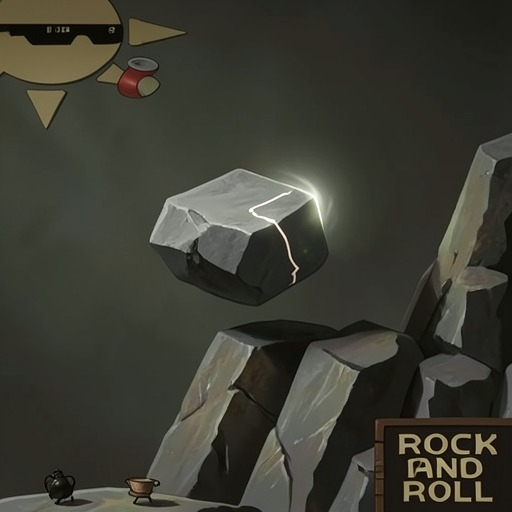
Rock Falls, Everyone DiesThe Defeat of Demon Lord Diablos is the stone’s accidental entry into heroic history. While rolling down a mountain, the newly awakened pebble strikes Demon Lord Diablos in the head at precisely the moment a white-clad hero is fighting him. The impact causes only one point of damage, but the brief flinch creates the opening through which the hero drives a sword into the demon lord’s chest. The stone therefore defeats neither opponent through strength or intention alone; its apparently trivial collision becomes the decisive interruption in a battle already staged as a mythic confrontation.
Causes and Battlefield Context
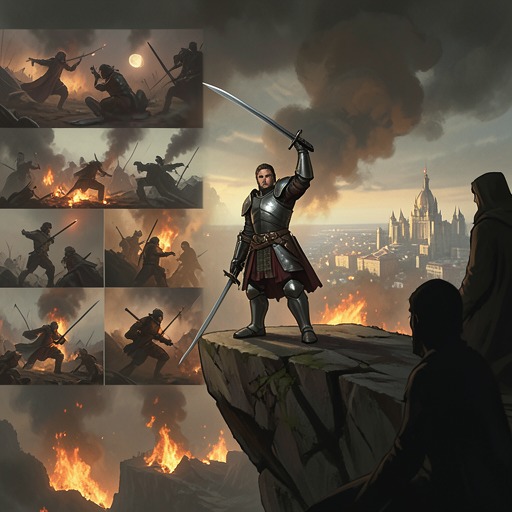
The event occurs on a mountaintop high above the clouds, where a hero and a villain are engaged in a grand battle. The scene is deliberately framed like the opening of a conventional fantasy adventure, complete with extravagant attacks and opposing champions, but the stone enters from outside that expected structure. It is not summoned, chosen, or sent toward the combatants by either side. Its trajectory begins as an ordinary flight and ends with an unplanned collision that connects the stone’s physical momentum to the battle’s larger stakes.
By the time the pebble approaches the combatants, it has begun to understand movement as a source of advancement. Its flight has made the numbers associated with its condition grow, and it is eager to repeat anything that produces such increases. The approaching red-skinned creature is therefore first perceived as a target in the stone’s developing, highly practical understanding of the world. The stone does not recognize the encounter as a legendary battle before acting; it simply continues along a path that happens to cross the demon lord’s head.
The Collision and Reversal
The decisive beat is marked by the blunt impact of the pebble against Demon Lord Diablos. The system records that Collision activated and calculates the stone’s damage as one point. The numerical result is almost comically small beside the scale of the battle, yet the contact has a disproportionate tactical effect: Demon Lord Diablos flinches for a second, and that second permits the white-clad hero to plunge a sword deep into his chest.
The event thus produces a sharp reversal between physical force and narrative consequence. The stone does not overpower the demon lord, pierce his defenses, or deliver the killing wound. Instead, its momentum changes the timing of the duel. A minor object becomes an agent of interruption, and the hero’s victory depends on an action whose significance neither the battle’s dramatic framing nor the stone’s own limited expectations could have predicted. The stone’s new velocity after the collision carries it away from the scene, leaving the conventional hero and villain behind while the consequences follow it down the mountain.
Demon Lord Diablos declares that the defeat is not final, promising to resurrect in 666 years and warning that humanity will then be doomed. The hero responds that the Isekai Office contracted him for only one demon lord and that he is leaving the world. Their exchange makes the victory less like the completion of a noble campaign than the closing of a limited assignment. The demon lord’s threat establishes a future cycle of danger, while the hero’s indifference emphasizes how little the stone understands the institutional and cosmic context into which it has been swept.
Rewards and Immediate Consequences
After the stone has rolled far away from the mountaintop, the system announces that it has assisted in defeating Demon Lord Diablos. The wording is important: the stone receives credit not for independently killing the demon lord but for assistance. That distinction preserves the event’s causal structure, in which the collision creates the opening and the hero supplies the lethal attack.
The reward is nevertheless enormous. The stone receives 500,000 assist experience, gains the title Enemy of Demons, and reaches level 1 after the system discards the experience that exceeds the amount required for advancement. The title grants 20 percent greater damage against demons and 20 percent more experience from killing demons, while also establishing permanent hostility with all demons. An accidental act therefore becomes a durable change in the stone’s identity, abilities, and future relationships.
The level-up also produces a concrete bodily transformation: the stone’s mass rises from 0.3 kilograms to 1.0 kilogram. Its increase in size is not merely decorative. Earlier, the pebble has already connected violent impacts with growth, and this reward confirms that contact with the world can alter its physical capacity. The defeat of Demon Lord Diablos is consequently both an external battle outcome and an internal developmental milestone: the stone leaves the scene heavier, more dangerous, more specialized, and permanently marked as an enemy of demons.
Narrative Significance
The event establishes the book’s central pattern of accidental agency. In a genre where heroes normally seek battles and villains await defeat, the stone has no heroic pedigree and no stated intention to intervene. Its momentum performs the work of destiny without requiring prophecy. The collision is meaningful because the stone’s material properties—speed, direction, mass, and impact—can enter a network of magical and political consequences normally reserved for speaking characters.
The episode also begins the recurring contrast between grandiose battle language and the stone’s impersonal physical existence. The demon lord’s promised return after 666 years, the hero’s contracted employment, and the system’s exact damage and experience calculations occupy different registers, yet they converge around a single bonk. The result is not that the epic world becomes unreal, but that its definition of a consequential actor expands. A pebble can alter the course of a demon lord’s defeat because the world’s systems record effects rather than intentions.
Finally, the defeat supplies the stone with its first durable enemy relation and foreshadows the cyclical structure of the wider story. The demon lord’s threatened resurrection points toward repetition, while the stone’s reward launches it into a quest whose later stages will again place an apparently fixed object inside battles, disasters, endings, and beginnings. The first victory is therefore both modest and foundational: one point of damage is enough to give the stone a title, a level, a new mass, and a place in the history of the world.