Demon
Rock Falls, Everyone DiesDemons are the story’s recurring antagonistic creature type, defined less by a single continuous society than by their repeated role in conflicts with Heroes and humanity. Their presence turns the mountaintop duels, system notifications, resurrection promises, and even absurd magical schemes into variations on an ongoing demonic threat. Across the narrative, Demons are dangerous enough to shape the protagonist’s development, but theatrical enough to reveal the comic machinery behind the heroic genre they inhabit.
Nature and Recurring Role
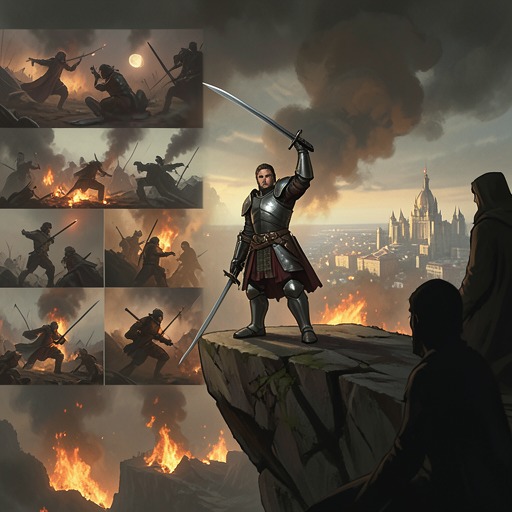
Demons enter the narrative through the conventional image of a grand battle between a Hero and a villain on a mountaintop above the clouds. In the opening chapter, the conflict is framed through extravagant named attacks, including the Holy Infinite Beaming Sword of Banishing the Nasty Darkness. The demon’s defeat is not merely a background victory: the newly awakened pebble assists it by striking the red-skinned creature in the face, creating the moment that allows the white-clad combatant to drive a sword into its chest.
The defeated Demon immediately claims that the victory is temporary, declaring that it will resurrect in 666 years and that humanity will then be doomed. The threat establishes a recurring demonic rhythm: defeat does not necessarily end the enemy, and the number 666 becomes part of the world’s ritualized cycle of apocalypse and return. Yet the Hero’s response undercuts the expected solemnity. He explains that the Isekai Office contracted him for only one Demon Lord and is already saying goodbye to the world. Demonic evil is therefore embedded in a bureaucratic and transactional universe, where the supposedly eternal struggle may be only another completed assignment.
System Relations and Consequences
The system recognizes the pebble’s intervention as assistance in defeating Demon Lord Diablos and grants it 500,000 assist experience. It also awards the title Enemy of Demons. That title has concrete effects: the recipient deals 20 percent greater damage to Demons, receives 20 percent more experience from killing them, and acquires permanent hostility with all Demons. The creature category thus becomes a formal relationship rather than merely a moral label. Once the title is gained, future encounters with Demons are shaped by an enforced mechanical antagonism, binding the pebble’s growth to the continued existence of its enemies.
This reward also changes the meaning of the opening battle. The pebble does not understand the heroic duel as a human would, nor does it need to defeat the Demon directly. A single well-placed impact is enough to alter the battle’s outcome and trigger an enormous system payment. Demons consequently function as advancement nodes within the protagonist’s strange education: their violence threatens the world, but their defeat supplies the experience, titles, and hostility that make the pebble increasingly capable of acting within it.
Demons Among Other Nonhuman Threats
The narrative repeatedly places Demons beside other nonhuman beings, including rabbits, skeletons, Dragons, and the stone protagonist itself. The pebble’s early hunting logic begins when it sees a long-eared rabbit and remembers that striking creatures in the head can make it grow larger, as well as remembering that it can steer. Later, after patiently observing the rabbit for two seasons and witnessing its romance and offspring, the pebble pursues revenge. That episode is not a demonic encounter, but it helps clarify the creature’s evolving ethics: hostility first appears as a practical hunting response and then becomes deliberate vengeance.
The same widening field of nonhuman agency appears in the dungeon, where the rock faces a mass of skeletons advancing through a sloping corridor. It feels little fear because it is a rock, though it does register heat produced by braking during its fall and stores a temperature of 150K. A Dragon later enters the cavern and gently pats the rock before choosing the chamber as a new lair, giving the rock a roommate rather than an enemy. Against this background, Demons stand out not simply because they are monstrous, but because the story repeatedly assigns them the inherited narrative position of designated antagonists. Other beings may hunt, invade, shelter, or coexist; Demons are the creatures for whom the system and heroic plot most insistently prescribe opposition.
Repetition, Death, and Recurrence
The demonic conflict is replayed in altered forms. On another mountaintop, a Dragon’s passing gust distracts a Hero and a Demon Lord, allowing the Demon Lord to seize the advantage and kill the human Hero with a demonic weapon. The Demon Lord then announces that its reign will last 666 years and condemn humanity to servitude. The Hero answers that another noble Hero will always appear, preserving the cycle even as the immediate combatant dies.
The pattern reaches a later and deliberately ridiculous version in the second epilogue. Jerome, a level 60 Hero, faces a red-skinned Demon made of orange jade with a red ruby mustache. This Demon claims to have used the same teabag to make 666 cups of tea, gaining the power of Infinite Tea and becoming the Infini-tea Demon. Its plan is to drop the tea bag into the ocean and convert all the world’s water into tea. Jerome’s water beam strikes the Demon’s core, vaporizing it and sending the small pebble that supplied the assist careening aside. The corpse leaves behind only stylish leather boots, while Jerome remains unsettled by death despite having spent more than two years in the world.
The system then records the result as contract progress: two of three Demon Lords have been defeated, followed by another level increase. Demonic death is therefore simultaneously absurd spectacle, genuine violence, contractual progress, and numerical advancement. The Demon is destroyed, but the larger structure promises another confrontation still to come.
Narrative Significance
Demons give the book a recurring mythic skeleton: a Hero and a villain meet above the clouds, a spectacular attack is announced, a reversal occurs, and the world’s future is measured in cycles of 666 years or in system counters such as two out of three defeated Demon Lords. The same pattern appears at the beginning, during the quarry conflict, at the end of the world, and in the epilogue, where the repetition is exposed as a setup for another battle.
Their importance is consequently structural as much as biological. Demons embody the story’s inherited assumptions about evil, heroism, resurrection, and final battles, while the pebble repeatedly disrupts those assumptions through accidental force, patience, gravity, music, and planetary transformation. Even as the world moves toward destruction and a new jade world fills with people, animals, plants, mountains, lakes, forests, and songs, the demonic pattern remains available for restart. Demons are the antagonists who make the cycle legible—and the recurring joke that proves the cycle has never been as stable or as sacred as the heroic language suggests.