Jerome Smith
Rock Falls, Everyone DiesJerome Smith is the central human Hero of the epilogue’s parallel storyline, a young man whose significance lies in the gap between heroic expectation and actual competence. Summoned under a contract requiring him to defeat three Demon Lords, he begins without the special boons or cheat abilities he believes such a destiny should provide. Yet the disadvantage becomes the foundation of his identity: Jerome advances through grit, ironclad will, cleverness, and improvised applications of remembered physics and chemistry rather than through divine favoritism. His rise makes heroism less a matter of inherited power than of finding an exploitable principle inside an unfair system.
Identity and Summoning
Jerome is introduced as an eighteen-year-old newly brought before Solara, the minor goddess of heroes, at the Isekai Office. He argues that the contract’s demand to defeat three Demon Lords is unreasonable if he is to receive no additional boons, asking for what he regards as a proper cheat skill for his new life. Solara’s response is grounded in his unimpressive prior record: she reminds him that Jerome Smith had reached the age of eighteen with no notable achievements. His complaint is therefore comic but structurally important. He enters the other world expecting the conventions of the transported Hero narrative, while the institution responsible for his transfer treats him as an unremarkable claimant whose request for exceptional treatment has not been earned.
Jerome’s lack of a divine advantage does not prevent his advancement. Instead, the narrative identifies his real advantage as a small reserve of ingenuity applied at exactly the right moment. He remembers fragments of high-school physics and chemistry, including the idea that water consists of molecules connected by bonds. Although his scientific understanding is approximate rather than expert, it is sufficient to let him construct a powerful water-magic technique that surpasses the Gemstone Mages of the new world. The contrast defines him: Jerome is not omniscient, but he knows enough about an unfamiliar system to make ordinary knowledge extraordinary.
The Hero’s Repeated Battlefield
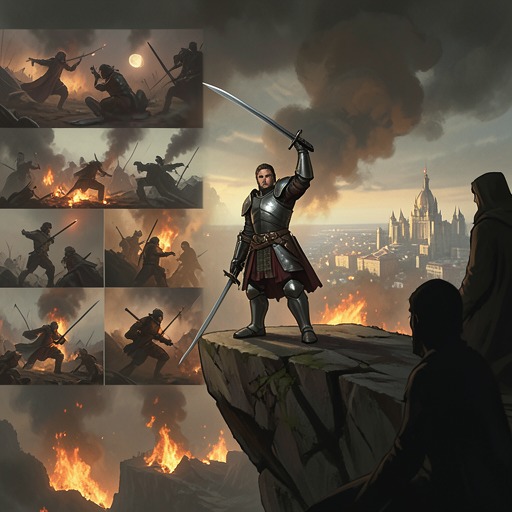
Jerome’s confrontations are framed through a recurring image: on a mountaintop high above the clouds, a hero and a villain prepare for a grand battle, complete with exaggerated attack names and the expectation of a final duel. The same ritualized setup appears at the opening of the story, during the chapter titled “A Rolling Stone Gathers no Moss,” and returns in “A Quarry to Settle” and “The World Ends With Rock.” Jerome’s appearance in the later cycle places his personal quest inside a broader pattern of repeated heroic theater, where grand speeches and spectacular techniques are continually staged against the enduring presence of rock.
In the final confrontation, Jerome is already a level 60 Hero when he faces a red-skinned demon of orange jade with a red ruby mustache. The demon claims to have used the same teabag to make 666 cups of tea and thereby gained the power of Infinite Tea, becoming the Infini-tea Demon. Jerome answers with a sword attack, but the weapon is a deception. He has learned that enemies expect a Hero to fight with a blade, so he uses that expectation against them. The fake sword is not merely a joke about heroic conventions; it is a practical expression of his defining method, turning an opponent’s assumption into an opening.
The Battle with the Infini-tea Demon
The demon attacks with the Abyss of Infinite Tea, while Jerome unleashes the Water Beam That is Actually Made of Like Molecules and Stuff. The two beams collide above the shattered mountaintop, sending jets and sprays across the landscape and carving through the clouds below. At first, the tea beam gradually gains ground. Jerome responds not by producing a new supernatural resource, but by concentrating on the atoms and bonds that make his water magic stronger. His power depends on a strange fusion of partial scientific memory and magical visualization: the more precisely he can hold the material structure in mind, the more forcefully the spell operates.
The decisive interruption comes from outside Jerome’s plan. A small rock falls from the sky and strikes the demon in the face with a blunt bonk. The impact breaks the battle’s apparent balance long enough for Jerome’s water beam to reach the villain’s core, vaporizing the demon. The pebble careens away after providing the decisive assist. Jerome therefore wins the duel through a combination of preparation, deception, scientific improvisation, and pure contingency. The scene undercuts the myth of the solitary Hero without nullifying his achievement: Jerome creates the winning technique and sustains the contest, but the final opening arrives from the same stone-centered world that has repeatedly shaped the larger narrative.
Progress, Success, and the Cost of Victory
The demon’s destruction advances Jerome’s contract to two of three Demon Lords defeated. The victory also grants him enough experience to reach level 61, with overflow experience discarded and his Strength increasing from 261 to 263. These numerical rewards confirm that Jerome has become a genuine high-level Hero, but the display remains deliberately mechanical. His progress is recorded as contract completion, experience allocation, level advancement, and stat increase, making heroic achievement legible as a sequence of system updates rather than as an exclusively moral or spiritual triumph.
Despite his success, Jerome remains unsettled by death. After the demon is vaporized, only the villain’s stylish leather boots remain, and Jerome is still thrown off balance by the sight even after more than two years in the world. This reaction complicates his public status as the greatest Hero in the land. He can improvise a technique powerful enough to defeat an enemy who controls Infinite Tea, yet he has not become emotionally indifferent to what victory requires. His endurance has made him formidable, not invulnerable.
Narrative Role and Inherited Quest
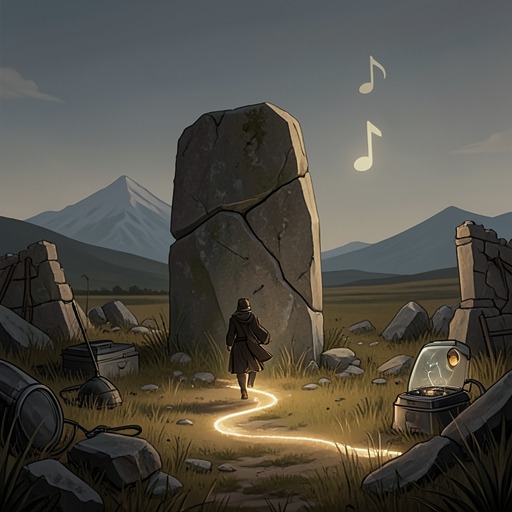
Jerome’s story is paired with the fate of the rock at the center of the planet. After the world’s ending and subsequent Genesis, the old rock has successfully transferred its quest forward to a young Hero. It waits to discover what reward will appear when the numbers reach their promised goal, and it may occasionally place itself on the scales to help the young Hero when progress stalls, while avoiding enough interference to provoke the system’s anger. Jerome is consequently more than a separate adventurer: he is the kind of future figure toward whom the rock’s long labor has been redirected.
This transfer turns the conventional Hero’s Journey into an interrupted and repeating inheritance. Jerome begins as a dissatisfied newcomer demanding a cheat skill, becomes a self-made Hero through persistence and lateral knowledge, and then stands inside a quest structure whose deepest origin lies elsewhere. The older being watches the young Hero’s numbers rise and wonders what will happen at the end, suggesting that Jerome’s apparent autonomy exists within a chain of carefully reproduced conditions. His heroism is real, but the quest itself has become portable, passed from one life and one form of existence to the next.
Jerome’s final significance lies in this tension between mythic destiny and practical improvisation. He is called a Hero, bound by a contract, measured by levels, and placed in repeated mountain-top confrontations, yet his victories are never presented as pure fulfillment of an ordained ideal. He has no special boon, relies on a fake sword, draws power from imperfect classroom knowledge, and receives the final interruption from a falling pebble. The result is an inversion of the chosen champion: Jerome becomes extraordinary not because the world grants him a perfect instrument, but because he learns how to make limited resources matter.