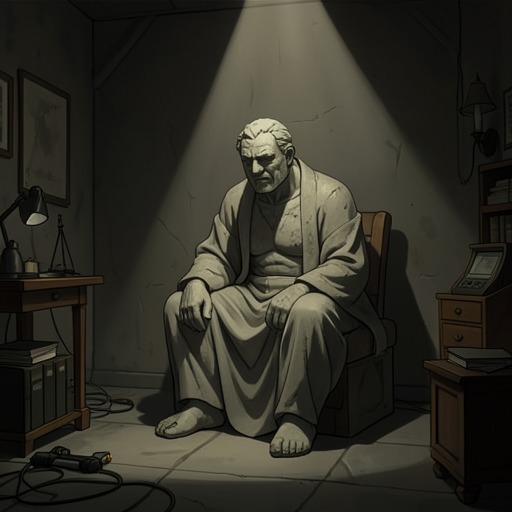
Shiyan Wuyibainian Jingzhi Qi
Rock Falls, Everyone DiesThe stone’s five-hundred-year stillness is a decisive period of apparent inactivity that becomes, on closer examination, the hidden beginning of its cultivation. For most of the interval, it remains unmoving in an enclosed room, but the silence gives it access to a new mode of existence: patience itself becomes an active condition, allowing energy to gather and the stone to begin changing without visible motion.
Apparent Inactivity
The period is first presented as an almost comic void. The stone sits still, and from an outside observer’s perspective it appears to be doing absolutely nothing in a closed-off room. The narration deliberately stretches the expectation of action across five hundred years, turning the absence of movement into the event’s defining feature. This is not a brief pause between adventures but a temporal scale radically different from the short battles, thefts, alarms, and confrontations elsewhere in the story.
The stillness also establishes a distinctly nonhuman rhythm. The stone does not experience immobility as ordinary living characters would. It has never truly been asleep; instead, it lets time pass in the manner of a rock, remaining unmoving within the stream of time. The interval therefore reframes inactivity as a form of endurance rather than helpless suspension. What would signify stagnation for a human becomes a natural capacity for the stone.
The Hidden Development
The claim that nothing happened is later corrected. The stone spends five hundred years mostly sitting still, but “mostly” matters: while its body remains apparently unchanged, something becomes available to it. Its patient waiting qualifies it for the Cultivator subclass, and the system presents cultivation as a new possibility. The stillness is thus revealed as an eligibility process whose result could not be recognized from the outside.
The stone accepts the subclass without hesitation because cultivation appears to serve its central desire to cultivate mass. Its acceptance also gives the long interval a retrospective purpose. The room is no longer merely a place where the stone is trapped; it becomes the first environment in which geological patience can be converted into advancement. The stone’s willingness to treat cultivation as a practical means of growth, and possibly as a route out of the room, turns a static condition into an objective-driven stage of development.
Meditation and Energy
After accepting the new class, the stone experiments with Energy Shift, converting energy into kinetic energy and managing only the slightest wobble. At level one, it is not powerful enough to shift the heavens, so immediate escape remains impossible. Rather than abandoning the attempt, it uses the limitation as a reason to continue waiting and focusing.
Meditation becomes the mechanism through which stillness acquires material consequences. The stone senses a subtle field of energy passing through the room. Its new ability latches onto that field, slowly absorbing a trickle of energy and converting it into a strand of Qi. The process is extremely gradual, but the Qi begins to expand. The five-hundred-year interval therefore contains a concealed accumulation: no visible journey occurs, yet the stone’s internal resources are steadily increasing.
The text extends this temporal pattern beyond the original interval when another two hundred years pass with almost nothing happening, except at the very end. That continuation emphasizes that the stone’s development is measured less by visible episodes than by thresholds reached after prolonged preparation. Its power does not arrive through constant action; it emerges when accumulated time finally produces a change the system can register.
Place in the Larger Story
The stillness stands between the stone’s earlier circulation through violence and its later expansion into larger realms of conflict. Before the interval, the stone can be noticed, carried, and used by others: goblins recognize it as special, while the Bone Core panics because the intruder in the Bone Zone refuses to stop. Elsewhere, a Dragon seizes the stone with its tail because it needs a weapon against adventurers. These episodes define the stone through motion imposed by external actors.
The enclosed-room period reverses that arrangement. No goblin carries the stone, no dungeon guardian confronts it, and no Dragon launches it as a weapon. The stone’s most consequential action is choosing to accept cultivation and then continuing to meditate. Its agency becomes quieter but more durable, shifting from being moved through the world to developing power within a fixed place.
Temporal and Narrative Significance
The interval gives the story a time scale in which battles can be brief interruptions and geological patience can become a form of power. Later signals in the narrative repeatedly return to this contrast: a class advancement answers a long-sustained plea, a sensor alert interrupts the calm of space, and the final cycle sends a young hero forward while the older stone waits to discover what the transferred quest will produce. Against these reversals, the five-hundred-year stillness establishes the stone’s characteristic relationship with time: it does not defeat delay by escaping it, but turns delay into preparation.
Its importance lies precisely in the gap between appearance and consequence. To observers, the stone is tranquil, enclosed, and motionless. In the stone’s own developmental logic, however, the same condition permits qualification, meditation, energy absorption, and the first expansion of Qi. The stillness is therefore not an empty chapter in the stone’s history. It is the period in which waiting becomes cultivation and an apparently inert object begins to acquire the means to act on a much larger scale.