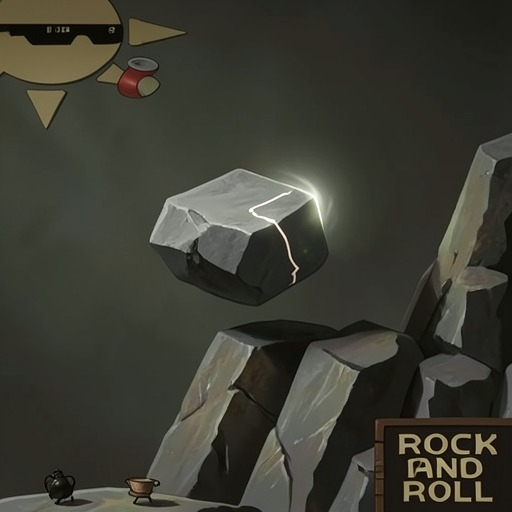
Tutorial Quest: Roll out
Rock Falls, Everyone DiesTutorial Quest: Roll out is the system rule that defines the awakened stone’s initial purpose and gives its seemingly aimless movement a measurable direction. Its instruction is precise—reach the bottom of the mountain—yet its legendary difficulty, hidden reward, and repeated unresolved status transform a basic descent into the governing structure of the story. The quest begins as a tutorial, but it survives long enough to become a test of persistence, a source of escalating rewards, and finally a mechanism caught in the contradiction between a finite objective and a world that has grown too large to contain it.
Definition and Initial Assignment
The quest first appears before the stone has established any identity beyond its desire to become the best of all stones. A new system screen assigns “Roll out” and states the objective as “Reach the bottom of the mountain.” The starting altitude is 10 000 meters, the difficulty is Legendary, and the reward is concealed as an unknown legendary prize. Those terms immediately give the stone a directional imperative and a promise of disproportionate compensation: the action is merely to roll, but the scale of the reward implies that the system regards the descent as an extraordinary undertaking.
The rule also supplies a framework for the stone’s awakening. Rather than receiving a conventional summons, a spoken mission, or guidance from a mentor, it receives an interface and a destination. The mountain becomes both terrain and tutorial boundary. Every interruption, collision, battle, and change in the stone’s abilities is measured against the same downward trajectory, making the quest less a side assignment than the narrative’s basic axis.
Progress Through Descent
The stone’s first movement begins at the moment the quest is assigned. While it rolls away from the mountaintop, the system records its progress numerically; an early update places it at 9 673 meters. The display turns motion into evidence. The stone does not need to understand the larger world before acting, because the quest reduces its immediate problem to altitude and direction. The descent therefore functions as a primitive form of agency: the stone moves because the system has supplied an objective, and the objective remains legible even when everything around it is not.
The quest’s progress is repeatedly accompanied by the game-like feedback of experience and levels. The stone receives 500 000 assist experience after helping defeat Demon Lord Diablos, and it later levels up when the system processes accumulated experience, including instances in which overflow is discarded. Other updates record thresholds such as 100 out of 70 experience, 400 out of 250, and 1 000 out of 1 000. These numbers do not replace the quest’s objective; they make the descent feel productive even when the destination has not yet been reached. The stone’s accidental participation in conflicts becomes folded into the same progression system, so victories elsewhere still strengthen the entity whose formal task is simply to continue rolling downward.
This produces a recurring tension between local rewards and the global requirement. Titles and level increases confirm that the stone is advancing in power, but they do not certify completion. The system can recognize assistance, overflow, and advancement while leaving the central tutorial unresolved. In that sense, the quest is both motivational and absurd: every reward encourages further action, yet the basic command remains stubbornly unchanged.
Completion at the World’s Center
The quest eventually reaches an apparent endpoint when the stone arrives at altitude 0. The system again displays the title “Tutorial Quest,” the command “Roll out,” the instruction to reach the bottom of the mountain, Legendary difficulty, and an unknown legendary reward. This time, however, the completed altitude is followed by “Resolving...” rather than an immediate reward. The stone has satisfied the literal measurement, but the system still has to interpret what that satisfaction means.
The delay becomes significant because the stone is no longer merely at the foot of a mountain. It is later described as sitting at the center of a planet, deep beneath the earth, watching the prompt and waiting for the message to fill in. The original spatial vocabulary has expanded beyond its intended scale. “Bottom of the mountain” can be fulfilled numerically, but the surrounding reality has changed so radically that the system’s tutorial logic struggles to classify the result. The stone has completed the movement while exposing the inadequacy of the rule’s assumptions.
Unresolved Status and System Failure
The final form of the quest is not successful resolution but a corrupted display. A renewed prompt gives the same title, command, objective, Legendary difficulty, and unknown reward, yet the current altitude is shown as “????” and the status is explicitly “UNRESOLVED.” The newly forged planet shakes while the stone watches the final error. Completion has therefore become paradoxical: the altitude once reached 0, but after planetary transformation the system can no longer determine the relevant location or apply the original mountain-based measure.
The unresolved status also separates narrative effort from mechanical acknowledgment. The stone has rolled through an enormous sequence of dangers and consequences, accumulated levels, and reached the value that should have ended the tutorial. Nevertheless, the interface refuses to deliver the promised reward. The rule’s authority depends on numerical clarity, and once the world exceeds the scale of the original assignment, that clarity collapses. The quest remains active not because the stone has failed to move, but because the system has failed to understand what the movement accomplished.
Recurrence and Structural Significance
“Roll out” is repeated across the story’s changing scale, alongside recurring mountaintop battles and repeated chapter framing. Its repetition makes the quest a structural refrain. The same instruction can govern the first descent from a mountain, the journey toward the planet’s center, and the aftermath of a world-ending transformation. Each recurrence preserves the wording while altering its context, turning a tutorial objective into a test of whether rules retain meaning when their original world has disappeared.
The quest also embodies the story’s numerical-growth logic. Experience, levels, titles, and system calculations continually promise that action can be translated into progress, while the tutorial exposes the limits of that promise. Rewards may increase, values may overflow, and the stone may become powerful enough to participate in events of planetary consequence, but none of those increases guarantees interpretive closure. The rule begins as a straightforward command to descend and ends as an unresolved question posed by a system confronted with a planet, a new world, and an objective it can no longer measure.