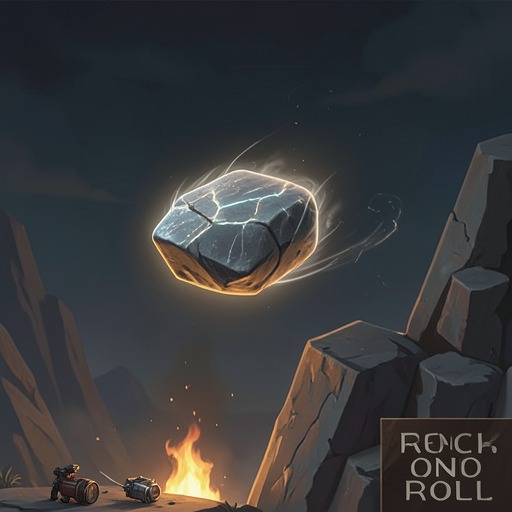
Unnamed Gneiss Stone
Rock Falls, Everyone DiesUnnamed Gneiss Stone begins as a small, attractively shaped gneiss pebble on a violently shaking mountaintop, the sort of stone a child might carry away because of its coloring. Its decisive transformation is not physical at first but mental: amid the mountain’s racket, it wishes for peace and quiet, then realizes that wishing and thought themselves are new. That first flicker of awareness makes an ordinary piece of matter the story’s central agent and establishes its unusual power to turn passive existence into purposeful development.
Definition and Awakening
Unnamed Gneiss Stone initially has no title, identity, or known history beyond its long period of comfortable silence on the mountaintop. A strange grey screen appears before it, and the stone’s attention toward that interface marks the beginning of its contact with a system that will repeatedly structure its growth. The object is therefore both geological and personal: its material form remains that of a pebble, while its new awareness gives it curiosity, memory, frustration, and the capacity to choose.
Its earliest consciousness is sharply limited. The stone can reason about its surroundings only through the narrow range of sensations available to it, and it does not initially understand smell, taste, or sound. That limitation becomes a recurring engine of development. When it tries to steer toward a rabbit, it mistakes the motionless animal for an inferior opponent; the rabbit’s twitch and sudden dodge expose the error in its model of living things. The stone strikes another rock, becomes lodged between boulders above a chasm, and stops moving. Its first action thus combines agency with misapprehension: awareness gives it a goal, but not yet the sensory knowledge needed to achieve one.
Classes and Material Agency
The system translates the stone’s material experiences into a sequence of available forms. After it grows while rolling, it receives the option to become a Rolling Stone, a class that turns movement itself into a path toward greatness. The class gives the pebble a framework for interpreting acceleration, velocity, and direction, but it does not make motion effortless. Its failed attempt to hit the rabbit demonstrates that even a system-assisted object remains constrained by bodily form and incomplete perception.
The stone’s abilities broaden when it is heated and cooled inside a hostile chamber. It begins experimenting with Energy Shift, the capacity to change energy from one form into another. Because kinetic energy is the form most immediately intelligible to a rolling object, the stone first understands energy through mass and velocity, then gradually notices the unfamiliar exchange involved in heating and cooling. Seasonal temperature changes on the cyclical mountains had been too slow for it to distinguish clearly; confinement makes the shift palpable. The stone’s materiality is not merely a passive condition being acted upon. Heat, motion, gravity, confinement, and the system together become forces through which it learns and acts.
On a battlefield, goblins notice that the stone is not ordinary and rush to pick it up, treating it as a potentially valuable weapon because they generally cannot afford enchanted tools. Their attention changes the stone’s position within the world: it is no longer simply an object lying on a mountain, but a contested instrument carried by other agents. Later, a Bone Core inside a mountain panics because the intruder in its Bone Zone refuses to stop. The contrast is important. The stone’s apparent simplicity repeatedly conceals persistence that overwhelms the expectations of creatures and systems designed to classify or control it.
Stillness, Expansion, and Cosmic Scale
The stone’s development does not proceed through constant action. During roughly five hundred years of apparent inactivity, it remains in a closed room, unmoving to an outside observer. Yet this stillness becomes a form of cultivation rather than emptiness. The system offers it the sub-class Cultivator, implying that patient endurance and the ability to let time pass have themselves become an accomplishment. The stone has not been asleep; it has occupied time in the manner of rocks, and its stillness becomes the condition for another kind of growth.
Its scale expands through increasingly violent or externally directed movement. A dragon seizes the stone with its tail because it needs a weapon for throwing at intruders who steal from its hoard. The dragon’s anger and physical power turn the pebble into ammunition, but the resulting trajectory carries the stone beyond the local landscape. At an altitude of 15,000 meters, it sees that the mountain where it began is only one point on the continent’s spine. The view makes its smallness newly visible, but the resulting pause is not surrender. When the system announces that class advancement is unlocked and offers Meteorite, the stone receives a new route toward the strength it needs to continue.
As a Meteorite, Unnamed Gneiss Stone reaches a perspective that overturns its earlier assumptions. It looks down upon the blue planet with green continents and clouds, recognizing the world it had inhabited without understanding its overall shape. The planet is itself only a very large rock. The stone then turns outward toward the distant orange star and recognizes another rock, merely a glowing and perhaps much larger one. This change in scale does not erase difference; it reframes difference as size and power rather than substance. The system records the insight as a philosophical breakthrough and raises the stone to Cultivator Level 7.
Perception, Conflict, and Independence
The stone’s perceptions continue to expand as its body and domain expand. Before its launch into space, it could register only the rumbles and vibrations of the earth because it had no ears. In space, it develops mastery over a new domain. While its energy reaches downward toward a jade figure that reaches up toward it, the stone hears a soft, sorrowful yet energetic song for the first time. The moment matters because growth is no longer measured only by altitude, velocity, class, or destructive capacity. A previously inaccessible form of experience enters its world and opens a different direction for its powers.
This widening awareness also produces a moral and strategic realization. The stone understands that if it wants to follow its path to its end, it must rely on its own power rather than power borrowed from others. Other beings can carry it, throw it, or use it for their agendas, but dependence allows their purposes to determine its course. The dragon’s weapon and the battlefield’s carriers therefore become part of a larger lesson: external momentum can advance the stone while also compromising its autonomy. Its decision to stop relying on borrowed power marks a shift from being moved by networks of creatures and circumstances to deliberately directing its own development.
Planetary Fusion and New Purpose
The next transformation carries the object beyond the category of isolated projectile or celestial body. The system announces that it is now a level 12 Planet and begins the planetary fusion process. Unnamed Gneiss Stone accepts the prompt without examining the results, and it does not watch the new numbers or observe itself growing as it merges with surrounding matter. The scale of its body becomes immense, but the scene is deliberately emotionally restrained: becoming the biggest of all is less satisfying when it is treated as another system notification rather than as a final revelation.
That indifference prepares the stone’s most consequential change. It has become the strongest rock and reached the apparent summit of its former ambition, yet strength has come to seem meaningless when it leaves destruction behind. It no longer wants to rush blindly forward and destroy merely because it can. Having exhausted the path of power for power’s sake, it chooses a new life goal: beauty. As a Planet, it will attempt to become the most beautiful Planet of all rather than the most forceful.
Creation then replaces impact as its defining activity. Over eons and millennia, the planetary stone experiments, learns, and levels, acquiring new abilities and developing new skills. Its first attempts at plant life are clumsy, misshapen forms resembling melted candlesticks, but persistence turns experimentation into craftsmanship. Eventually it sculpts trees from gemstones, whose emerald leaves ring in the wind like chimes. The object that once measured progress through rolling, launching, altitude, and class advancement now measures it through deliberate making. Its final demonstrated direction is not toward another conquest but toward a world capable of beauty, sound, and sustained creation.