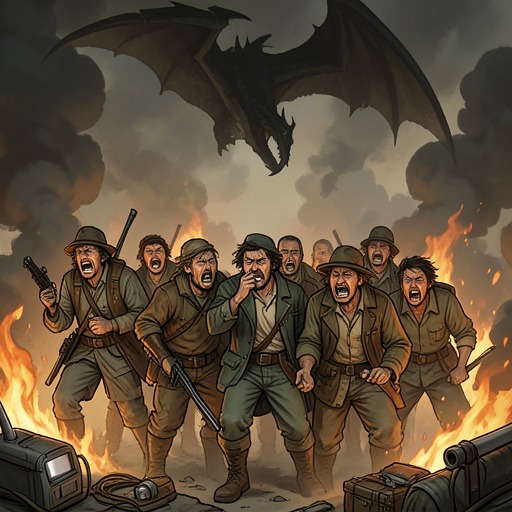
Unnamed Rock–Dragon
Rock Falls, Everyone DiesUnnamed Rock–Dragon is a relationship built on radically different understandings of possession. The Dragon believes it has acquired a pleasant new lair and placed an ordinary stone within its treasure hoard; the rock, meanwhile, uses the Dragon’s shelter, gold, body, and anger as successive conditions for its own advancement. Their association is never founded on mutual recognition, yet it repeatedly changes both participants’ circumstances. What appears to the Dragon as ownership and pest control becomes, from the rock’s perspective, an accidental cultivation system whose final result is the disappearance of the hoard and the rock’s escape into a much larger world.
Accidental Cohabitation
The relationship begins after centuries in which the rock remains largely still. A Dragon crawls into the cavern, inspects the mana-reinforced walls of the bottommost chamber, and decides that the space will serve as a new lair. The Dragon does not discover a person or rival there; it discovers a suitable stone and treats it gently enough to make the rock a roommate by circumstance rather than choice.
The Dragon then remakes the cavern according to its own standards. It breathes fire around the walls and ceiling, leaving eternally burning patches as a distinctive backdrop, before opening its Astral Pocket and releasing an avalanche of gold. Coins stamped by a hundred kingdoms cover the floor. With its tail, the Dragon lifts the rock and places it at the summit of the golden mountain, surveying the result as a small kingdom arranged to its satisfaction. The placement establishes the central asymmetry of the relation: the Dragon believes it is organizing property, while the rock has been installed at the center of an enormous source of power.
The Hoard as Cultivation Environment
The gold first becomes meaningful to the rock when coins lodge themselves in its exterior. The rock extends its new Qi vessels toward them, draws energy through its shifting stone flesh, and begins absorbing the metal toward an interior core. Three coins enter its body, but only a small portion remains there; the rest disappears, revealing that the process is not ordinary accumulation but a conversion whose rules the rock must learn.
The result appears through a numerical increase: Gold reaches 1 percent. That modest figure gives the rock a measurable objective and turns the Dragon’s hoard into a training ground. The rock rolls over the coins, heating the surfaces against which stones strike, while its Qi gathers lodged gold and directs it toward the growing core. The method is deliberate and optimized rather than passive. Eventually the display reaches Gold: 100 percent, and the rock completes a Golden Core breakthrough. The Dragon’s treasure has therefore crossed from private wealth into the rock’s body, changing value from something collected and guarded into something absorbed and transformed.
The Dragon’s Misrecognition and Weaponization
The breakthrough wakes the Dragon. It cannot sleep through the energies produced beside its head, yet when it looks toward the rock it sees only Just a Rock, an apparently ordinary object without cultivation. The Dragon’s failure to perceive the rock’s development is crucial: the rock’s greatest advantage is not concealment through magic but the Dragon’s assumption that stone cannot be an agent.
The Dragon’s interpretation changes when it notices theft. Its nostrils flare with fire, it roars about thieves, and its tail lashes out to seize the rock. The motive is practical as well as angry. The Dragon needs a weapon and remembers throwing stones at Adventurers who entered its lair to covet the hoard. The rock is thus converted from a decorative piece of the lair into an instrument of retaliation, but the Dragon still does not understand that the object in its grasp has already consumed part of the treasure.
The new arrangement gives the rock mobility and a route out of the cavern. Carried by the Dragon, it leaves the fixed enclosure that had enabled its cultivation. The Dragon believes it is taking a weapon to investigate and punish thieves; the rock experiences the same act as transport, opportunity, and the continuation of its quest. Their purposes overlap only materially. The Dragon supplies force and direction, while the rock supplies an unnoticed source of consequences.
Pursuit, Misplaced Blame, and the Thrown Stone
A few hundred years later, a grand battle erupts on a mountaintop, with spells and abilities tearing through the landscape as a Hero and Demon Lord Diablos fight over the fate of the world. The Dragon flies past the combatants, its interlaced green and red scales sending gales across the peak. The gust knocks the Hero down, allowing Demon Lord Diablos to drive a demonic weapon into the human’s chest. The Dragon is present at a world-changing conflict, but its immediate purpose is narrower: it is searching for the culprit behind the theft from its hoard.
After surveying the peaks, the Dragon concludes that neither the Hero nor Demon Lord Diablos could be responsible and begins descending in a methodical search from the top downward. It keeps the rock in its grasp as it folds its wings and turns its body into a missile of aerodynamic potential. The Dragon’s careful investigation accidentally places the rock in precisely the condition it wants. As the Dragon dives, the quest number begins dropping rapidly, and the rock abandons the tranquility it had gained from contemplating the heights of Mt Tartus. A started quest must be completed, and the Dragon’s movement becomes the mechanism that accelerates that completion.
The Dragon eventually finds an adventuring party inside a quarry: a Knight, a Cleric, a Mage, and a Thief. The Thief’s large money-marked bag makes the party look like obvious suspects, so the Dragon swoops down. What follows reveals the extreme difference between the Dragon’s expectations and the rock’s actual power. One ordinary throw annihilates the supposed foes. The Dragon can scarcely believe that Adventurers have become so weak, but when it returns to search the crushed bodies, it finds them empty of magical tools. The treasures are gone because the rock has continued rolling onward, leaving the Dragon with evidence of destruction but not an explanation of possession.
A Relation That Outgrows Its Original Scale
The rock’s association with the Dragon becomes part of a larger pattern in which each apparent object of control becomes a passage to another scale of existence. The Dragon’s cavern provides the gold that enables the rock’s core formation; the Dragon’s tail provides the means of transport; its anger provides the launch; and its search for stolen treasure keeps the rock moving. Yet the Dragon never consciously mentors, recognizes, or partners with the rock. The relationship is productive precisely because intention is divided: one participant acts according to ownership and suspicion, while the other turns every surrounding structure into an opportunity.
This dynamic also exposes the limits of the Dragon’s authority. It can shape a lair, possess a hoard, carry a weapon, and investigate a theft, but it cannot control what its property becomes. The rock’s absorption of gold converts the hoard without the Dragon’s awareness, and the Dragon’s attempt to recover what was stolen only sends the transformed object farther away. The apparent owner is therefore reduced to pursuing effects whose cause remains outside its model of the world.
The relationship’s significance reaches beyond the cavern. Later, the rock recognizes that everything is fundamentally rocks, differing only in scale and power; planets, sand, and the rock itself belong to one material continuum. That realization recasts the earlier Dragon encounter. The Dragon’s treasure and body were not merely fantasy ornaments or tools in an isolated adventure but parts of a network in which material forms become energy, weapons, environments, and agents. The Dragon–rock relation is the earliest sustained example of the rock turning another being’s possessions and assumptions into its own development.
At the far end of the story, after the rock has become capable of creating a planet and sculpting jade people, it waits for a young hero to continue a quest that it has successfully transferred forward. The old one wants to see what the successor will do and what reward will appear when the numbers reach their promised goal. This later act echoes the earlier Dragon relationship: the rock again works through another agent, placing itself on the scales only when necessary and allowing the apparent hero to believe in personal fate. The Dragon was the first major carrier and launcher in that pattern, an unwitting participant whose hoard, strength, and suspicion helped turn a stationary stone into a power capable of moving through worlds.