Double-Booked Lease and Accidental Cohabitation
Roommate Wars & Midnight Kisses (My College Romance)Double-Booked Lease and Accidental Cohabitation is the decisive inciting event of the story, transforming a routine move into an involuntary partnership between Leah Kim and Liam Reed. A landlord’s administrative mistake places both legally entitled tenants in the same small Ann Arbor apartment, making shared domestic life the only practical alternative to immediate displacement. The resulting collision establishes the book’s core structure: attraction and resistance develop under conditions of enforced proximity, where every boundary must be negotiated rather than assumed.
Arrival and Misrecognition
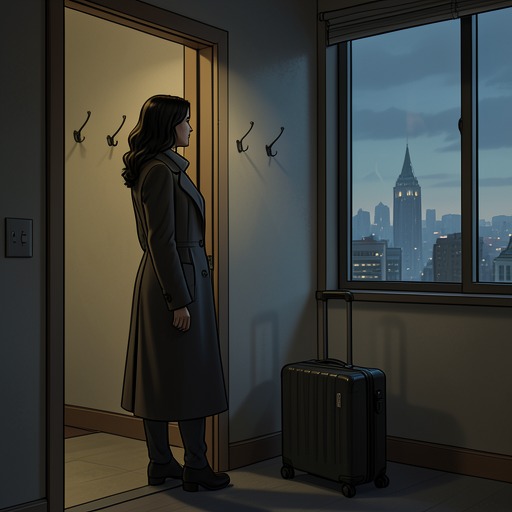
Leah Kim reaches the apartment already physically and emotionally strained. Her phone is nearly dead at three percent, and she is carrying a suitcase, a duffel, and a box of textbooks that feel heavier than she does. The building is not the attractive brick row house shown in the Facebook photographs but an old Ann Arbor two-story divided into apartments, with peeling paint around the porch railings and bicycles chained outside. Its smells of rain, stale beer, and laundry detergent establish a setting that is serviceable rather than welcoming, a material reality that immediately contradicts Leah’s expectations.
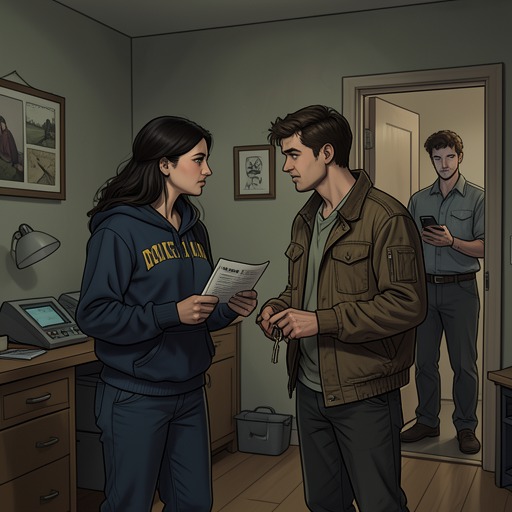
The mistake becomes visible at the door. Leah expects to enter her new home and instead finds a half-dressed man inside the apartment. Liam Reed stands beside the tiny kitchenette wearing only black athletic shorts, holding a frying pan in one hand and a phone in the other. His damp hair suggests that he has just showered, while tattoos extend from his shoulder down his arm. The encounter is defined by mutual shock: both occupants freeze because each has arrived under the assumption that the other has no legitimate claim to the space.
The apartment’s physical details intensify the misrecognition. Liam is not simply an unexpected stranger in a hallway; he is already using the kitchenette, cooking, and occupying the domestic center of the unit. Leah’s intended private home has become, before she can even settle in, someone else’s established living space. The frying pan, the phone, the kitchenette, and Liam’s presence make the lease error materially undeniable: the apartment is not an empty object waiting for Leah but an inhabited environment with competing claims.
The Landlord’s Error and the Impossible Choice
The landlord, Mark, confirms that the conflict is not a trespass but an administrative failure. He describes a “little admin mix-up” and admits that he may have double-booked the unit in the system after a last-minute opening. Liam immediately points out the obvious consequence: another person is present with all her belongings. The scene therefore shifts the dispute away from identifying who belongs and toward deciding who must surrender a legally valid claim.
Leah’s position is precarious. She has already paid the deposit, housing is full, and the university had directed her toward off-campus housing as her best option. She cannot afford to find another place, nor does she have enough time to search while classes are beginning. Her move has already required leaving her old school, old town, and former life, while her mother’s savings account is supporting an education Leah experiences with guilt. The lease is therefore tied to more than a room: giving it up would threaten the entire transition she has made.
Mark offers no genuine solution. He says that both leases are legal and presents only two choices: the tenants can share, or Mark can refund whichever person gives up the unit, leaving that person to find housing in September. His attempt to call the apartment “a big unit for one” and to note that it was technically once a one-bedroom does not alter its practical size. Liam flatly rejects the description, and the disagreement exposes the landlord’s effort to make an impossible arrangement sound manageable.
The value at stake changes from privacy to basic stability. Neither Leah nor Liam is choosing a roommate, and neither is being asked to make a temporary social compromise with an easy exit. Each is trapped by the combination of legal validity, scarce housing, paid money, and the timing of the academic year. The double booking converts the home into a contested threshold where every available choice carries a loss.
Accidental Cohabitation
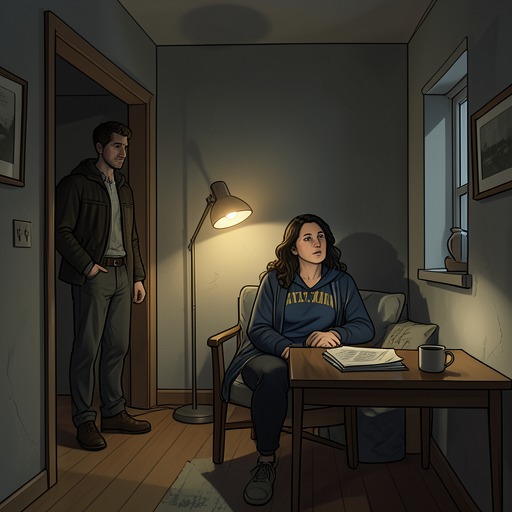
After the landlord’s options are exhausted, the immediate crisis resolves through reluctant acceptance rather than agreement or repair. Liam lowers his phone, looks at Leah with dark brown eyes, and concludes that they are roommates. Leah accepts because every alternative is worse. Their exchange is brief, but it changes the story’s relational status: two strangers become cohabitants without having established trust, rules, or even a shared understanding of what the arrangement will require.
The apartment feels smaller once the decision is made. Leah registers burnt cheese, cheap coffee, and the faint antiseptic edge of Liam’s EMT gear, sensory details that define him before either character knows him. The kitchenette and the studio’s limited space now carry the pressure of two lives. A door slamming somewhere below echoes upward like a warning, turning the building itself into an acoustic reminder that the agreement is not freedom but confinement.
The event’s immediate consequence is mutual entrapment. Leah and Liam are not merely sharing rent; they are forced to share the rhythms of cooking, sleeping, studying, entering, leaving, and encountering one another at close range. The phrase “stuck with each other” captures the arrangement’s lack of consent at the level of circumstance, even though both must make active choices about how to behave within it. The accidental home becomes the mechanism through which later emotional developments can occur.
Narrative Function and Significance
As the opening disruption, Double-Booked Lease and Accidental Cohabitation performs the romance’s meet and resistance beats simultaneously. Leah and Liam meet in a scene charged with embarrassment, territorial confusion, and immediate physical awareness, but the practical situation gives them no graceful period of courtship. Instead, attraction and irritation are placed inside a legal and domestic problem that demands cooperation before either character wants emotional closeness.
The event also establishes a sustained contrast between expectation and result. Leah expects the apartment pictured in the listing and finds a worn Ann Arbor building; she expects an empty residence and finds Liam; both tenants expect exclusive possession and receive shared occupancy. Each reversal is grounded in a concrete object or condition—the misleading Facebook photographs, the nearly dead phone, the luggage and textbooks, the kitchenette, the frying pan, the competing leases—so the romance begins not with an abstract coincidence but with a chain of material failures.
Its significance extends beyond the landlord’s error because it makes space itself an active source of pressure. The studio’s walls, thin enough for domestic life to remain constantly perceptible, will force privacy and exposure into the same environment. The apartment is legally divided into a home for each tenant but physically organized as one shared room, a contradiction that mirrors the relationship’s later tension between independence and intimacy. The event’s lasting consequence is therefore not simply that Leah and Liam become roommates; it is that their emotional lives are made answerable to the same cramped, accidental household.