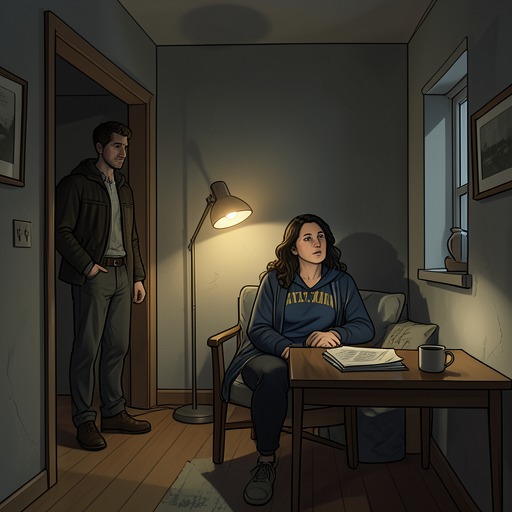
Establishing Roommate Life Rules
Roommate Wars & Midnight Kisses (My College Romance)“Roommate ground rules” is the negotiation in which Leah Kim and Liam Reed give their accidental cohabitation its first workable structure. Sitting across from each other at the small table in Apartment 3B, they convert immediate tension into written obligations: no hookups in the room, no touching Liam’s gear, shared chores, quiet before major exams, and a weekly rotation between the bed and the couch. The scene matters because it does more than organize domestic life; it makes two unwilling roommates acknowledge one another’s needs and creates a framework that later intimacy can challenge and revise.
A Negotiation Under Pressure
The rules are drafted after Leah has unpacked her suitcase, placed her clothes in the smaller dresser, and left her posters stacked in a corner awaiting Command Strips. The physical details show that she has begun occupying Apartment 3B even though the arrangement still feels provisional. The pair have circled each other long enough for the atmosphere to feel electrically tense, and the little table becomes a negotiation site where neither can simply retreat into private space.
Liam initiates the process by tapping a pen against a yellow legal pad and declaring that they need rules. His insistence that they cannot proceed blindly frames the conversation as self-protection rather than friendliness. Leah answers with skepticism, but she remains at the table and participates. The exchange therefore begins in resistance while already containing the possibility of cooperation: both understand that shared space will magnify every unspoken assumption.
Boundaries of Intimacy and Property
Liam’s first rule prohibits hookups in the room by either roommate. The rule is symmetrical, preventing either person from turning the shared studio into a private extension of a dating life. Leah agrees quickly and indicates that she is not planning to bring anyone home, adding that a previous man’s presence in her space rearranged her entire life. The remark gives the apparently practical rule an emotional undertow: privacy and sexual access are not neutral subjects for her, and the boundary protects more than household convenience.
His second rule is that Leah must not touch his gear. The specificity of the restriction suggests that his equipment is central to his private territory, even within a home they must share. The two rules together establish a division between communal residence and individual identity. They can negotiate the apartment, but neither is entitled to enter the other’s intimate or material sphere without permission.
Labor, Scholarship, and Quiet
Leah takes the initiative with her first rule: a chore chart. She rejects the prospect of living in a biohazard and names the work that must be divided—kitchen, bathroom, trash, and floors. Her demand is not an abstract appeal to fairness; it is a written system that can be adjusted when one roommate is too busy. Liam initially treats the phrase as excessive, but he rewrites it as “Division of labor,” giving the demand a more formal name without removing its practical force.
The chore chart also reveals Leah’s preference for visible accountability. A verbal promise might disappear amid the disorder of shared life, whereas a list can be consulted when resentment begins to accumulate. In this sense, the chart is both household tool and conflict-prevention device: it turns invisible labor into an assignable responsibility.
Leah’s second rule requires quiet hours before major exams. She forbids blasting music, loud video games, and large gatherings to watch a game, because she must keep her GPA above 3.7 to retain her scholarship. If she loses the scholarship, she will have to go home. The rule therefore carries a much higher stake than ordinary roommate etiquette. Quiet is tied to her education, financial security, and ability to remain in her present life. Liam’s request that she define “quiet” exposes how easily a seemingly shared value can become a dispute over interpretation, so Leah answers with concrete examples rather than leaving the term vague.
The Bed-and-Couch Compromise
The most immediate unresolved dispute concerns sleeping arrangements. They argue over who is the guest, whether the younger roommate should take the couch, Leah’s back problems, and Liam’s night shifts. Each claim is grounded in a different form of legitimacy: occupancy, age, physical condition, and work schedule. Because the apartment contains only a bed and a couch, the disagreement cannot be solved by giving both people equal access at the same time.
Liam finally proposes alternating the bed and couch weekly, switching every Sunday. Leah accepts the arrangement as fair, though grudgingly, and insists that it belongs on the written list. Liam records it as “Alternate bed/couch weekly,” extending the principle of division into the most intimate and physically consequential part of their shared routine. The compromise does not eliminate inconvenience; it distributes it predictably. That distinction is crucial. Their agreement is not based on discovering that the situation is comfortable, but on making its discomfort reciprocal.
The First Domestic Contract
When Leah scans the completed page, it looks official enough to frame, yet her final qualification is that they are good “for now.” The written rules create order without creating trust. They are a provisional contract between strangers whose lives have been forced together, and the qualification preserves the possibility that circumstances will change.
The scene’s larger significance lies in the way its practical language anticipates the relationship’s later emotional complications. The pair begin by regulating access, noise, possessions, labor, and sleep; in other words, they establish consent and boundaries before they can safely reconsider them. The legal pad becomes an early record of mutual recognition. Liam learns that Leah’s scholarship and physical needs impose real limits, while Leah accepts that his work schedule and equipment deserve protection. What begins as defensive housekeeping becomes their first collaborative act, shifting the shared apartment from a site of unavoidable friction toward a home governed, however precariously, by negotiated responsibility.