First Kiss During the Storm Blackout
Roommate Wars & Midnight Kisses (My College Romance)First Kiss During the Storm Blackout is the decisive intimacy scene between Leah Kim and Liam Reed. A storm removes the ordinary infrastructure of their shared apartment, while Leah’s memories of family conflict and an emotionally coercive ex expose why closeness has felt dangerous to her. In that stripped-down darkness, Liam’s patience and Leah’s deliberate refusal to retreat carry them across the boundary their rules were designed to protect.
Causes and Conditions
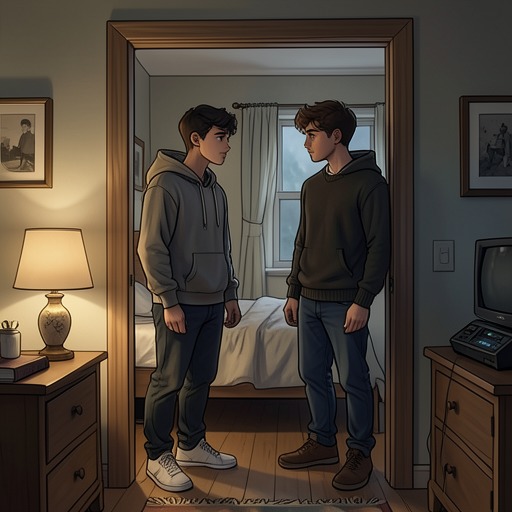
The encounter begins when the storm finally cuts the power, plunging the apartment into total darkness and silencing its familiar appliances. The blackout is not merely a change in lighting: it removes routine, privacy within the small shared space, and the practical distractions that have helped Leah and Liam keep their attraction manageable. Liam refuses to let the isolation become a spiral. He proposes using his fully charged laptop, downloaded films, headphones, a blanket, and food to wait out the outage, turning an emergency into a controlled movie night rather than leaving Leah alone with the thunder.
Liam climbs onto the sleeping platform with the laptop, and Leah follows with the large gray blanket. The platform leaves barely enough room for them side by side, making physical proximity unavoidable while still presenting it as an ordinary practical arrangement. His invitation is light and deliberately nonthreatening, but the cramped space gives the scene its pressure: their established distance can no longer be maintained without an active choice.
Fear, Disclosure, and Care
Thunder makes Leah jump, and Liam begins to reach toward her before stopping to ask whether she is all right. Her answer identifies the storm as a trigger rather than a simple dislike of loud weather. She explains that her parents used to fight when she was younger and that her ex repeatedly chose storms, shouting, and power outages for major conversations. Those elements have blurred together for her, so the blackout reproduces an atmosphere in which intimacy and danger have previously been entangled.
Liam does not diagnose or minimize her response. Instead, he apologizes for what she endured and says that he hates the way her former partner trained her to shrink. Leah answers that she is trying to un-train herself, and Liam affirms that she is doing a good job, adding recognition at a moment when she has not been assured of it. His response changes the emotional meaning of the confined room. The storm still resembles the past, but Liam’s conduct offers a contrasting pattern: attention without pressure, concern without control, and closeness that does not demand her submission.
The Kiss and Its Immediate Conflict
The first decisive movement comes from Leah. When Liam seems ready to move the laptop, withdraw the blanket, and return to the supposedly safer distance of the couch, she reaches out without letting her fear or caution stop her. Her fingers catch in the front of his T-shirt, a small physical action that carries disproportionate emotional weight because it is her choice to prevent retreat. Liam goes still and says her name; the pause allows the gesture to register as an invitation rather than an accident.
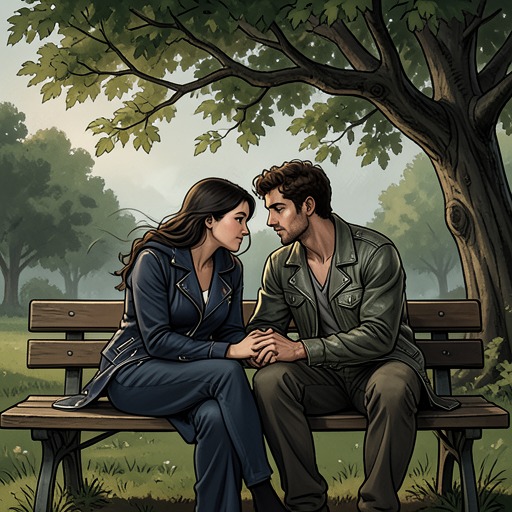
He then leans in. The kiss is awkward, hot, and unfinished in the way of an encounter formed from everything they have not said. Liam cups Leah’s jaw and brushes her cheekbone while adjusting to her, and she responds by parting her lips. The storm continues against the windows, but the immediate force of the scene shifts from external threat to reciprocal action. Their breathing, the blanket, and Liam’s hand on Leah’s hip keep the moment bodily specific, while neither of them moves away.
The scene repeats its central contradiction in the whispered admission that the kiss is a terrible idea. Both recognize the danger: they live together, have constructed rules to contain their attraction, and cannot easily separate desire from the consequences of crossing those rules. Yet the warning does not cancel consent or mutuality. Leah answers that she knows, then remains where she is and keeps hold of his shirt. The repetition of the exchange makes the kiss neither a careless misunderstanding nor a fully resolved commitment; it is a conscious step into a conflict both understand.
Turning Point and Significance
The blackout kiss converts latent attraction into an explicit shared fact. Before it, Leah and Liam can treat their charged silences, protective impulses, and careful distance as problems still contained by roommate boundaries. After it, their bodies and choices have contradicted that containment. The scene therefore functions as a value reversal: the apartment’s darkness initially threatens to revive Leah’s association between storms and emotional harm, but the same darkness becomes the setting for trust, agency, and mutual desire.
Its strongest reversal is Leah’s movement from automatic retreat to active pursuit. Her history has taught her to make herself smaller when intimacy becomes volatile, while the storm appears to confirm that old lesson. Instead, she names the history, accepts Liam’s witnessing, reaches for him, and does not let go after the kiss. Liam’s role is equally important but differently shaped: he creates room for her choice, recognizes the damage done by her former relationship, and still responds when she closes the distance. The encounter does not erase the past or settle the practical problem of sharing a home after intimacy. It establishes something more disruptive and more durable: the rules are no longer sufficient to describe what exists between Leah Kim and Liam Reed.