Leah Caring for Liam After His Night Shift
Roommate Wars & Midnight Kisses (My College Romance)Leah Caring for Liam After His Night Shift marks a decisive change in the relationship between Leah Kim and Liam Reed. Returning to their cramped shared apartment at 5:41 a.m. after an exhausting emergency shift, Liam brings the physical trace of a fatal call into the room. Leah cannot undo the death or solve his distress, but she responds with practical, unplanned care: she washes the dried blood from his arm, finds him clean clothes, and stays present when he finally explains that one driver survived and the other did not.
The Return at Dawn
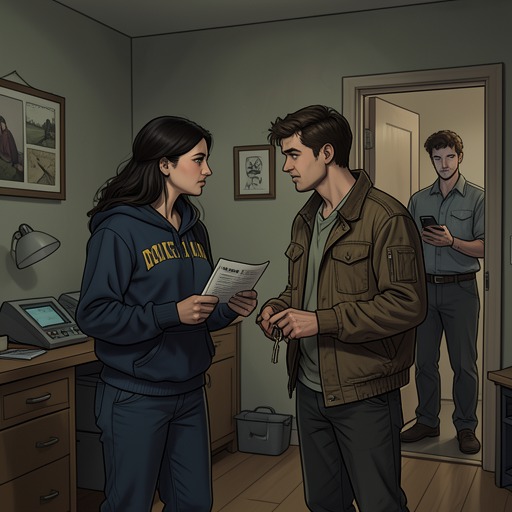
The action begins after a night of thin, uneasy sleep. When the door opens, Leah experiences the delay as both ten seconds and ten hours, a perception that captures how alert she has become to Liam’s movements despite the rules and emotional distance surrounding their accidental cohabitation. The hallway light briefly cuts across the floor before the apartment returns to dim gray, making Liam’s arrival feel like an intrusion into darkness and also like a summons to attention.
Liam drops his bag too hard, and the EMT patch on his clothing catches the early light. His exhaustion is not abstract: his face is gray beneath the eyes, and the crease between his eyebrows suggests that the night has not ended psychologically merely because he has reached home. The patch and the fatigue establish the emergency work he has just left behind, while the blood on his arm gives Leah a concrete sign of what the work has demanded from him.
Care as Immediate Action
Leah’s first response is bodily rather than analytical. Her chest tightens, and she gets off the bed before fully deciding to do so. When she asks whether he needs anything, Liam answers with exhausted sarcasm, naming sleep, a new spine, and a procedure that might stop him from replaying the same call. His reply exposes both the intensity of the shift and the repetitive mental return through which the call continues to occupy him.
Instead of accepting his suggestion that he simply shower, Leah insists on helping. She jokes that if he passes out in the shower, she will not deal with the lawsuit, but the humor protects a serious refusal to leave him alone with his condition. She takes a clean dish towel, wets it in the sink, wrings it out, and reaches for his arm. Liam startles at first, then becomes still and lets her take his wrist. The gesture changes their physical relation: the guarded roommate permits contact, and Leah’s concern becomes something enacted through touch rather than declared through confession.
The cleaning itself is deliberately limited. Leah cannot do anything about what happened, but she can remove the blood from his skin. She concentrates on the slow brownish streaks coming away under the towel instead of on the meaning behind them. This distinction gives the scene its ethical force. Care does not pretend to repair the fatal call; it attends to the injury and residue that can be addressed in the immediate present.
The Shirt and the Shared Space
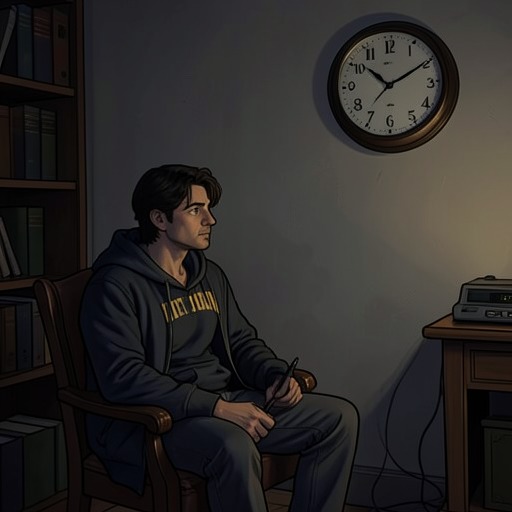
After finishing, Leah throws the towel into the sink and searches the laundry basket for clean clothes. She pulls out Liam’s soft, worn gray T-shirt, marked by a cracked university logo, and pushes it toward him so he will not keep wearing the clothes from the shift. The shirt is an ordinary household object, but its use makes the apartment newly intimate: Leah knows where his clothes are, handles one without ceremony, and converts the shared domestic mess into a source of relief.
Liam accepts the shirt and brushes her knuckles as he takes it. His thanks is brief, yet the contact extends the care beyond its practical purpose. The scene does not resolve the larger trauma or establish complete emotional openness; it creates a small, tangible permission for dependence. Within the apartment’s limited space, the sink, towel, laundry basket, and worn shirt become the means through which a relationship previously organized by boundaries begins to acquire mutual obligation.
Naming the Fatal Call
The scene deepens when Leah asks what happened and Liam hesitates, catching his fingers in the hem of his shirt as though considering whether to deflect the question. He eventually says that it was a two-car wreck: one driver walked away, while the other did not. The disclosure gives the blood and exhaustion a precise origin and confirms that his distress is tied to a death rather than merely to a difficult shift.
Leah answers with an apology for the loss. Liam’s response is equally compressed, agreeing that he is sorry. Neither character produces a complete account of the call, and the silence around its details remains part of the event’s meaning. What is shared is enough to establish the burden he carried home: Liam, only twenty-two, is holding the weight of another person’s worst night while still appearing to himself as a young man who has to remove his boots, change his shirt, and survive the morning.
Leah then tells him that he did what he could. The reassurance is not presented as a proven medical assessment; it is offered because it is the only truth she can find that might meet his guilt and helplessness. Liam says she sounds like his supervisor, and Leah replies that the supervisor is clearly very smart. Their exchange briefly restores sarcasm and humor, but the humor now follows recognition rather than replacing it. It lets Liam remain himself without denying what has happened.
Narrative and Relational Significance
Leah Caring for Liam After His Night Shift is a threshold action in the developing romance. It is not a grand declaration or a planned confession. Its importance comes from the mismatch between Leah’s stated distance and her immediate behavior: she notices Liam’s condition, crosses the apartment, touches his wrist, cleans him, finds his shirt, and listens to the fatal call. The movement from observation to action is the scene’s central reversal.
The event also establishes a pattern in which trauma first appears as physical residue and only afterward becomes language. The dried blood can be removed, while the replayed call cannot. Leah’s care therefore operates on two levels at once: it offers a modest practical remedy and creates the conditions for Liam to speak. By the end, the apartment is no longer merely the site of an accidental shared lease. It has become the first place where Liam can return from emergency work carrying its consequences and where Leah can answer not with a rule, but with attention.