Study-Session Trauma Disclosure
Roommate Wars & Midnight Kisses (My College Romance)Study-Session Trauma Disclosure is the decisive emotional turn in the library study-session blow-up between Leah Kim and Liam Reed. In an overcrowded third-floor library defined by dust, printer toner, stress, blue laptop light, and the struggle for every table and outlet, an argument about Liam’s self-trust and emergency work exposes the wound beneath his sense of duty. Liam reveals that his commitment to emergency medical response began when his father suffered a heart attack during Liam’s sixteenth year. The confession changes Leah’s judgment of him, gives a personal origin to his professional purpose, and establishes a new form of mutual recognition between them.
Setting and Immediate Conflict
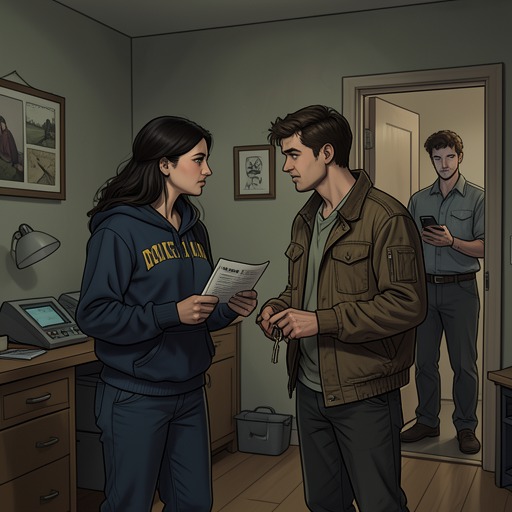
The disclosure begins amid the pressure of a practical study session rather than in a deliberately intimate setting. The third floor of the library is full, noisy enough to make concentration difficult, and tense with academic exhaustion. When a girl at the next table shushes Leah and Liam, they apologize and lower their voices, but the social restraint only compresses the conflict rather than resolving it.
Liam urges Leah to trust that she knows what she is doing instead of continually doubting herself. Leah answers by attacking the logic of his own behavior, suggesting that he does not need to throw himself into burning buildings to matter. Her remark is not merely about risk; it interprets his emergency work as a performance of importance. Liam immediately asks whether she believes he seeks danger in order to feel important. The question exposes the gap between Leah’s defensive reading of him and the private history she does not yet know.
Liam’s Recalled Crisis
Liam responds without escalating the insult. He tells Leah that his father had a heart attack when Liam was sixteen. His father collapsed in the basement, and Liam found him on the floor. Liam called 911 and attempted to follow the operator’s instructions, but his hands shook so badly that he repeatedly mishandled the compressions. The memory is presented through a concrete sequence of helpless actions: hearing the fall, discovering the body, making the emergency call, and failing to feel competent while time passed.
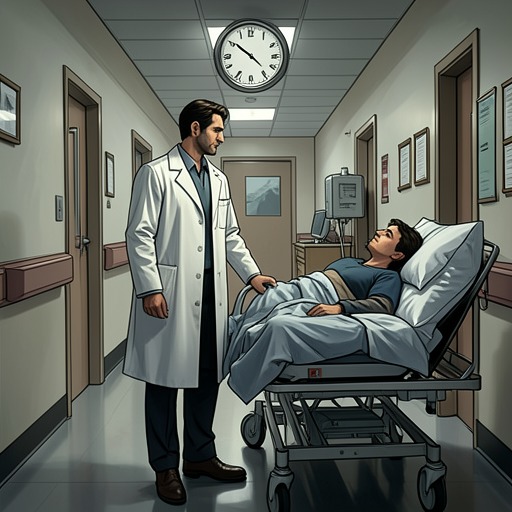
The arriving EMTs become the contrast that organizes Liam’s memory. They were calm and efficient, knew exactly what to do, took over the crisis, and got his father to the hospital. His father survived, underwent bypass surgery and rehabilitation, and is now okay. Yet the successful outcome does not erase Liam’s recollection of the three minutes before professional help arrived. He continues to replay that interval, imagining that better knowledge might have prevented him from losing control so completely. The event therefore joins survival to guilt rather than allowing survival to end the trauma.
Vocation as Overcorrection
Liam interprets his emergency work as an overcorrection born from that scene. He may have signed up to become the person he wished had entered the door earlier, transforming a memory of helplessness into a promise of preparedness. His objective is not abstract heroism. He wants the next young person who calls 911 to have someone who knows what to do, so that the caller will not have to watch an entire world fall apart without competent help present.
This explanation revises the meaning of Liam’s danger. Leah had treated the danger as evidence of a need to feel important; Liam defines it as the unbearable alternative to acting. His commitment is shaped by identification with the frightened child who once had to respond alone. The emergency worker he tries to become is simultaneously a professional ideal and a corrective figure for his own past.
Recognition and Relationship Shift
The confession produces a sharp value shift in the scene. Leah’s earlier jab, which had seemed like a defensive attempt to control the argument, suddenly appears small and cruel beside the history Liam has disclosed. Her physical reaction registers the change before she can fully articulate it: the heat of embarrassment gives way to a tight throat and an immediate apology. She says she did not know, acknowledging that her interpretation had been formed under conditions of incomplete knowledge.
Liam’s explanation also resists turning him into a simple victim. He remains dryly self-aware, noting that he does not introduce himself by asking people to inquire about his trauma. The line preserves his humor while making clear that the trauma is not a public identity he offers freely. His disclosure is therefore an act of controlled vulnerability: he lets Leah see the origin of his behavior without surrendering all distance or composure.
Mutual Reading and Narrative Significance
After Leah apologizes, Liam applies the same interpretive pressure to her. He calls her defensive and compares that defensiveness to her academic annotations. When she jokes that he is dragging her academically and emotionally, he softens and explains that he understands the impulse to control everything possible because so much of her life has felt outside her control. His response creates a reciprocal structure: Leah has misread Liam’s risk-taking, while Liam identifies the protective logic behind Leah’s need for control.
The study session thus becomes more than a disagreement about studying or emergency work. It is the first sustained exchange in which both characters move beyond observable habits toward the histories that produced them. Liam’s trauma disclosure turns a potentially damaging accusation into an encounter with testimony and recognition. It also establishes a pattern central to their relationship: intimacy arrives not through effortless confession, but through conflict that forces each person to revise the story being told about the other.
The event’s significance lies in the difference Liam insists upon between seeking importance and finding it unbearable not to help. That distinction becomes the ethical center of the scene. His father’s survival does not cancel the fear of those first three minutes; instead, the memory becomes the source of a durable promise. By allowing Leah to witness that promise, Liam changes both her understanding of his vocation and the emotional terms on which they can continue to know one another.