3B Lease and Sublease Agreement
Roommate Wars & Midnight Kisses (My College Romance)The 3B lease and sublease contract is the central material proof in the opening housing dispute between Leah Kim and Liam Reed. What should have been a transparent instrument guaranteeing a place to live instead becomes visibly contradictory: Leah Kim arrives with a valid sublease, while Liam Reed possesses a separate lease for the same Apartment 3B. Its decisive significance is therefore practical rather than merely symbolic. The documents do not settle possession; they demonstrate that both occupants have been given a legitimate claim and make accidental cohabitation the only immediate solution.
Appearance and Intended Function
The contract first appears through the move-in instructions Leah Kim receives: a studio near campus, utilities included, a September 1 move-in date, and a lockbox code of 0920. The key waiting inside the lockbox is a dull brass square marked with blue tape labeled “3B,” giving the paperwork a physical extension. The key is supposed to convert an administrative promise into a secure home, but the moment Leah Kim uses it, the object’s ordinary reliability collapses. Instead of opening an uncontested residence, it opens onto another tenant’s already established life.
The paperwork has been treated as sufficiently concrete to justify Leah Kim’s relocation. She has paid a deposit, arranged her move, and brought all her belongings after leaving her old school and town. Her claim is not a casual misunderstanding or an unverified online inquiry: she identifies herself as subletting 3B for the year and says she has a lease, receipts, and the financial and emotional cost of trying to find the place. The contract thus carries the weight of her limited housing options and her family’s strained resources, not just the narrow language of a rental agreement.
The Double Claim
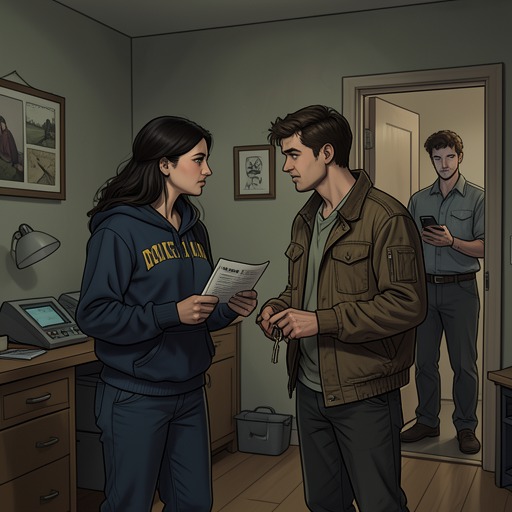
When Leah Kim enters Apartment 3B, Liam Reed immediately identifies it as his apartment and says that he has held 3B since the previous September. The collision between the two agreements becomes concrete when Leah Kim opens the email from the landlord and shows Liam Reed the signed sublease, move-in date, key code, and her name. The screen supplies a formal record of her right to be there, but it does not displace Liam Reed’s position.
Liam Reed answers with a physical document of his own. He swipes through Leah Kim’s pages, narrows his eyes, then takes a pile of papers from the table and finds a lease bearing his name at the top. Holding it up as proof that he is not imagining the situation, he makes the contradiction visible: each tenant can point to an apparently authoritative document, and neither document can be dismissed as a hallucination or a trespasser’s excuse. The contracts function as rival witnesses whose testimony is equally credible.
Administrative Failure and Forced Choice
The landlord, Mark, eventually names the cause of the contradiction as a “little admin mix-up,” acknowledging that he may have double-booked the unit in the system after a last-minute opening. The wording minimizes the error, but its consequences are immediate and severe. Both leases are described as legal, while the apartment remains a single, cramped studio rather than the generous one-bedroom Mark suggests it once was.
Because Mark cannot produce another studio, he offers only two choices: share the apartment or accept a refund and attempt to find housing elsewhere in September. The contract therefore changes from a guarantee of private shelter into the mechanism that limits everyone’s options. Leah Kim cannot afford another place, has already paid the deposit, and faces full housing and the beginning of classes. Returning to her old life is not a realistic alternative, so the legal equality of the two agreements produces an unequal pressure toward staying.
Material Object and Narrative Consequences
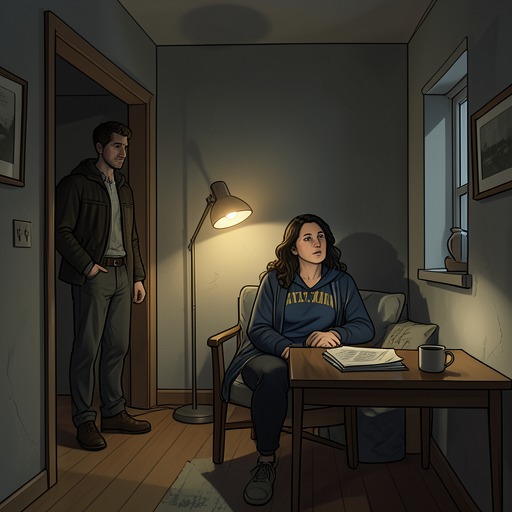
The 3B lease and sublease contract makes the apartment’s boundaries unstable. The key, code, email, receipts, signed pages, and paper lease each promise certainty, yet together they create evidence of competing realities. Their failure is not that they are absent; it is that they work too well as separate records and cannot reconcile the shared space they authorize. The object becomes conspicuous precisely when it stops functioning transparently as an ordinary housing tool.
That failure launches the relationship between Leah Kim and Liam Reed. The documents force an adversarial first exchange, require both strangers to display private proof, and turn a presumed home into a negotiated living arrangement. They also give the conflict a basis beyond personality: Liam Reed’s irritation and Leah Kim’s panic are intensified by a structural mistake that neither caused. In narrative terms, the contracts convert property into proximity. By proving that both occupants belong, they make their unwanted cohabitation legally difficult to reject and establish the material premise for the story’s later emotional development.