Division of Labor Chart
Roommate Wars & Midnight Kisses (My College Romance)The Division of Labor Chart is the first durable institution Leah Kim and Liam Reed create inside their cramped shared studio. Written on a yellow legal pad after their accidental cohabitation forces them to confront incompatible habits and limited space, it turns friction into terms that can be discussed, revised, and enforced. Although it begins as a defensive household document, the chart gradually acquires emotional significance: it makes care visible, gives each roommate a claim to fairness, and becomes a private language through which hostility can soften into trust.
Creation and Physical Form
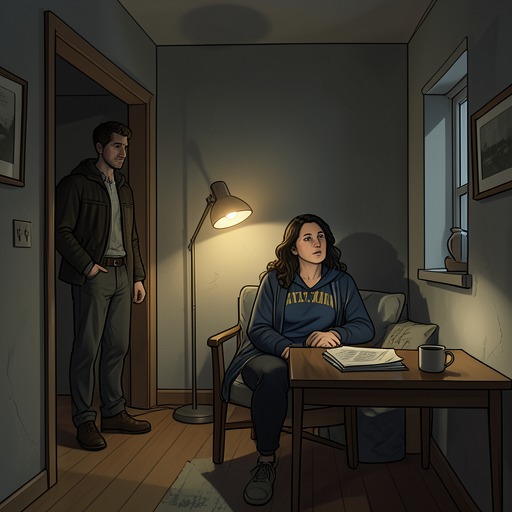
The chart emerges when Leah Kim and Liam Reed sit across from each other at the apartment’s small table as though negotiating a peace treaty. Liam Reed taps a pen against a yellow legal pad and announces that they need rules, establishing the document’s deliberately formal tone. The legal pad is an ordinary, provisional object, but the act of writing on it gives their unstable arrangement a structure neither person can rely on instinctively.
Leah Kim writes the first household provision in neat block letters: “1) Chore chart.” She refuses to treat domestic labor as an informal favor or an assumption that can be left to whoever notices the mess first. Her proposed division explicitly includes the kitchen, bathroom, trash, and floors. If either roommate becomes too busy, the schedule can be adjusted, but the labor must remain written down. Liam Reed objects to the phrase “chore chart” as though it sounds childish or bureaucratic, then replaces it with his messier wording, “Division of labor.” The revised title preserves Leah Kim’s demand while giving the document a more formal, shared vocabulary.
Rules and Negotiated Fairness
The chart’s first function is to distribute responsibility. Leah Kim’s insistence that the work be listed protects her from becoming the default caretaker of the studio, while Liam Reed’s willingness to record the arrangement turns reluctant agreement into an accountable commitment. The chart therefore does more than organize cleaning. It establishes that both occupants are responsible for the conditions they share, and that busyness is a reason to renegotiate rather than an excuse to disappear from the work.
The second major rule concerns quiet hours before important exams. Leah Kim explains that she must keep her grade-point average above 3.7 to retain her scholarship; losing it would mean going home. This disclosure places the material stakes of the rule beside the coffee ring on the table. Quiet is defined concretely: no blasting music, loud video games, or large gatherings to watch a game. Liam Reed responds by agreeing to plan his shifts and studying around the dates of her major exams. His immediate accommodation surprises Leah Kim because it offers more than technical compliance. It recognizes that her academic survival is part of the household’s shared reality.
A further provision requires each roommate to announce an impending entrance into the bathroom, translating privacy into a simple, repeatable signal. The chart also records the most contentious practical issue: who gets the bed and who uses the fold-out couch. Their argument invokes age, back problems, and Liam Reed’s night shifts, with neither person willing to surrender the better sleeping place permanently. The compromise is a weekly rotation, with the bed and couch changing every Sunday. That solution matters because it rejects both unilateral entitlement and indefinite sacrifice; fairness becomes something periodic and visible rather than a one-time concession.
Use in Domestic Conflict
Once the negotiation ends, Leah Kim pins the sheet to the cork strip by the door with a pushpin from her pencil case. The gesture places the agreement at the threshold of the studio, where it can remain in view as both reminder and warning. She looks around the cramped room, which has become “somehow both” of theirs, and understands that the chart is part of the process by which an unwanted arrangement becomes a shared home. Her hope that they can manage the space without killing each other preserves the antagonism of their beginning, but the posted document gives that antagonism a nonviolent procedure.
The chart later reappears as a joking accusation during a moment of physical care. When Liam Reed returns with dried blood on his skin and drips onto their floor, Leah Kim cleans him while insisting that he is violating “chore chart subsection three.” The reference converts concern into mock enforcement. Rather than openly naming her worry, she uses the household document as a protective script, allowing tenderness to appear as a complaint about cleaning. Liam Reed’s response softens the exchange, and the rule that once represented distance now provides a shared joke through which intimacy can safely surface.
Symbolic and Narrative Significance
As an object, the Division of Labor Chart embodies the couple’s early attempt to make closeness manageable. Leah Kim initially guards herself against becoming emotionally vulnerable, even warning herself not to mistake basic respect for something more. The chart gives her a principled framework for accepting Liam Reed’s cooperation without having to call it affection. At the same time, Liam Reed’s additions and compromises demonstrate that his participation is not merely passive surrender; he helps reshape the rules into language both can inhabit.
The document’s significance lies in its contrast between rigid wording and flexible practice. It records fixed categories—chores, quiet hours, bathroom access, and weekly sleeping arrangements—yet each category exists because the roommates must accommodate unequal schedules, academic pressure, physical discomfort, and the realities of a shared studio. The chart thus treats domestic life as negotiated labor rather than as an effortless expression of compatibility. Its rules do not eliminate conflict. They create a repeatable way to survive conflict without allowing resentment to become the household’s permanent order.
The Division of Labor Chart also foreshadows the broader pattern of Leah Kim and Liam Reed’s relationship. Their closeness develops through explicit boundaries, revisions, and acts of mutual adjustment. What begins as a list designed to prevent the roommates from destroying one another becomes evidence that they can listen, compromise, and care without pretending their differences do not exist. Its posted page is therefore both a household tool and an early material record of their movement from accidental cohabitation toward deliberate partnership.