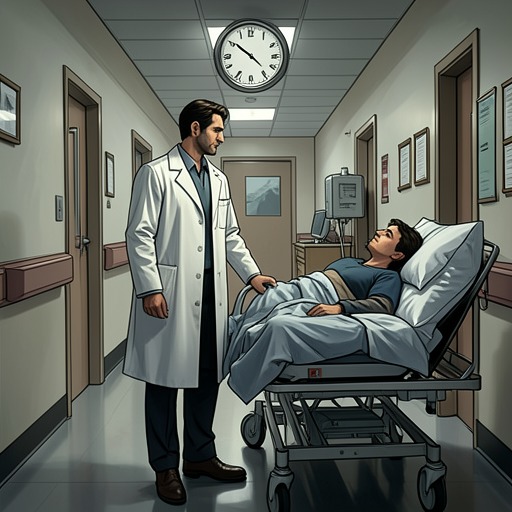
Liam Accepting an Extra EMT Shift During Game Weekend
Roommate Wars & Midnight Kisses (My College Romance)Liam Accepting an Extra EMT Shift During Game Weekend is a small domestic decision with unusually large emotional stakes. When Liam Reed’s supervisor asks him to cover an additional EMT shift on a busy game weekend, he must weigh financial necessity and professional responsibility against exhaustion, danger, and his relationship with Leah Kim. His eventual acceptance does not simply reaffirm his instinct to help strangers: it tests whether Leah Kim and Liam Reed can make a difficult choice without either person disappearing inside the other’s needs.
Causes and Background
The request arrives while Leah Kim is trying to study cognitive psychology at the table, repeatedly highlighting the same sentence, while Liam Reed sits on the couch with a frown fixed between his brows. His supervisor has texted that the service is short that night and wants him to pick up an extra shift. The timing makes the request threatening before any decision is made: the shift is not an abstract work obligation but a night expected to involve drunk people falling from porches and the intensified workload of a major game weekend.
The staffing shortage is substantial. Liam Reed explains that emergency calls surge during big game weekends, that the service attempts to staff up, and that half the on-call list has already refused. His acceptance therefore carries a collective dimension. He is not responding only to a supervisor’s preference; he is being asked to enter a gap created by a depleted roster, with the possibility that insufficient staffing could leave people without timely help.
At the same time, the decision is inseparable from the couple’s material circumstances. Liam Reed does not have to accept, but he needs the overtime. Rent, textbooks, and application fees sit beneath the couple’s more affectionate moments, making money an unglamorous but decisive pressure. The shift could help stabilize their shared life, while refusing it would protect his energy at the cost of income. The scene gives economic necessity the same narrative weight as romantic feeling rather than treating either as secondary.
The Decision and Its Emotional Negotiation
Leah Kim initially asks whether Liam Reed has to say yes, although she already knows that his sense of obligation makes the answer nearly predetermined. His attraction to emergency work is part of the difficulty: he visibly comes alive when discussing helping people. Leah Kim also recognizes that the overtime could cover roughly three of her lab fees, so the shift would benefit her directly as well as supporting their household.
Her strongest argument is not financial. She knows Liam Reed would spiral for a month if someone were hurt because too few people had been available. That imagined aftermath reveals the force governing his choice: responsibility is not merely a professional value for him but a psychological burden he carries beyond the end of a shift. Saying no might preserve his body for one night, yet it would leave him haunted by a harm he could imagine preventing.
The conversation becomes a conflict between two versions of Leah Kim. The old version would have answered that Liam Reed should do whatever he thought best and swallowed her discomfort. The newer version wants him to stay and choose her for once. Neither desire is adequate by itself. Unqualified self-denial would repeat Leah Kim’s earlier pattern of erasing her needs, while an unqualified demand that Liam Reed stay would deny the obligations that define him.
Leah Kim resolves the conflict by naming several wants at once: she wants Liam Reed alive, not burned out, and not financially overwhelmed, but she also wants him to do what he is plainly going to do because he would not forgive himself otherwise. This is the scene’s decisive value shift. The choice begins as a threat that could pit romantic security against public responsibility; it becomes a jointly acknowledged decision in which love means stating the danger without pretending that one desire cancels the others.
Acceptance and Immediate Consequences
Once Leah Kim makes clear that she will not punish him for going, Liam Reed’s shoulders drop with the relief of someone released from a chokehold. His response shows that he had been seeking more than permission. He needed to know whether accepting the shift would count as choosing work over the relationship, and Leah Kim’s answer removes that false opposition without removing the risk.
Liam Reed then texts his supervisor that he will take the shift. The action is simple and visible: the emotional debate ends in a message sent from the couch. Yet the acceptance is framed not as triumph but as an opening through which danger enters. Leah Kim feels as though she has opened a door and invited the night inside, an image that preserves her apprehension even after she has supported the decision.
The acceptance therefore produces no artificial certainty. Liam Reed receives the staffing need, the overtime, and the moral role he cannot easily refuse, but he also enters a night Leah Kim expects to be dangerous and exhausting. The scene holds both consequences in view: his choice may help strangers and relieve financial pressure, while it may also expose him to burnout and leave Leah Kim alone with worry.
Relationship Significance
The arrangement that follows is deliberately modest. Liam Reed promises to text Leah Kim when he can, warning that the shift will be busy but assuring her that he will check in. Leah Kim immediately tells him not to text while driving, placing safety above the reassurance she wants. His joking answer about having his partner send “bat signals” preserves their domestic playfulness without weakening the seriousness of the departure.
His kiss on the top of her head is equally important because it follows the decision rather than replacing the conversation. Physical affection does not settle the disagreement; it confirms connection after both people have spoken plainly. Leah Kim’s phrase “roommate-plus package” turns their shared living arrangement into a teasing language for intimacy, while Liam Reed’s promise to communicate turns that intimacy into a practical responsibility.
The event also demonstrates a changed pattern in their relationship. Leah Kim neither silently absorbs fear nor demands that Liam Reed abandon the work that matters to him. Liam Reed, in turn, does not treat her concern as an obstacle to be managed. He asks directly whether she will be angry, and he accepts the need to check in. Their compromise is not that the shift becomes safe; it is that the danger becomes discussable and the decision becomes mutual.
Narrative Significance
As an action, Liam Accepting an Extra EMT Shift During Game Weekend links the couple’s private life to the wider emergency system surrounding them. A supervisor’s text, an understaffed on-call list, the cost of lab fees, and the anticipated disorder of a game weekend all converge in one apartment conversation. The scene makes care material: it involves money, labor, exhaustion, staffing, transportation, and communication as much as tenderness.
The event also establishes Liam Reed’s defining contradiction. He is drawn toward helping people, but that vocation can turn into self-endangerment when every shortage feels like a personal summons. Leah Kim sees both sides at once. Her support is meaningful because it includes limits—alive, not burned out, not broke—rather than romanticizing his willingness to sacrifice himself.
Its deepest significance lies in the difference between choosing someone and asking them to abandon themselves. Leah Kim wants Liam Reed to choose her, yet she learns to ask for honesty and safety instead of demanding proof through refusal. Liam Reed accepts the shift, yet he remains accountable to the relationship through a promise to check in. The result is an intimate agreement shaped by risk: responsibility is not eliminated, love is not made magically secure, and neither partner has to pretend that the cost of the decision is imaginary.