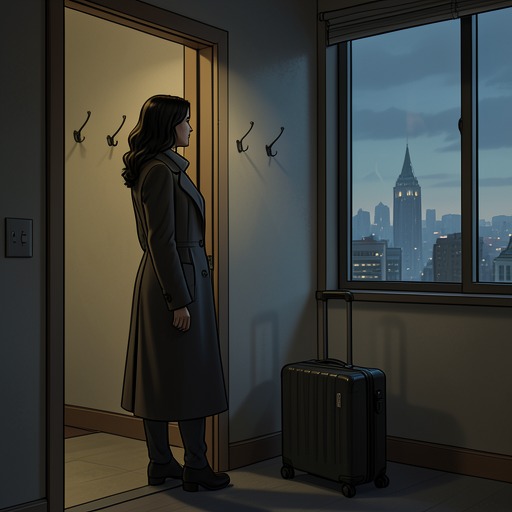
Liam's Traumatic Fatal Emergency Shift
Roommate Wars & Midnight Kisses (My College Romance)Liam's Traumatic Fatal Emergency Shift is the decisive crisis in which repeated death overwhelms Liam Reed's ability to remain emotionally available to Leah Kim. The shift transforms his emergency work from a demanding profession into an immediate psychological barrier: after confronting several victims and failing to save a child, Liam returns unable to accept comfort, fearing that closeness will make Leah part of the traumatic imagery he carries into every call.
Causes and Accumulated Trauma
The shift is defined not by one isolated emergency but by relentless succession. Liam recounts the child whose heart stopped in the back of the rig, then the father on the sidewalk who kept saying that he should have made his son stay home. The account moves from the victim's medical crisis to the surviving parent's guilt, showing how Liam is forced to absorb both physical death and the emotional aftermath carried by those left behind.
The failure of the resuscitation intensifies the burden. Liam describes thirty minutes of compressions that achieved nothing, a concrete measure of effort whose duration only sharpens the fact of failure. Before he can recover at the bay, he is dispatched again because another driver has gone onto the wrong side of the road. The shift therefore denies him any interval in which the first call can be processed; repetition becomes part of the injury, with one emergency immediately replacing another.
What Happens Between Liam and Leah
When Leah asks him to explain what has happened, Liam answers by placing the conversation before the chain of emergencies. His harsh exhalation and account of the calls make the experience bodily before it becomes fully reflective, while Leah steps closer and reaches for his hand. Liam flinches away. That recoil is the scene's immediate physical boundary: Leah offers contact, but Liam experiences contact as something he cannot safely receive.
Liam then explains that he cannot be emotionally present in the ordinary sense. He says he has no capacity to be soft or open and is running on fumes, while Leah clarifies that she is not asking him to perform a role; she only wants to sit beside him while he breathes. Her offer reduces intimacy to presence rather than emotional labor, but Liam still backs away. The conflict is not over whether Leah cares. It is over whether Liam can allow care to reach him without opening the entire uncontained sequence of calls.
Fear of Contamination and Withdrawal
Liam refuses to talk because he believes speaking will make the memories continue without restraint, prevent him from sleeping, and leave him facing another shift the next day. His fear is specifically repetitive: if he lets the account begin, he will not be able to stop, and exhaustion will carry into the next round of emergency work. The past is therefore not safely past; it is poised to return whenever he enters another bad call.
His most revealing fear concerns Leah's face. Liam says he does not want to picture her during bad calls, and he does not want her to see what he sees or have it touch her. The statement makes his withdrawal protective as well as defensive. He treats intimacy as a possible route by which professional trauma could invade Leah, while also recognizing that the relationship has become emotionally vivid enough to enter his emergency imagination. His refusal of her hand and his insistence on distance are thus attempts to contain contamination, even though they wound Leah and leave the relationship exposed to the consequences of his silence.
Consequences and Narrative Significance
The shift changes the meaning of support between the couple. Leah's willingness to remain beside Liam cannot by itself overcome his belief that disclosure would make the trauma permanent or contagious. The scene consequently turns the usual romantic promise of closeness into a source of danger: the more Leah matters, the more frightening it becomes for Liam to let her witness his working reality.
The episode also establishes that Liam's suffering is not simply ordinary tiredness. His exhaustion follows a child death, a parent's self-blame, an unsuccessful prolonged resuscitation, and a second dispatch involving a fatal driving error. His cracked voice and physical retreat externalize what he cannot yet narrate without losing control. The event's significance lies in this collision between emergency duty and private attachment: Liam can continue answering calls, but he cannot yet cross the smaller, more intimate distance between himself and Leah.
As a turning point in the relationship, Liam's Traumatic Fatal Emergency Shift replaces easy emotional reciprocity with a painful mismatch. Leah offers companionship without demanding a performance, while Liam answers by withholding access altogether. The resulting separation is not presented as proof that his feelings have ended; it is the immediate consequence of a traumatic shift in which survival, sleep, and the next call take precedence over the comfort he wants but cannot accept.