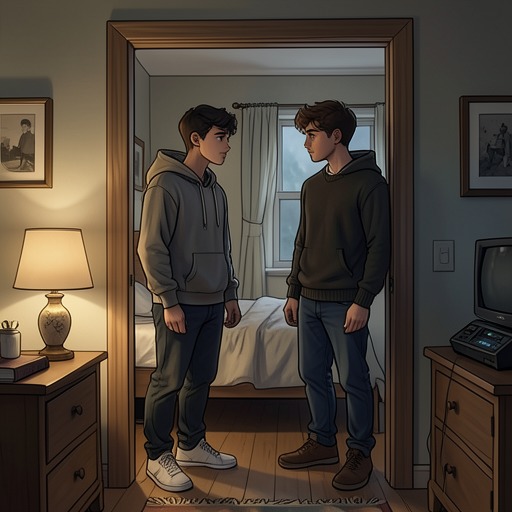
Four-Hundred-Square-Foot Shared Studio Apartment
Roommate Wars & Midnight Kisses (My College Romance)The Four-Hundred-Square-Foot Shared Studio Apartment is the physical and emotional center of Leah Kim and Liam Reed’s relationship. Its decisive function is paradoxical: the room is objectively cramped, yet its meaning repeatedly changes with the state of the people living inside it. It begins as a space that can make absence, conflict, and emotional distance impossible to ignore, but ends as a chosen home whose mess, routines, and shared objects record a life built rather than merely endured.
Definition and Physical Setting
The apartment is a single, compact studio whose limited dimensions force several functions into the same space. It serves as bedroom, kitchen, study area, and the setting for arguments, reconciliations, and private tenderness. Its low ceilings, struggling radiator, and unreliable oven make the room materially imperfect. By November, a blue rug lies beneath the occupants’ bare feet, plants sit on the windowsill, and a crooked photo strip of Leah Kim and Liam Reed from the county fair is attached to the refrigerator beside a counseling appointment card and a magnet from the EMT station. These details make the apartment legible not as neutral housing but as an accumulating record of shared experience.
The room’s objects also preserve the tension between disorder and attachment. Near the end, fairy lights illuminate the rug, unwashed cups, a stack of textbooks, and two pillows on the bed instead of one. The apartment remains familiar chaos rather than a polished domestic ideal. Its material condition therefore matters precisely because it is not transformed into something larger or more luxurious: the same small room becomes different through use, memory, and mutual commitment.
Space of Estrangement and Emotional Pressure
The apartment first registers emotional absence as a physical contradiction. After Liam Reed leaves for emergency work, it feels bigger and smaller at the same time. The extra space does not produce freedom; it makes his departure more visible, while the room’s confinement keeps Leah Kim surrounded by reminders of the person who is gone. She returns to her laptop and attempts to study Erikson’s stages of psychosocial development, but her attention repeatedly breaks down as an hour passes with the same paragraph being reread and her phone remaining dark. The apartment thus turns waiting into an embodied condition: academic work continues in the same room, but emotional uncertainty occupies it more completely.
After Liam Reed’s traumatic game-weekend shift, the apartment becomes the site of a different kind of absence. For three days, he is technically present—his boots remain by the door, his jacket is thrown over a chair, and his textbooks are open on the table—yet his attention is elsewhere, sealed behind the flat expression he brings home. He sleeps for only a few hours at a time, wakes abruptly, checks his phone, and stares at the ceiling as though awaiting an alarm that never comes. The studio’s closeness cannot automatically restore connection. Instead, it makes the distance between the two occupants visible in every abandoned object and interrupted routine.
Confined Room, Expanding Relationship
The apartment also becomes the setting in which Leah Kim and Liam Reed confront what their relationship requires. Across the tiny room, which has served as bedroom, kitchen, battlefield, and sanctuary, Leah Kim tells Liam Reed that she loves being with him and loves the way he makes her feel brave, messy, and alive. The confession is important because it occurs in the same compressed environment that has held their conflict and uncertainty. The room does not erase those contradictions; it gives them a common place in which they can be spoken.
Its spatial pressure makes relational boundaries concrete. A shared studio leaves little separation between domestic labor, private emotion, physical intimacy, and recovery from crisis. The apartment consequently becomes a testing ground for whether the couple can remain connected without allowing one person’s needs to consume the other. Leah Kim’s declaration that she will not lose herself for Liam Reed is especially significant within this setting: the home can be shared only if sharing does not mean surrendering individual agency.
Transformation into a Chosen Home
By November, the studio feels bigger even though its square footage has not changed. The low ceilings remain, the radiator still hisses as if struggling to survive, and the oven still has opinions about temperature. What changes is the apartment’s emotional arrangement. The rug, living plants, county-fair photograph, counseling card, and EMT-station magnet show that the space now contains both ordinary domestic pleasure and deliberate signs of care and recovery. The apartment’s expanded feeling is therefore not an illusion of improved architecture but the result of accumulated belonging.
The final return to the room makes that transformation unmistakable. After climbing back through the window, Leah Kim and Liam Reed enter amid laughter, and Liam Reed catches Leah Kim around the waist when she nearly trips over the radiator. Fairy lights fall across the familiar disorder, while the two pillows on the bed establish the bed as “our” bed and the mess as “our” mess. The apartment is no longer merely the place where they happen to be living together; it is the interior boundary of a life they recognize as shared.
Narrative Significance and Ending
The apartment’s ending is deliberately qualified. It contains shared mornings with coffee breath and bedhead, whispered jokes, arguments that the couple returns from, continuing check-ins, Liam Reed’s voluntary support-group attendance, and Leah Kim’s commitment to attending therapy appointments. It also contains loud, tangled nights and mundane mornings spent brushing teeth over the same tiny sink while planning the day. The domestic future is presented through repeated practices rather than a claim that every difficulty has vanished.
The final description defines the apartment—and the relationship it houses—as imperfect, untidy, and not fixed, but chosen. That distinction resolves the room’s central tension. The studio once magnified separation because its occupants could not escape one another’s absence; it finally feels spacious because Leah Kim and Liam Reed have made conscious decisions about how to remain present, seek support, return after arguments, and build routines together. Its walls do not change, but the meaning of inhabiting them does. The Four-Hundred-Square-Foot Shared Studio Apartment becomes the novel’s clearest material image of commitment as an ongoing practice rather than a finished condition.