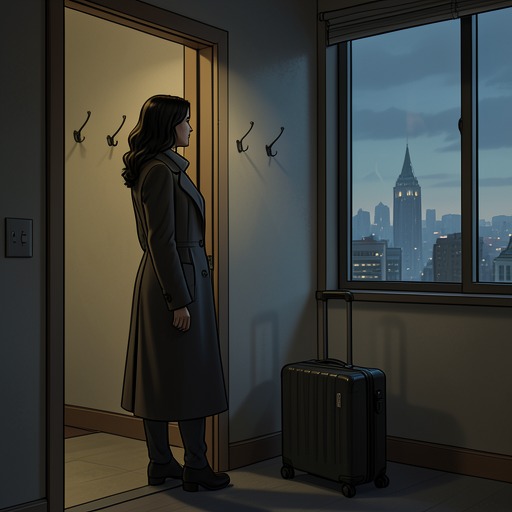
Leah and Liam's Relationship Pause
Roommate Wars & Midnight Kisses (My College Romance)Leah and Liam's Relationship Pause is the story's decisive break between love and self-erasure. In the tiny room that has served as bedroom, kitchen, battlefield, and sanctuary, Leah tells Liam that she loves being with him and loves the courage, disorder, and vitality their connection awakens in her. She nevertheless refuses to let that love require another disappearance of her own needs. The relationship does not end because affection has vanished; it pauses because Leah recognizes that affection without balance is making her repeat an older form of self-abandonment.
Causes and Background
Leah's immediate grievance is Liam's inability to give the relationship a commitment equal to the commitment he gives his work. She explicitly refuses to ask him to quit his job or stop taking shifts, and she does not deny the importance of his career path. Her demand is narrower and more difficult: work cannot remain the only part of his life that receives his full devotion. The conflict therefore turns on competing forms of responsibility rather than on a simple absence of love. Liam's exhaustion and professional obligations have become so dominant that Leah is left waiting for fragments of time and treating those fragments as sufficient.
The pause begins when Leah decides to speak before resentment changes her into someone she does not want to become. She explains that she needs space to discover what her life in this place looks like without wrapping it around Liam's shifts, and she needs to hear her own thoughts without continually adjusting them to fit his burnout. Her language makes the event an act of self-definition: she is not punishing Liam for working, but drawing a boundary before accommodation becomes another form of self-loss.
What Happens
Leah first names the positive truth between them. Her declaration that she loves being with Liam and loves how he makes her feel brave, messy, and alive makes the following limit more consequential, not less. She then states that if he cannot meet her halfway, she would rather be alone. When Liam slowly identifies her statement as a breakup, Leah clarifies that she is calling it a break from all of it: from the bed, from the heat, and from pretending they are fine when they are not. Continuing to sleep with him while watching him leave would allow physical closeness to conceal an emotional cost she can no longer accept.
The verbal boundary becomes a physical rearrangement. Leah crosses the room to the sad, lumpy pullout couch they fought over during their first week and moves her belongings there. Liam may have the bed; Leah will take the couch. They will divide the space, chores, and bills, but they will not share a pillow or blanket, and they will not blur themselves together until neither can tell where one ends and the other begins. The old object of early conflict becomes the furniture of the new separation, turning the apartment's history into a practical map of limits.
Immediate Consequences
The arrangement keeps Leah and Liam under one roof while dismantling the habits that made the apartment function as a shared intimate world. The distance is measured in only a few feet but experienced as an ocean. Leah stacks her textbooks on the crate beside the couch and establishes a small territory within the same room. Their separation is therefore neither a clean departure nor an effortless return to ordinary roommate life. It is a deliberately maintained condition of living alone together, in which every object and routine can expose the closeness that has been suspended.
The first night makes the emotional cost unmistakable. Leah lies beneath a thin blanket and stares at the ceiling while listening to Liam move in the darkness only a few feet away. Each rustle of fabric becomes an unanswered question, translating the pause into bodily vigilance and unresolved uncertainty. The scene preserves proximity without allowing it to become intimacy: Liam remains present, but the former shared bed is no longer available as proof that the relationship is functioning.
Meaning and Narrative Function
The event changes the value structure of the relationship. Love remains present, but it can no longer justify unlimited accommodation; closeness gives way to dignity, and automatic partnership gives way to negotiated boundaries. Leah's choice is especially significant because she identifies it as something she should have done years earlier. The pause repeats the shape of a breakup while reversing its moral center: instead of abandoning herself to keep someone else, Leah accepts the pain of separation to remain answerable to her own limits.
The romance beat represented here is the dark moment, but it does not operate as a claim that the preceding love was false. Its force comes from the contradiction that Leah can love Liam and still choose distance. The scene also resists treating reconciliation as the only meaningful romantic outcome. Its immediate resolution is not a grand gesture or a restored bed, but a couch, separate blankets, divided bills, and the difficult discipline of hearing one's own thoughts. Leah's final recognition—that for the first time in a long time she has not abandoned herself to keep someone else—makes self-preservation the event's lasting consequence. The pause is thus both a rupture in the couple's shared life and a beginning in Leah's independent life.