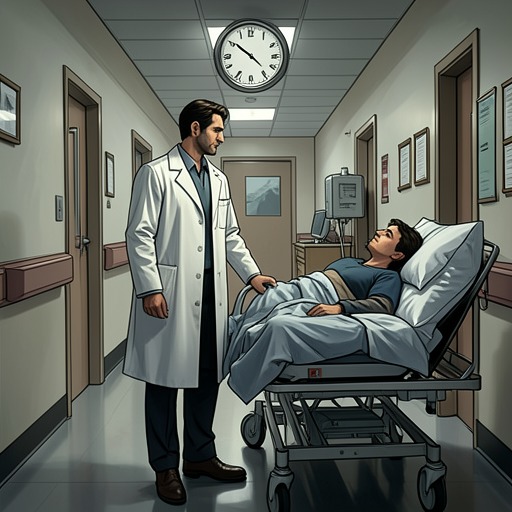
Liam's Fatal Car-Wreck Call
Roommate Wars & Midnight Kisses (My College Romance)Liam's Fatal Car-Wreck Call is the defining emergency in Liam Reed's early characterization, an encounter with death that professional competence cannot turn into rescue. The call exposes both the limits of his work and the private burden he carries afterward: a young woman is brought into the ambulance already close to death, briefly revived, then lost when she codes again; at the scene, a child keeps asking whether she will be all right; and Liam is left with the knowledge that the crew did everything correctly without changing the outcome. The event first reaches Leah Kim as fragments of a late-night phone call and later becomes a direct disclosure, transforming an apparently guarded roommate into someone visibly carrying another person's worst night.
Causes and Circumstances
The incident is a two-car wreck. One driver walks away, while the other does not survive, establishing from the outset that the emergency is not a balanced accident with a recoverable outcome but a divided scene of survival and irreversible loss. Liam recalls that the patient appeared to be in her early twenties, although the responders were not told much about her. The lack of biographical detail makes the call especially stark: she arrives not as a fully known person but as someone the crew must try to save with almost no history available to them.
The patient is already critically unstable when the EMT crew picks her up. Liam describes her as having been “already circling the drain,” and the phrase conveys both the immediacy of the medical crisis and the helplessness that shadows the response. The call is therefore not presented as a failure of preparation or effort. Its tragedy lies in the narrow space between doing everything required and still being unable to preserve a life.
What Happens During the Call
The patient codes twice in the rig. The crew gets her back the first time, producing a brief reversal from death's approach toward the possibility of survival. The second arrest breaks that possibility: she cannot be revived. The sequence gives the event its decisive value shift. Liam and the crew move from emergency action, to provisional recovery, to final loss, while the ambulance becomes the confined setting in which technical intervention meets an outcome it cannot control.
At the crash scene, a child repeatedly asks whether the woman will be okay. Liam keeps having to refuse an answer, not because he is indifferent but because he cannot promise what he does not know. Later, when he recounts the scene, he rubs the back of his neck and looks at the floor, as though searching for a script that does not exist. The gesture connects the public role of the responder with the private inadequacy of language: procedures can organize a rescue attempt, but they cannot supply a truthful comfort when the result remains uncertain.
Leah's Discovery and Liam's Disclosure
Leah first hears the call indirectly while lying still in the Four-Hundred-Square-Foot Shared Studio Apartment, caught between the etiquette of new roommates and the instinct to listen. In the dark kitchenette, Liam runs water, handles a mug, and speaks quietly on the phone. His words initially sound almost private or prayer-like before Leah realizes that he is talking to someone who understands the work. He explains that the patient coded twice, that the crew brought her back once, and that the second time there was no recovery.
The overheard conversation establishes that Liam does not interpret the death as proof that he performed badly. He acknowledges that they did everything right, yet insists that this is not the point. He also says he is not going to drop shifts and that he needed to say the experience aloud to someone who understood it. His response rejects two easy resolutions at once: he neither treats the death as meaningless nor responds by abandoning the work. The call remains active in him precisely because professional correctness has not erased emotional consequence.
When Liam later tells Leah the story directly, he strips away the evasive humor and identifies the event plainly as a car wreck. Leah offers sympathy, and Liam answers with restrained agreement rather than relief. His memory returns most sharply to the child at the scene, who kept asking whether the woman would be okay while Liam repeatedly had to avoid answering. For a moment, his sarcasm and snark disappear, leaving him as a twenty-two-year-old holding the weight of another person's worst night. Leah tells him that he did what he could, a statement he recognizes as sounding like his supervisor's reassurance. The exchange does not solve the trauma, but it gives the event a witness outside the emergency system.
Consequences and Narrative Significance
The call explains why Liam's exhaustion is older and heavier than ordinary student fatigue. A later sigh sounds older than twenty-two, and the contrast between his age and the burden he carries becomes central to Leah's changing perception of him. His work is not merely a background occupation or a source of scheduling conflicts; it has placed him repeatedly beside death and taught him that correct action can coexist with irreversible loss.
The event also establishes Liam's coping pattern. He seeks out someone who understands the call, says he will continue taking shifts, and tries to sleep after speaking the experience aloud. His refusal to quit is neither presented as uncomplicated strength nor as evidence that he has recovered. Instead, the call remains a pressure beneath his ordinary interactions, surfacing through quiet speech, physical weariness, and the sudden collapse of his defensive sarcasm.
For Leah, hearing and then receiving this account changes the emotional terms of their shared apartment. She does not encounter Liam only as a difficult roommate with thin walls and sharp humor; she becomes a witness to the difference between a responder's competence and a responder's powerlessness. The fatal call thus serves as a hinge between external rules and genuine intimacy. It cannot be repaired, reversed, or made fair, but its telling allows Leah and Liam to recognize the human cost that Liam has been carrying alone.