Storm Blackout and Forced Proximity
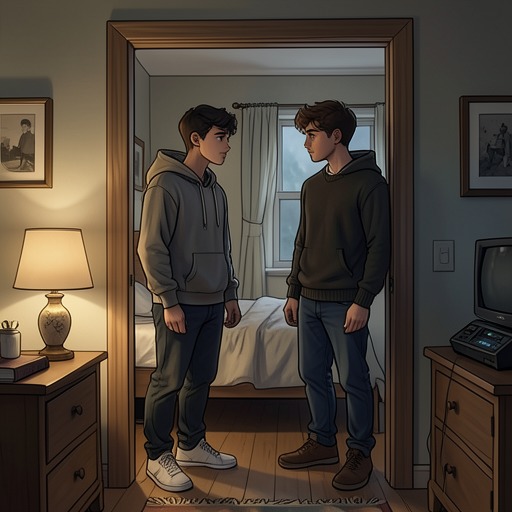
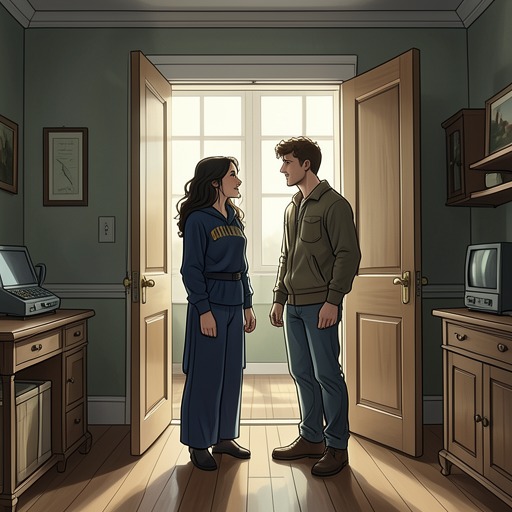
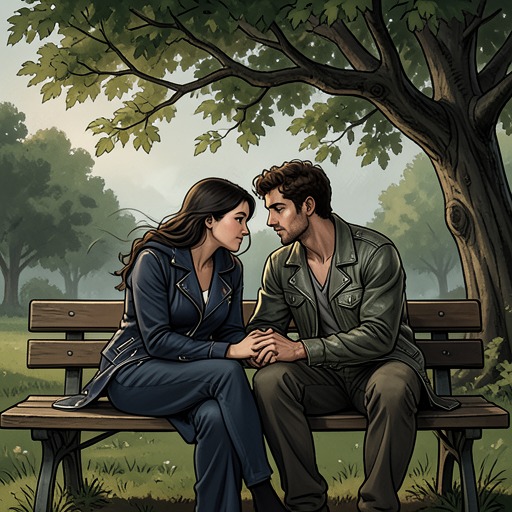
Roommate Wars & Midnight Kisses (My College Romance)Storm Blackout and Forced Proximity is a decisive intimacy event in Leah Kim and Liam Reed’s developing relationship. A storm over Ann Arbor removes the ordinary structure of Apartment 3B: electricity fails, familiar rooms become dark and uncertain, and the two accidental roommates are pushed into unusually close physical and emotional company. What begins as a night of weather and practical improvisation becomes a threshold moment, because both Leah Kim and Liam Reed disclose histories that explain the defenses shaping their present lives.
Causes and Setting
The event begins in late afternoon, when the sky over Ann Arbor turns the color of a bruise and wind drives dead leaves across the sidewalks outside the psych building. The storm is described as arriving with apparent hostility, giving the weather an active pressure before it produces any direct danger. Lightning and thunder intensify around the apartment; Leah Kim removes her damp jacket, the lights flicker, and the electrical system seems close to failure.
The power then cuts completely. A voice outside shouts, a car alarm begins sounding down the street, and the fridge, heater, and other ordinary signs of domestic stability fall silent. The blackout is therefore both a material disruption and a social one: the appliances that normally organize the shared studio stop working, leaving Leah Kim and Liam Reed without their usual distractions and making the apartment’s limited space more conspicuous.
Improvised Shelter and Forced Proximity
Liam Reed responds to the blackout with practical preparation rather than panic. He places his phone on the table so its light points upward, turning the room into a makeshift illuminated space, and searches the kitchen’s junk drawer for tea lights. His explanation that fire safety matters, reinforced by his memory of a previous twelve-hour outage during which he ate cold ramen in the dark, gives the crisis a mundane history and shows that he has prepared for this kind of inconvenience.
When Leah Kim begins trying to insist that she is fine, Liam Reed recognizes the strain beneath the repeated reassurance and tells her that they should not sit counting thunder because that would let her spiral. He proposes a contained plan involving a fully charged laptop, downloaded movies, headphones, a blanket, and food. The plan changes the blackout from passive waiting into shared activity, while his dry reference to the lease’s supposed “Acts of God” provision keeps their usual teasing rhythm alive even as the situation becomes more intimate.
Liam Reed carries the laptop onto the platform and settles against the wall. Leah Kim follows with the large gray blanket from the foot of the bed. There is only enough room for her beside him, and the narrow space makes closeness unavoidable rather than theatrically chosen. His invitation that he does not bite preserves a comic surface, but the physical arrangement marks a clear shift: the apartment’s accidental cohabitants now occupy the same small refuge, with the storm outside and the blackout eliminating their normal distance.
Trauma Disclosure and Witnessing
The storm exposes why Leah Kim reacts so strongly to it. She explains that storms are familiar because, when she was younger, her parents fought frequently, and her former partner had a habit of choosing the worst nights for major conversations. Thunder, shouting, and power outages have consequently blurred together in her memory. The present blackout does not merely frighten her as an isolated weather event; it repeats the environmental pattern through which earlier conflict became attached to darkness, noise, and electrical failure.
Liam Reed initially begins to ask whether her former partner ever harmed her, then stops and rephrases the question. That hesitation matters because it avoids forcing Leah Kim into a more explicit account than she has offered. Instead, he tells her he is sorry she endured it and says he hates that the former partner trained her to shrink. Leah Kim answers that she is trying to un-train herself, and Liam Reed assures her that she is doing a good job. His response treats her adaptation as an ongoing act of agency rather than as a fixed weakness, turning the disclosure into recognition rather than interrogation.
The scene’s emotional movement is carried as much by bodies and surroundings as by explanation. Leah Kim’s heart accelerates in the sudden dark, her voice rises when she claims to be fine, and her throat tightens after Liam Reed’s response. The candles and laptop screen soften his face and make his steady attention visible. Material objects that ordinarily remain unnoticed—the phone, tea lights, laptop, blanket, and silent appliances—become the means through which fear is contained and attention is shared.
Liam Reed’s Parallel Confession
Liam Reed answers Leah Kim’s disclosure with a history of his own. He recalls a former relationship in which his partner effectively lived in his dorm room and the two of them shared classes, meals, sleep, and frequent fights. The dorm room became a pressure cooker: every minor matter acquired exaggerated significance because there was no door to close and nowhere to retreat.
He describes the costs of that arrangement through ownership and time. His bed became her bed, his desk became her desk, and his time became her time. Liam Reed admits that he allowed the situation to continue because he liked feeling needed, even as he gradually stopped making decisions solely for himself. The confession parallels Leah Kim’s account without equating their experiences: her former partner taught her to become smaller, while Liam Reed participated in an engulfing relationship because dependence initially felt affirming.
The relationship ended in the explosive way Liam Reed had feared. A major fight brought crying, accusations that he had promised too much or changed, and his partner’s departure. Afterward, he slept for twelve hours and woke feeling both like an asshole and as though he could breathe again. The contradiction is central to his confession. Relief does not erase guilt, and guilt does not invalidate the need for space; Liam Reed is forced to hold both truths at once.
Consequences and Narrative Significance
The blackout produces a value shift from guarded cohabitation toward mutual witnessing. Before the power failure, the storm threatens to reactivate Leah Kim’s old associations and leave both roommates trapped in an uncomfortable apartment. Through Liam Reed’s practical care, the shared platform, and their reciprocal disclosures, the same confinement becomes a protected interval in which each can describe the relationship pattern he or she is trying not to repeat.
The event does not resolve either character’s history, nor does it erase the risks of intimacy. Instead, it establishes a more honest basis for their attraction. Leah Kim is seen not as fragile but as someone actively resisting the training that made her shrink; Liam Reed is seen not simply as self-sufficient but as someone who has confused being needed with freely choosing a life. The storm therefore functions as both external obstacle and emotional catalyst: by taking away light, heat, ordinary routine, and physical distance, it makes the hidden architecture of their previous relationships speakable.
As a romance beat, the night moves the pair from resistance into attachment without pretending that proximity alone is safety. The crucial intimacy is not merely the near-sharing of the platform or blanket. It is the reciprocal act of disclosure, followed by careful listening and an acknowledgment that both characters need relationships with room to breathe. The blackout’s temporary enclosure thus becomes the foundation for a different kind of closeness—one in which comfort does not require surrendering autonomy.