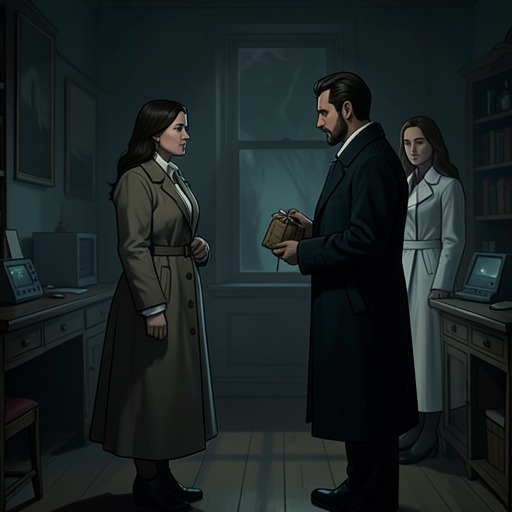
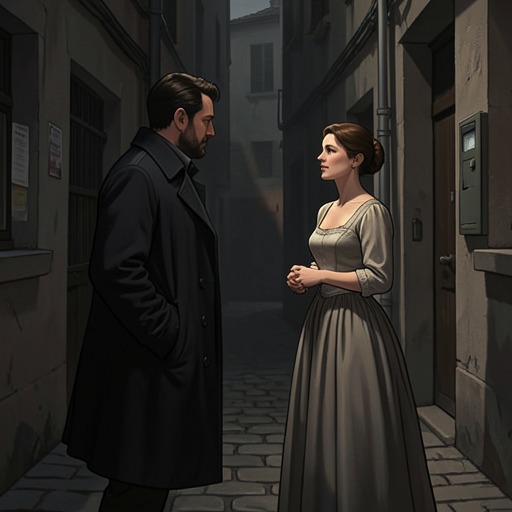
Adrian Marcato
Rosemary's BabyAdrian Marcato is a historical occultist whose past becomes a key to Rosemary Woodhouse’s understanding of the people around her. His reported attempt to summon Satan outside the Bramford links the building to an earlier public scandal; the later discovery that Roman Castevet is Marcato’s son, Steven, turns that history into evidence of the conspiracy around Rosemary and her child.
Identity and Historical Record
Rosemary learns about Marcato in a book Edward Hutchins had left for her, where his life is discussed in a chapter devoted to him. The account says he was born in Glasgow in 1846, brought soon afterward to New York, and died on the island of Corfu in 1922. It describes the tumult of 1896, when Marcato claimed to have called forth Satan and was attacked by a mob outside the Bramford. Similar incidents were reported in Stockholm in 1898 and Paris in 1899.
The book includes a standing portrait of Marcato, described as a black-bearded man with hypnotic eyes. Rosemary finds him fleetingly familiar when she sees the image. A less formal photograph shows him seated at a Paris café with his wife, Hessia, and their son, Steven. The book’s marked passages also draw attention to beliefs and practices involving fresh blood and black candles, details that later connect in Rosemary’s mind with objects and behavior she has encountered at the Bramford.
The Name and the Discovery
Marcato’s importance to the plot sharpens when Rosemary remembers Hutchins’s message that the book’s title, All Of Them Witches, is an anagram. Working through the letters with a Scrabble set, she recognizes that Roman Castevet’s name rearranges to Steven Marcato. She tells Guy Woodhouse that Roman is Adrian Marcato’s son and that “Roman Castevet” is “Steven Marcato” rearranged. The identification transforms Marcato from a figure in an old account into the family connection that explains Roman’s concealed identity.
The discovery is made through reading rather than a direct encounter with Marcato. Hutchins’s underlinings guide Rosemary toward the chapter and its details; the anagram then makes the evidence legible. The book’s title, historical account, photograph, and marked passages accumulate as clues, each changing the significance of what she has already seen.
Legacy at the Bramford
Marcato’s connection to the building is both historical and visual. The account places the 1896 mob attack outside the Bramford, while a portrait of Marcato hangs above the mantel at a gathering in the Castevets’ apartment. Rosemary reaches that apartment through a hidden door in the back of her linen closet, which opens into the Castevets’ home. There she sees the gathered conspirators beneath the portrait, making Marcato’s image a conspicuous presence in the scene where she confronts the group.
The painting cannot act, but its placement gives Marcato’s history a continuing presence in the household. His son’s assumed name, the old account of the Bramford, and the portrait above the gathering connect separate pieces of evidence across generations. The narrative establishes Marcato’s historical record and his relation to Roman, but does not explain his precise role in the group’s present-day plans.