Bramford coven
Rosemary's BabyThe Bramford coven is a secretive group embedded in the social life of The Bramford, where neighborly attention and familiar apartment gatherings conceal a shared religious allegiance and an interest in Rosemary Woodhouse’s child. Its power lies not only in what its members believe, but in how ordinary domestic forms—food, visits, medical care, and the connected layout of the apartments—make their collective purpose difficult for Rosemary to recognize and escape.
Identity and Emergence
Rosemary’s first understanding of the group is piecemeal. She and Guy Woodhouse move into The Bramford, an old building divided into large apartments, and gradually recognize that the voices and music they hear at night come from the adjoining portion of the apartment that had once been part of their own. At a party hosted by the Castevets, conversation and singing continue late into the night, accompanied by a flute or clarinet. At first these details can be taken for eccentric social habits; later they become part of Rosemary’s pattern of evidence.
A book Guy has discarded gives Rosemary a framework for interpreting that pattern. It describes covens, initiation, vows, baptism, anointing, and a mark associated with membership. Rosemary connects its account to the gatherings and to the tannis-related details she has encountered. She wonders whether Guy has joined the group, noticing that a flesh-colored bandage has appeared on his shoulder at different times and that he now sleeps in pajamas. These observations establish her suspicion, not proof of his initiation; the uncertainty intensifies her sense that the people closest to her may be concealing an allegiance she cannot verify.
Members and Social Methods
Rosemary identifies Minnie and Roman Castevet as central to the circle. In her reconstruction, Laura-Louise, the Fountains, the Gilmores, and the Weeses also belong to it. The group’s social life gives that suspected membership a deceptively ordinary appearance. At a farewell party for Roman and Minnie, attendees discuss tornadoes and civil rights, share homemade cookies and fruit punch, and contribute to a transistor radio in a pigskin case as a departure gift. Rosemary finds it difficult to reconcile these familiar, unremarkable people with the coven described in her book. The scene makes her uncertainty part of the group’s concealment: social warmth does not settle the question of what its members do together.
The gatherings recur with recognizable sounds. Rosemary remembers flat, unmusical singing and a wind instrument; later she connects those sounds with ritual meetings. In her dream, the same kind of music accompanies a ceremony, but the dream’s imagery cannot by itself verify what happens at the parties. The distinction matters: the coven is real, while Rosemary’s early visions and interpretations remain uncertain evidence. At the farewell gathering, she still struggles to believe that the people before her are members of such a group, even as the repeated social pattern gives her suspicions a shape.
Interest in Rosemary’s Child
The coven’s attention to Rosemary’s pregnancy is the clearest indication that its involvement is more than a matter of shared belief. When Rosemary explains her fears to Dr. Hill, she argues that the group wants the baby; Dr. Hill acknowledges that its interest has been evident from the beginning. The evidence presents this as a sustained concern, rather than a sudden response to the pregnancy’s final stage. Rosemary’s attempts to question her care and seek another medical opinion therefore place her in conflict with a network that reaches into both her home and her medical circumstances.
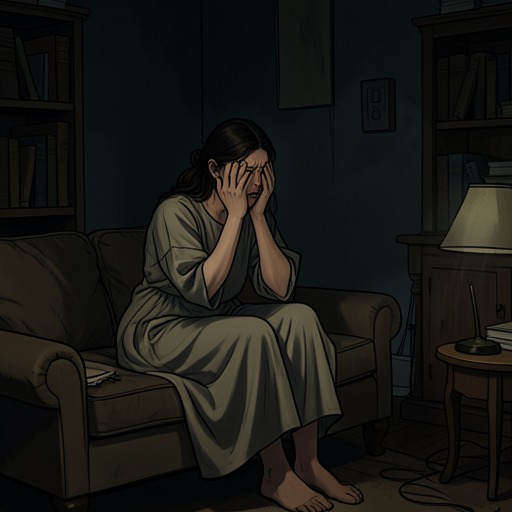
That conflict has a reproductive dimension. Rosemary had wanted a child, while Guy had resisted becoming a father; after pregnancy begins, she insists that she will not have an abortion and later plans to see Dr. Hill because she believes her pain signals that something is wrong. The group’s interest turns her pregnancy from a private family matter into the focus of other people’s decisions. When she attempts to leave the group’s control, Guy arrives with members of the circle and Dr. Sapirstein, who carries a sedative. They tell her that they are friends and that she will be all right, while preventing her from leaving. During labor, Guy continues reassuring her as she is held and given another injection. The coven’s care is thus inseparable from its ability to override her wishes.
The Bramford as a Hidden Structure
The building’s layout helps explain how the coven can act collectively while remaining difficult to detect. Its apartments had once formed a larger unit, and Rosemary comes to suspect a concealed passage between her home and the Castevets’ apartment. She reasons that the locked connecting door cannot account for how people entered, and searches the linen closet, which had been used to divide the former single apartment into smaller ones. Behind its shelves she finds a painted panel that swings inward, revealing another closet and a route toward the Castevets’ hallway. Looking through a keyhole, she can see a curio cabinet about twenty feet away.
When she passes through, the apartment’s hallway is empty and the baby is not in the bedroom Rosemary checks. A painting of a church in flames hangs above the curio cabinet. The passage turns the building’s architectural history into a practical means of access: the division that created separate apartments has not eliminated their hidden connection. Earlier, the basement laundry had also unsettled Rosemary, with its isolated service elevator and shadowed brick passages recalling a dead baby found there. These details do not independently establish the coven’s responsibility for every disturbing occurrence, but they make the building’s domestic spaces feel permeable, and its apparent boundaries unreliable.
Revelation and Significance
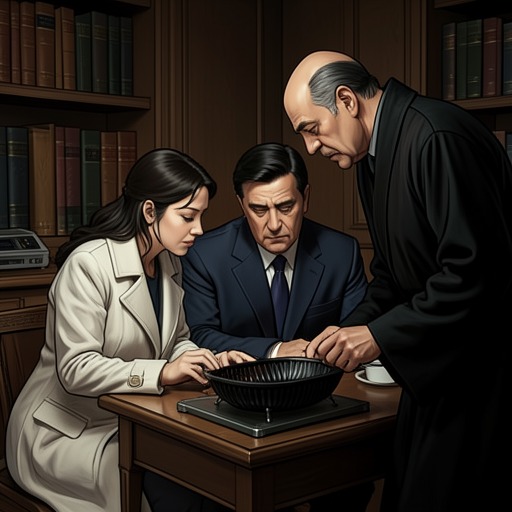
The coven’s presence becomes explicit when Rosemary enters its gathering carrying a kitchen knife. The group has assembled beneath a portrait of Adrian Marcato; Guy, Minnie, Roman, the Weeses, Laura-Louise, Mr. Fountain, and others are among those present. The attendees initially continue talking and drinking, and only gradually turn toward Rosemary. Roman then publicly identifies Satan as the child’s father and names the child Adrian, presenting him as the figure through whom the group expects vengeance and transformation. The members answer with repeated acclamations to Satan and Adrian. What had appeared to Rosemary as a jumble of suspicious clues is now joined to the coven’s own declaration of purpose.
The group’s menace is built through contrast rather than through a separate public institution: its members are neighbors and party guests, and its apparent concern can pass as kindness, while its hidden passage and coordinated intervention expose a more coercive structure. The narrative also preserves limits on what Rosemary knows. Her theory about particular illnesses, deaths, and Guy’s membership is not confirmed in every detail. What is confirmed is the coven’s collective presence, its control over the spaces around Rosemary, its intervention in her labor, and Roman’s announcement that her child belongs to its religious project. The Bramford coven therefore makes the apartment building’s intimacy double-edged: proximity offers familiarity, but also gives the group access to Rosemary’s home, care, and child.