Danger zone
Rosemary's BabyThe danger zone is Edward Hutchins’s name for the risk he sees in the Bramford: a building whose documented history of unsettling incidents, he argues, cannot be cancelled out by its handsome apartments and low rent. Guy Woodhouse treats that history as coincidence. As Rosemary Woodhouse encounters the basement and eventually discovers a hidden route between apartments, the phrase gathers force beyond Hutchins’s initial appeal to statistics: the danger is lodged in the structure of the home itself.
The warning and the building’s appeal
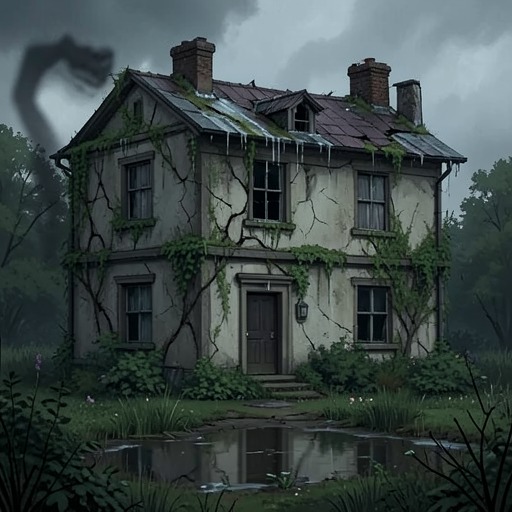
Rosemary and Guy had already signed a lease elsewhere when they learned that a four-room apartment in the Bramford had become available. They had been on its waiting list since their marriage, drawn by a building of high-ceilinged rooms, fireplaces, and Victorian detail. Its imposing age and architecture offered precisely the nineteenth-century splendor they wanted, but Hutchins urged them to consider the other side of its reputation.
Hutchins had spent three hours with the Times Index and microfilm researching the building. He cited a dead baby found in the basement and an elevator man killed in an accident the previous winter, and warned that the Bramford had an unusually high incidence of unpleasant happenings. Rather than treating the matter as mere atmosphere, he asked why the couple would deliberately enter a danger zone and suggested the Dakota or the Osborne as alternatives. Rosemary replied that the Dakota was a cooperative and the Osborne was due to be demolished; the Bramford’s attractions remained concrete, while the history Hutchins described could still be held at a distance.
Coincidence and recurrence
Guy’s answer is statistical rather than supernatural. A run of five heads, he argues, does not make the next five flips predictable or make the coin different from any other; the Bramford’s incidents need not indicate that more are coming. Rosemary, too, tests the warning against ordinary explanations, asking whether a genuinely dangerous house would not have been demolished. Hutchins counters that the Bramford belongs to the church next door. The exchange leaves the phrase suspended between evidence and interpretation: Hutchins has assembled a record, but Guy refuses to read a pattern into it.
After Theresa Gionoffrio’s suicide, that disagreement returns in the Woodhouses’ bedroom. Rosemary recalls Hutchins’s claim that the building had more suicides than other buildings. Guy again calls the danger-zone idea nonsense, while Rosemary observes that Hutchins believes it. The exchange does not establish what caused Theresa’s death; instead, it shows how the building’s reputation persists even when the people living in it would rather dismiss the connection. A warning once argued over at dinner has become difficult for Rosemary to keep out of mind.
The basement as lived evidence
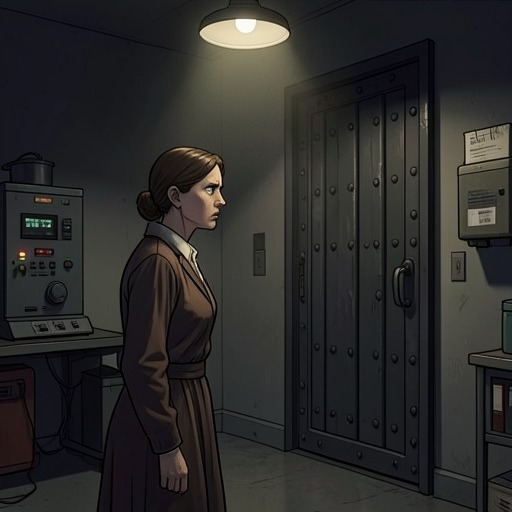
The basement gives the warning a setting Rosemary cannot reduce to a list of newspaper reports. Every few days she takes the small, unmanned service elevator down to do laundry. It creaks and trembles; below, footfalls seem distant in the once-whitewashed brick passageways, unseen doors thud shut, and discarded refrigerators face the walls beneath glaring caged bulbs. The laundry room continues the same institutional unease, with steamy brick walls, iron-mesh cubicles, and deep double sinks.
Rosemary knows that a dead baby wrapped in newspaper was found there. She wonders whose child it was, how it died, and whether anyone responsible was caught. She considers looking up the story, as Hutchins did, but decides that knowing exactly where the baby lay would make the basement more dreadful. Her choice of partial ignorance makes the danger-zone phrase personal: the threat is no longer only a pattern in the building’s past, but a place she must pass through on the way to an everyday chore.
From reputation to concealed access
Later, Rosemary reasons that there must be a hidden way between her apartment and the neighboring apartment. The door had been chained on the night people entered, she recalls, so she concludes that another route must exist. She searches the linen closet, removes its shelves, and finds that a white-painted panel swings inward. Beyond it is a second closet, with a keyhole looking toward the hallway of Minnie and Roman Castevet’s apartment; the door opens into their home.
The discovery gives the building’s menace a physical mechanism. Its divided apartments conceal a passage that lets people move between homes without using the ordinary entrance. When Rosemary enters, she finds the hallway empty and no crib or baby in view. The phrase danger zone began as Hutchins’s warning about accumulated incidents, resisted by Guy as a faulty inference from chance. The concealed doorway does not prove every part of Hutchins’s account, but it makes the Bramford’s danger more immediate: its domestic boundaries can hide access, movement, and secrets.