Donald Baumgart’s blindness and Guy’s casting
Rosemary's BabyDonald Baumgart’s blindness and Guy Woodhouse’s casting form a single abrupt reversal: a rival actor’s sudden catastrophe opens the way to the role Guy wants. The news arrives during an otherwise domestic stretch of activity, but turns routine attention to a long-awaited phone call into a morally uneasy career breakthrough. Guy accepts the opportunity while acknowledging its terrible source, then leaves the apartment to absorb what has happened.
Background and Anticipation
Guy’s call comes after a weekend of restless productivity. On Sunday he builds shelves and shoe racks for the bedroom closets and invites Luther people over for Moo Goo Gai Woodhouse. The next day he paints the new fittings and stains a bench Rosemary Woodhouse had found in a thrift shop. This industriousness accompanies a more focused preoccupation: Guy cancels his session with Dominick and keeps listening for the telephone, answering each call before its first ring is finished.
At three on Monday afternoon, the phone rings again while Rosemary is trying a different arrangement of the living-room chairs. From the bedroom she hears Guy respond with alarm and sympathy. His reaction initially gives her no explanation, only the sense that the call has brought terrible news. The contrast is immediate: Guy has been waiting for a professional opportunity, but its arrival is inseparable from someone else’s suffering.
The News and the Offer
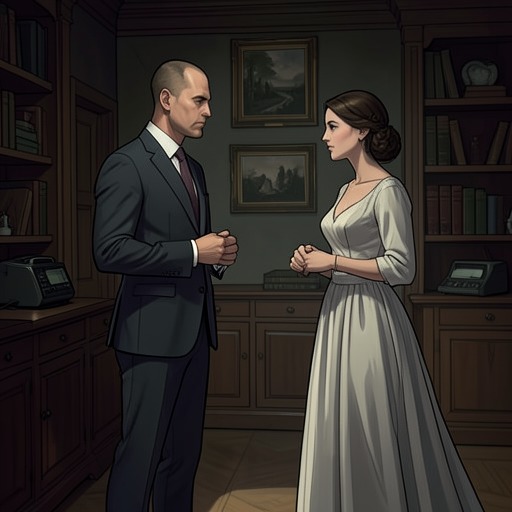
Rosemary goes to the bedroom doorway. Guy sits on the bed with the phone in one hand and a can of Red Devil paint remover in the other, at first not looking at her. He asks whether anyone knows what is causing the problem and calls the situation awful. As the conversation continues, he straightens in his seat. The posture change marks the shift from receiving bad news to recognizing what it may mean for his own career.
The caller is Mr. Weiss. Guy says that he is willing to take the part, although he immediately qualifies that willingness by saying he would hate to get it this way. He directs Weiss to speak with his agent, Allan Stone, about that end of the arrangement, while assuring him there will be no problem from their side. The exchange makes the professional consequence plain without turning the call into uncomplicated triumph: Guy is being offered the role because the actor who had it can no longer perform.
Baumgart’s Crisis and Guy’s Response
After the call, Guy tells Rosemary that Donald Baumgart has gone blind. Baumgart woke the previous day unable to see; on Monday morning he tried to hang himself and is now at Bellevue under sedation. The account compresses a frightening sequence—sudden loss of sight, a suicide attempt, and hospitalization—into the news that has simultaneously altered Guy’s prospects. The scene does not describe Baumgart’s experience beyond these facts, keeping the crisis sharply present while centering the consequences Guy must face in the apartment.
Guy says that he has the part, but calls it a hell of a way to get it. He looks at the paint remover in his hand and sets it on the night table. That small action accompanies the recognition that his long-awaited professional gain cannot be separated from the circumstances that produced it. He tells Rosemary he needs to get out and walk around, explaining that he has to absorb the news. Rosemary says she understands and steps back from the doorway. Guy leaves as he is, going down the hall and out the apartment door, which swings closed behind him.
Consequences and Significance
The event changes Guy’s career prospects while withholding any sense of uncomplicated celebration. His vigilance for the telephone has prepared the scene as the arrival of consequential news; the call delivers precisely that, but in a form that collides with his pity for Baumgart. Guy does not refuse the part, and he does not conceal the personal advantage he gains. Instead, his stated regret and his need to leave register the gap between accepting an opportunity and feeling able to welcome it.
Rosemary’s position in the scene is equally concrete: she hears the fragments, approaches the doorway, receives Guy’s explanation, and gives him room to go. Their painful look at one another briefly holds the two sides of the reversal together—the distress of Baumgart’s condition and the significance of the part for Guy. The casting therefore arrives not as a private victory detached from other people, but as an advancement shadowed from its first moment by another actor’s blindness and attempted suicide.