Dreams and Premonitions
Rosemary's BabyDreams and Premonitions give shape to what Rosemary cannot yet understand directly: a private threat that reaches her first as uneasy fragments, bodily impressions, and warnings without an explanation. Her visions do not offer a dependable map of events. Instead, the novel lets dream imagery anticipate concealed realities, then sets it against waking evidence that Rosemary must interpret for herself.
Dreams assembled from ordinary life
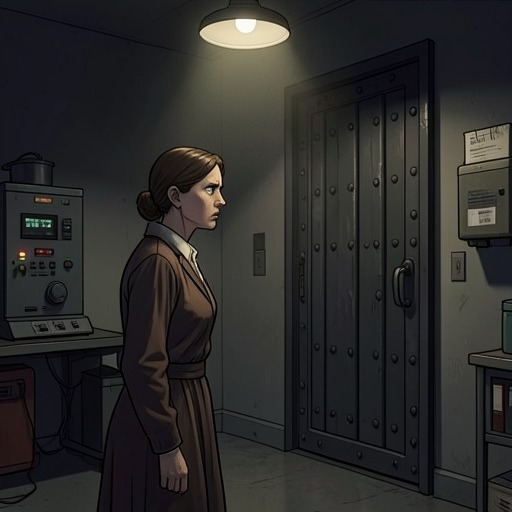
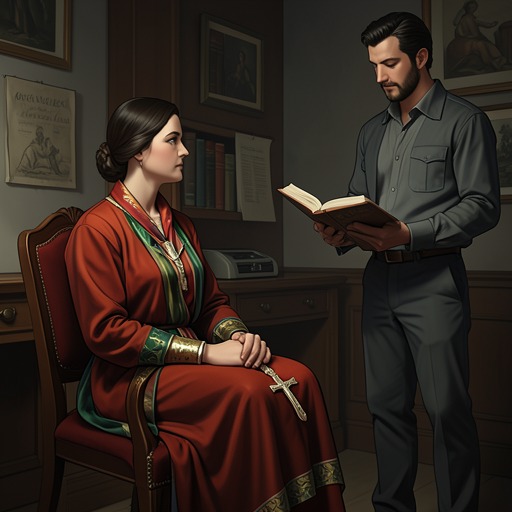
One of Rosemary’s dreams returns her to Our Lady, where Sister Agnes angrily blames her for the school’s withdrawal from a competition after its windows were bricked up. The dream turns Rosemary’s earlier decision to tell Sister Veronica about the windows into an accusation of betrayal: the school, Sister Agnes insists, has lost its chance to win because of her. An obscure discussion of what kind of woman would be suitable for an unnamed purpose intrudes into the quarrel, although its implications remain outside Rosemary’s understanding. The scene then shifts without explanation to a Saturday afternoon at a candy counter in the Orpheum, where Rosemary and her friends are about to see The Fountainhead as a live performance. School grievance, unexplained reproductive criteria, and a familiar outing coexist as though they belonged to one continuous memory.
The dream’s fragments echo the novel’s waking pattern of knowledge arriving in disturbing pieces. In the basement, where Rosemary goes to do laundry, she remembers Hutch’s misgivings and the story of a dead baby found wrapped in newspaper. She considers researching the discovery but decides that knowing exactly where it happened would make the place harder to bear. Her choice to remain partly ignorant is not the same as dreaming, but it establishes a related tension: Rosemary senses that the Bramford holds a history she does not know and resists learning more until she can no longer keep the fear at a distance.
A warning without an explanation
Margaret calls Rosemary because she has had a strong feeling that something has happened to her, perhaps an accident or hospitalization. Rosemary says she is fine. Margaret remains uneasy and asks her to stay home that night; Rosemary replies that this is already the plan. The warning gives the novel a waking premonition, but not a usable explanation: Margaret cannot identify a cause, and Rosemary has no reason at that moment to treat the feeling as knowledge.
Placed before the later events of the evening, Margaret’s concern acquires a sharp dramatic edge. It does not prevent what follows, nor does it reveal who is dangerous or what is being planned. Its force lies in the gap between the intensity of the warning and its lack of particulars. Like Rosemary’s dreams, it makes danger perceptible before it becomes intelligible.
The dream that is also happening
After drinking, Rosemary becomes dizzy, and Guy helps her to bed. The bed seems to her to float gently, a transition from physical disorientation into the elaborate dream that follows. She imagines herself aboard a ship, then in a ballroom where a church burns on one side and a black-bearded man watches from the other. In the center, Minnie and Roman are among a group gathered around a bed. Roman, dressed in a black miter and robe, traces designs on Rosemary while the others chant and a flute or clarinet sounds. The dream draws together the Castevets, a burning church, ritual, and the unsettling music associated with their gatherings.
The dream’s most consequential turn is Rosemary’s recognition that the scene is not merely a dream. Guy is having sex with her while she is incapacitated, and the ritual imagery overlays the real assault. The novel therefore makes the vision both a distorted account of what is happening and a means by which Rosemary recognizes its reality. What she experiences as a ceremony does not explain the conspiracy, but it gives form to a violation she cannot initially confront in ordinary terms.
The next morning, Rosemary restores the apartment, opens the windows, and takes a long shower while trying to order her thoughts. She wonders whether the previous night was intended to produce a pregnancy, but her immediate distress is about having been treated without her knowledge as though her wishes and personhood did not matter. She also looks back over the preceding months and begins to question whether Guy’s words have matched his feelings. Because he is an actor, she wonders how she could know when he is being genuine. The dream thus leaves consequences that extend beyond its images: it changes how Rosemary understands her marriage and makes earlier doubts newly difficult to dismiss.
From vision to waking evidence
Later discoveries offer a contrast to the uncertainty of dreaming. Rosemary works out that there must be a hidden route between her apartment and the Castevets’ because the coven appeared despite the chained door. She searches the linen closet and finds a concealed panel opening into another closet, with a view into the Castevets’ apartment. The secret passage is a physical confirmation of movement that had seemed impossible; unlike the dream, it can be tested by opening a door and looking through it.
The images nevertheless retain their force. In the Castevets’ apartment, Rosemary sees a vivid painting of a church in flames, recalling the burning church in her dream. She then finds her infant son alive in a black bassinet and sees that his eyes are golden yellow with vertical pupils. Roman tells her that Satan is the child’s father and names the boy Adrian. Rosemary’s final appeal to God meets Roman’s declaration that God is dead, followed by the coven’s acclamation of Satan and Adrian. These are waking revelations, not a dream’s symbolic solution. Their concrete force completes the movement the visions began: from ominous fragments and inexplicable forewarning to a visible child, a hidden passage, and an openly declared conspiracy.