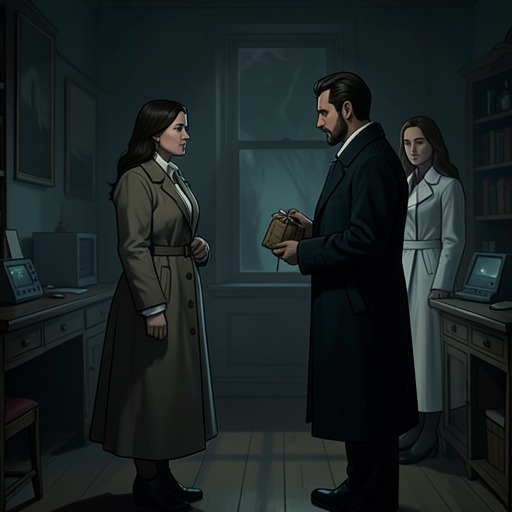
Edward Hutchins
Rosemary's BabyEdward Hutchins is Rosemary Woodhouse’s neighbor, confidant, and most perceptive early guide to the dangers surrounding the Bramford. His practical kindness helps her establish an independent life in New York City; later, his warning about the building and the clue he leaves behind become part of the knowledge Rosemary uses to confront the coven. His friendship thus links her earlier history of seeking advice to the novel’s final discovery of a hidden passage and Roman Castevet’s identity.
Identity and Background
When Rosemary first came to New York City in June 1962, Edward Hutchins lived next door to her and three other young women in their Lexington Avenue apartment. English and fifty-four at the time, he had raised two daughters and declined to become a full-time father substitute for the younger women. He nevertheless remained available in emergencies. Hutchins wrote boys’ adventure series under three different pen names, a professional life that contrasts with his later role as a source of calm, practical counsel.
Rosemary had left behind a family in Omaha that made her feel guilty and selfish for going away. Hutchins helped her resist that pressure with strong tea and conversations about parents, children, and a person’s duty to herself. He encouraged her to take a philosophy course at NYU and treated her questions as worth asking, including questions she had been unable to raise at Catholic school. Their exchanges had warmth and humor: he imagined making a duchess of her, and she answered in kind. His support did not replace her independence; it helped her claim it.
Friendship and the Bramford Warning
After Rosemary married Guy Woodhouse, she and Guy continued to see Hutchins every month or so, sharing dinner either at home or in a restaurant. Guy found him somewhat boring but remained cordial. Hutchins’s family connections also touched the theater world: his wife was a cousin of Terence Rattigan, with whom Hutchins corresponded. Guy, conscious that connections could matter in his profession, recognized the potential value of even a secondhand link.
When a four-room apartment became available in the Bramford, Hutchins tried to talk the couple out of taking it, calling the building a danger zone. He explained its early-century reputation by recalling several notorious residents and episodes: the Trench sisters, who had eaten children; Keith Kennedy, known for his parties; Adrian Marcato; and Pearl Ames. The history was not abstract for Rosemary once she and Guy moved in. The building’s odd noises and unsettling basement made Hutchins’s warning recur in her thoughts, particularly during trips to the laundry room through the small, unmanned service elevator and the dim brick passageways.
Hutchins eventually stopped pressing his objection. He apologized for meddling and offered to provide a bolt for their door, but Rosemary pointed out that it already had a bolt, a chain, and a peephole. He urged them to use all three and warned them against casually wandering the halls to introduce themselves to everyone. His caution is grounded in the building’s particular history, yet his eventual retreat respects the couple’s choice. The advice also establishes the Bramford as a domestic space whose apparent conveniences—doors, corridors, and shared access—carry an undertone of vulnerability.
Concern During Rosemary’s Pregnancy
Hutchins remains attentive after Rosemary becomes pregnant. In December, while Guy is occupied with a commercial, he calls to invite the couple to see Marcel Marceau at City Center. Rosemary declines because she has not been feeling well and Guy has work; Hutchins asks what is wrong. The invitation is an ordinary gesture of friendship, but it also marks how pregnancy has begun to narrow Rosemary’s social life and how her friends’ concern can reach her only through brief calls and visits.
During a later conversation about the drink Rosemary has been taking, Hutchins reacts to the unfamiliar name Tannis root. He wonders whether she means anise or orris root. Roman Castevet confirms the name, and Rosemary offers Hutchins her Tannis-root charm, presenting it as lucky and drawing his attention to its smell. Hutchins’s uncertainty provides a small but concrete contrast with Roman’s confidence: the root is strange to the friend who has known Rosemary for years, while it belongs to the Castevets’ intimate circle of advice and care. The exchange does not establish what Hutchins concludes, but it places him briefly beside Rosemary as she tries to make sense of the drink and its ingredients.
Coma, Death, and the Book
Hutchins fails to appear for an appointment with Rosemary. After waiting, she calls his apartment from a phone booth in the building’s basement lounge. Grace Cardiff answers and tells her that Hutchins was taken ill the previous night or early that morning, is in a deep coma, and is at St. Vincent’s Hospital; doctors have not determined its cause. The unexplained illness cuts off a relationship that had offered Rosemary counsel at moments of uncertainty.
On June 3, Hutchins dies in his hospital bed. His son-in-law, Axel Allert, gives Rosemary the news and tells her about the memorial service at the Ethical Culture Center. She weeps both for her friend and from guilt: during the preceding months she had largely forgotten him, had not visited while he lay in a coma, and had avoided being near someone sick because she feared for herself and the baby. Guy’s reaction is unexpectedly profound; he turns pale and remains withdrawn for hours. Hutchins’s death therefore carries consequences beyond the loss of a friend, exposing how Rosemary’s pregnancy and fear have drawn her away from people who once mattered to her.
Grace Cardiff later brings Rosemary a book Hutchins had left on his desk. In his final moments of consciousness, he had repeatedly insisted that the book be given to Rosemary and that she be told that the name was an anagram. He had apparently been reading it when he was stricken. The message reaches Rosemary after Hutchins can no longer explain what he meant, turning the book into a final communication whose urgency survives its sender.
Posthumous Clue and Narrative Role
The book points Rosemary to Adrian Marcato and to the name Steven. She rearranges the letters of Steven Marcato into Roman Castevet, then back again. Hutchins’s clue thus gives her a means of recognizing that Roman’s apparent identity conceals a connection to the notorious Marcato family. The discovery does not come from a confrontation or a direct accusation by Hutchins; it depends on his choice of book, his insistence that the name mattered, and Rosemary’s work of solving the anagram.
His role also returns in Rosemary’s later reasoning about how the coven can move through the building. Remembering Hutchins’s warning and the way the apartment had once formed part of a larger residence, she concludes that a secret route must connect her apartment to the Castevets’. She suspects that the linen closet conceals it and connects Hutchins’s death to the witchcraft she believes surrounds the building. That connection is Rosemary’s inference, not a confirmed account of what caused his coma. When she opens the closet’s painted panel, however, she finds a second closet and a door leading into the Castevets’ apartment. The hidden passage makes the Bramford’s architecture answer her suspicions while recalling the friend who first taught her to take its history seriously.
Hutchins is neither an investigator who can expose the coven in person nor a protector able to remain at Rosemary’s side. His importance lies instead in the durable traces of his care: the habits of questioning he encouraged, his early warning about the Bramford, and the book and anagram he leaves behind. In a story where apparent domestic safety conceals unseen access, his practical attention to doors and his posthumous clue help Rosemary turn private unease into knowledge.