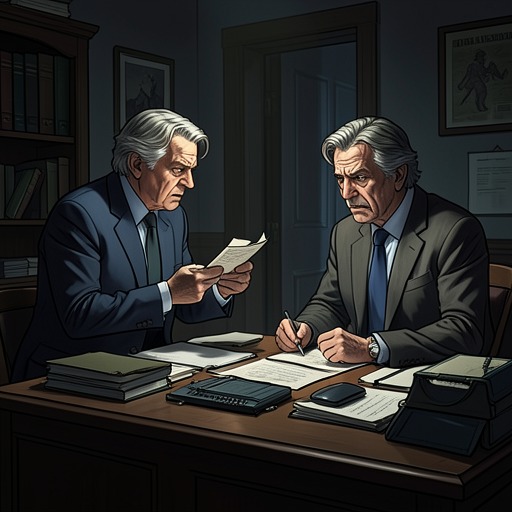
Guy Woodhouse and Donald Baumgart
Rosemary's BabyGuy Woodhouse and Donald Baumgart are professional rivals whose connection turns on a career-making reversal: Donald goes blind just as Guy receives the opportunity that might otherwise have gone to him. For Rosemary Woodhouse, the coincidence becomes more than an accident to explain. Donald’s disability marks the point where Guy’s success and her fear that he is involved with the Bramford coven become difficult to separate, while Donald himself responds to Guy with striking generosity rather than resentment.
Professional Competition
Guy and Donald are linked by the part Guy obtains after Donald loses his sight. Their rivalry is not presented as a long-running personal feud; it emerges through the unequal consequences of a sudden misfortune. At a gathering, Guy describes having spent six days in rehearsal and says the play works better onstage than on the page. When another guest asks whether Donald is still blind, Guy says he does not know. The exchange places Donald’s condition alongside Guy’s new professional opening, though Guy’s answer does not establish what he knows or feels about Donald’s circumstances.
Donald is also identified as the person living with Zöe Piper, and as the writer of a play whose first two scenes are praised for their anger. These details make him more than an invisible competitor displaced by illness: he has his own work and artistic standing. Yet the immediate public fact of his blindness threatens to reduce him, in other people’s conversation, to the question of whether he can see, even as Guy’s rehearsal and prospects are discussed around him.
Blindness and Guy’s Breakthrough
Donald’s blindness becomes the pivot of Rosemary’s effort to account for Guy’s sudden rise. She recalls that Donald was blind only a day or two after the Saturday when Guy may have joined the witches. Guy, meanwhile, stayed home to answer the telephone whenever it rang, waiting for news. The close timing and his watchfulness sharpen Rosemary’s suspicion, but the sequence does not itself prove that Guy caused the blindness.
The professional consequences are substantial. Rosemary traces the play, its reviews, a new play, and a movie offer back to the opportunity opened by Donald’s incapacity. She also wonders whether the part Guy has in Greenwich Village might have been Donald’s had he not inexplicably gone blind. Her reasoning moves from one lost role to the larger pattern of Guy’s improving career: each success appears to follow from the same injury. In her mind, that pattern makes the coincidence increasingly difficult to dismiss, although she continues to question whether witchcraft is real and whether Guy is truly involved.
Her suspicion has a specific context. The book All Of Them Witches describes spells that can take a victim’s sight, hearing, or movement, and Rosemary connects that account to Donald’s blindness. She also knows that such spells require one of the victim’s belongings. Guy’s conduct regarding a different man, Hutch, intensifies her concern: she concludes that Guy took Hutch’s glove after Roman warned him that Hutch was investigating tannis root. That episode does not show that Guy obtained Donald’s property or caused Donald’s blindness, but it gives Rosemary a concrete reason to believe that Guy might assist the coven in acts involving personal belongings.
Rosemary’s Contact with Donald
Seeking direct information rather than relying only on speculation, Rosemary calls Actors' Equity Association to obtain Donald’s telephone number. When she reaches him, she asks whether his sight has improved. Donald answers with dark humor, describing a day in which he has broken six glasses, fallen down three flights of stairs, and tapped his way in front of two speeding fire engines. He also insists that there has been enormous improvement. His joking does not erase the practical dangers and indignities he describes; it lets him address them without making the conversation solely an appeal for sympathy.
Rosemary tells Donald that she and Guy are unhappy that Guy received his break because of Donald’s misfortune. Donald pauses, then refuses to treat Guy’s success as a simple theft of his own future. He says Guy would have done well anyway and recalls that, after their second audition for Two Hours of Solid Crap, he was certain Guy would get the part because Guy had been terrific. His assessment gives Guy credit independently of Donald’s blindness. It also complicates Rosemary’s fear: Donald, the person most directly harmed by the change in fortune, does not accuse Guy of taking his place by design.
Donald dates the onset of his blindness to the Sunday following a matinee he attended, placing it only a few days after the earlier events Rosemary is trying to connect. He jokes about whether Guy put something in a drink, and Rosemary denies that he did. The exchange contains suspicion and levity at once, but it offers no confirmation of foul play. Rosemary then tells Donald that Guy has something of his, opening another line of inquiry into the men’s contact.
The Ties and the Unresolved Suspicion
Later, Rosemary asks Guy why he traded ties with Donald and says that he needed one of Donald’s personal belongings so a spell could be cast to make Donald blind. Guy challenges the implication rather than accepting her account. When she questions his explanation that the ties came from Dominick, he says he got them from a woman he met at an audition and had drinks with. The exchange leaves Rosemary and Guy sharply divided over how to interpret the ties: she treats their connection to Donald as evidence of a spell, while Guy rejects the inference.
Rosemary also points to the tannis root associated with Abraham Sapirstein, whose receptionist told her she could smell it on him. Guy counters that Minnie might have given him a good-luck charm just as she gave Rosemary one, and disputes the idea that using it would establish that someone was a witch. The argument shows how Donald’s blindness has changed the meaning of ordinary professional and personal details for Rosemary. A role, a traded tie, and a charm become possible parts of a single supernatural explanation, but the exchange supplies accusation and denial rather than proof.
The relationship therefore remains defined by an unequal pair of outcomes: Donald loses his sight and Guy advances, while Donald nevertheless speaks well of Guy’s talent and does not insist that he was cheated. Rosemary’s fear depends on reading the timing and Guy’s actions as a pattern; Donald’s response supplies a counterweight, not a resolution. Their connection makes Guy’s breakthrough morally uneasy even before the supernatural explanation can be established.