Hutch’s cabin near Brewster
Rosemary's BabyHutch’s cabin near Brewster is a borrowed retreat where Rosemary Woodhouse temporarily separates herself from Guy Woodhouse and, amid the quiet of an autumn stay, considers what she wants from her marriage and her life. Its importance lies less in any described feature of the building than in the change of distance it makes possible: away from the Bramford, Rosemary can rest and test the idea of independence, though the respite remains brief and uneasy.
A Borrowed Place of Retreat
Edward Hutchins keeps the cabin near Brewster for occasional weekends. Rosemary asks to use it for three or four days, perhaps a week, explaining that Guy is beginning a new part and that she thinks it will be easier for him if she is out of the way. Edward Hutchins agrees readily and tells her the cabin is hers. His permission is generous rather than conditional: he has no immediate plans for it, and she may stay as long as she likes.
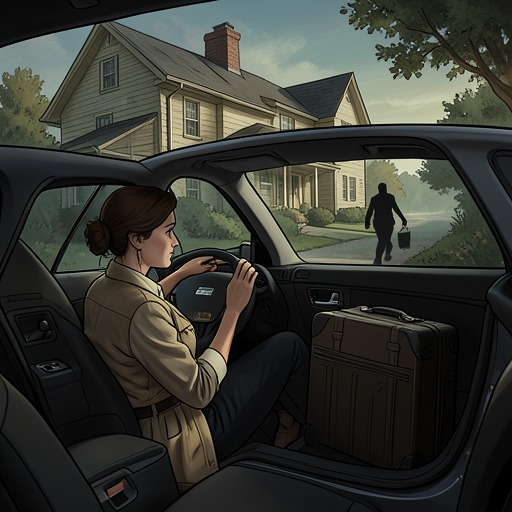
The practical arrangements make the temporary escape possible. Edward Hutchins lends Rosemary his car as well as the cabin key, and gives her a sketch-map of the route and typed instructions about the pump, the refrigerator, and possible emergencies. The car is an old light-blue Oldsmobile; its registration papers are in the glove compartment. The details establish the cabin as a usable, self-contained destination rather than an abstract wish to get away, while the borrowed car and instructions keep Rosemary’s refuge connected to Edward Hutchins’s practical help.
Rosemary’s Five Days
Rosemary leaves on Saturday, October 16, and stays for five days. She walks through woods bright with yellow and orange leaves, sleeps early and late, reads Daphne du Maurier’s Flight of The Falcon, and cooks substantial meals on the bottled-gas stove. During the first two days, she takes satisfaction in not thinking about Guy, treating her absence as a quiet answer to his cheerful agreement that she should go.
On the third day, her thoughts turn to the marriage she has stepped away from. She judges Guy vain, self-centered, shallow, and deceitful, and recognizes that she had once mistaken being his audience for being his partner. She sets herself a year in which he must become a good husband; if he does not, she will leave without religious qualms. Meanwhile, she resolves to return to work and recover the independence and self-sufficiency she had been eager to relinquish. The cabin stay thus gives her not a settled decision about the marriage but a standard by which she intends to judge it.
The physical retreat does not eliminate bodily discomfort. On the third day, the heavy meals of canned beef stew and chili con carne begin to disagree with Rosemary; she feels mildly nauseated and can eat only soup and crackers. The change punctures the fantasy of uncomplicated ease: even amid the woods and freedom from domestic routine, her body imposes its own limits.
Narrative Significance
The cabin marks a temporary counterspace to Rosemary’s life at the Bramford. There, she can be alone long enough to imagine leaving Guy and to name the independence she wants back; the first two days of deliberate mental distance give way to a more sustained reckoning on the third. Yet the visit is short, and the evidence establishes neither a permanent separation nor a resolution of the marriage. The cabin’s significance is precisely that it affords Rosemary room to form a private judgment, while leaving her to carry that judgment back into the life she has briefly escaped.