Minnie Castevet
Rosemary's BabyMinnie Castevet enters Rosemary Woodhouse’s life as a neighborly presence in The Bramford: attentive, sociable, and repeatedly involved in the small routines of a new household. That familiarity becomes the cover for a more consequential role. Minnie helps sustain the coven’s access to Rosemary, tending to her pregnancy while concealing that Rosemary’s isolation and the group’s plan are connected.
Identity and Arrival
Minnie is Roman Castevet’s wife and one of Rosemary Woodhouse’s neighbors in The Bramford. When Rosemary and Guy Woodhouse learn that an apartment in the building has become available after signing a lease elsewhere, Minnie and Roman are identified as residents on the seventh floor. Their proximity turns the building’s everyday comings and goings into the setting for a relationship that seems, at first, simply social.
Minnie approaches Rosemary directly, arriving at her door while Rosemary is putting away groceries and asking to come in. She soon invites Rosemary and Guy to dinner, explaining that a large sirloin steak is defrosting and that half would otherwise go to waste. The practical, hospitable pretext makes the invitation feel unremarkable: Minnie offers an ordinary neighborly reason to cross between the apartments, not a warning of the control that will later be revealed.
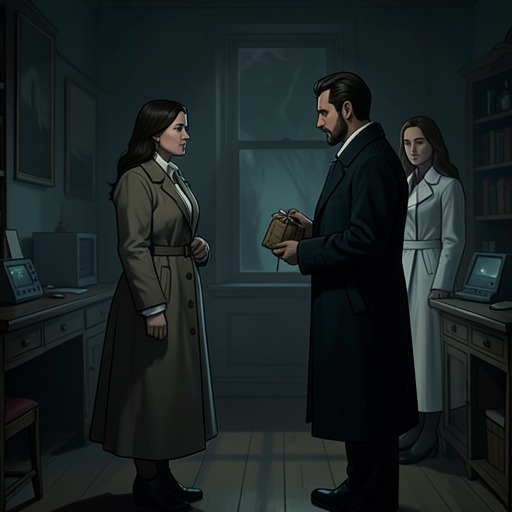
A small present extends that welcome. During a visit, Minnie gives Rosemary a packet wrapped in pink tissue paper, with a hard object inside, and calls it a moving-in gift from herself and Roman. The object’s identity is not disclosed in the episode, but the gesture matters as part of Minnie’s accumulation of intimate obligations and tokens. Her care arrives in manageable forms: an invitation, a present, something to eat, something brought over at a familiar hour.
Care and Pregnancy
After Rosemary becomes pregnant, Minnie brings her a cold, sour drink each morning. Rosemary finds that her appetite has diminished and that she has no cravings, while Minnie’s drink becomes a regular feature of the day. When Rosemary says she will be out at the usual delivery time, Minnie appears to accommodate the change: Rosemary need not take the drink at a fixed hour, she says, and can call when she returns. The exchange presents Minnie as flexible and solicitous, while keeping the drink within the pattern of care she has established.
Rosemary asks what is in it, and Minnie answers with a playful rhyme rather than an explanation. The teasing response preserves the drink’s mystery without breaking the friendly tone. Later, when Minnie’s drink is accompanied by a white, gritty sweet cake, Rosemary consumes both, taking the cake partly for its candy-like taste and partly from her resolve to be conscientious about pregnancy. The routine gains force because it is not presented as a dramatic command: it is folded into the reassuring habits of being looked after.
Rosemary’s pain later stops, and her sleep and appetite improve. She drinks the beverage Minnie gives her to the last drop and eats the accompanying cake. Abraham Sapirstein listens to the baby and responds with excitement; Rosemary also begins to look healthier and buys maternity clothes. The sequence links Minnie’s regimen to a striking change in Rosemary’s condition, though the evidence does not establish Minnie’s drink as the medical cause. Its significance lies in the trust and compliance the routine secures, even as the larger threat remains hidden.
Neighborly Intimacy and Concealment
Minnie’s strongest protection is the familiarity she creates. At a bon voyage party held by Laura-Louise, Rosemary watches the guests discuss travel, tornadoes, and civil rights. Their ordinary conversation makes it difficult for her to hold on to the belief that they are witches. Minnie belongs to a social world that can look like a collection of older neighbors and friends, not an organized threat. Rosemary even feels sympathy for Roman, thinking that he knows his life is nearing its end.
Minnie actively reinforces that ordinary surface when she addresses Rosemary’s awareness of Roman’s father. She says she understands why Rosemary has grown cool toward them, describes Roman’s deceased father as a source of misery, and explains Roman’s preference for travel as a desire to leave before people discover who he is. She asks Rosemary not to let Roman know what she has learned, presenting concealment as kindness toward a husband whose feelings might be hurt. Minnie’s appeal works through care for Roman, encouraging Rosemary to treat knowledge as a private burden rather than a reason to challenge the household.
The building itself gives this concealment a physical form. Rosemary eventually discovers that a panel at the back of her linen closet opens into another closet, with a door leading into the Castevets’ apartment. The adjoining apartments and the concealed route make the neighbors’ apparent separation deceptive: the dividing wall does not guarantee privacy. The evidence does not show Minnie using the passage herself, but the discovery reveals how the coven’s access could evade the obvious entrance and makes the domestic space part of the deception.
The Coven’s Plan Revealed
In Rosemary’s earlier dream, Minnie appears among the people gathered around her, alongside Laura-Louise and Roman. The scene’s ritual imagery and unmusical chanting make Minnie part of Rosemary’s fearful vision, but Rosemary later tries to dismiss it as a dream. That uncertainty echoes the larger pattern of Minnie’s role: what Rosemary has seen can be reclassified as imagination, while the neighbors continue to behave as companions and caretakers.
The uncertainty collapses when Minnie explains the coven’s purpose. She tells Rosemary that Satan chose her from all the women in the world to be the mother of his only living son. Minnie says that he brought Rosemary and Guy to their apartment and arranged events around them, including making Theresa Gionoffrio frightened and unsettled so that the coven had to change its plans. The confession transforms Minnie’s earlier gestures. Her attention was not merely kindness offered by a neighbor; it had helped sustain a situation that Minnie now describes as arranged for Rosemary’s pregnancy.
Minnie’s claim also exposes the difference between her intimate manner and the scale of the plan she serves. She speaks as someone close to Rosemary, but explains events as the work of a power and a group that have selected and directed her. Her solicitousness and her allegiance to Satan are not separate versions of Minnie. The revelation shows how the ordinary language of concern has allowed the coven’s intentions to remain concealed.
Final Encounter and Narrative Role
After discovering that her child is alive, Rosemary enters the Castevets’ apartment through the hidden passage and finds the coven gathered around a black bassinet. Minnie is among those who hail Rosemary as the child’s mother. The group’s acclamation attempts to assign her a place within its account of the birth and of the child’s identity. Rosemary does not accept that naming: she calls her son Andrew John Woodhouse.
Minnie then offers Rosemary a mug of tea and says it is ordinary tea with sugar and lemon when Rosemary asks whether it contains Tannis root. The offer repeats the familiar form of Minnie’s care, but it can no longer restore the trust that form once carried. Rosemary’s response is different from her earlier acceptance of the drinks and sweets: she faces Minnie with the knowledge of the deception and asserts her own understanding of the child.
Minnie’s narrative function depends on that reversal. She first makes the coven’s presence legible as neighborliness—dinner, a moving-in gift, daily provisions, and friendly conversation. Later, her own account connects those ordinary exchanges to a deliberate plan, while the concealed passage gives the apartment’s apparent boundaries a material counterpart. The final contrast is not simply between a kindly neighbor and a revealed witch; it is between Minnie’s efforts to define care on the coven’s terms and Rosemary’s insistence on naming her son for herself.