Minnie’s herbal pregnancy drink
Rosemary's BabyMinnie’s herbal pregnancy drink is a daily preparation made by Minnie Castevet for Rosemary Woodhouse after Dr. Sapirstein takes charge of her prenatal care. Described as a fresh, natural source of vitamins, it is also an object whose contents Rosemary has to ask about more than once. Its familiar appearance and regular delivery make it part of ordinary domestic routine; the unanswered questions surrounding its ingredients give that routine a more uncertain edge.
Prescription and Daily Routine
Dr. Sapirstein tells Rosemary not to take the vitamin pills prescribed by Dr. Hill. Instead, he says Minnie has a herbarium and a blender and will make a drink for her every day, which he presents as fresher, safer, and richer in vitamins than pills. He also advises Rosemary not to rely on pregnancy books or friends to tell her what to expect, emphasizing that pregnancies differ and directing her to call him with questions. The drink thus arrives within a broader care arrangement that asks Rosemary to trust the doctor’s instructions and Minnie’s preparation.
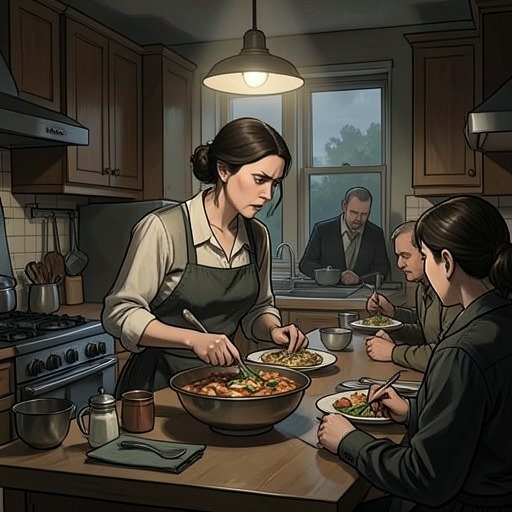
The regimen becomes a visible part of Rosemary’s mornings. She has no particular cravings and eats less than usual; breakfast may be coffee and toast, while dinner is a vegetable and a small piece of rare meat. At eleven each morning, Minnie brings over what Rosemary sees as a watery pistachio milkshake. It is cold and sour. Minnie waits as Rosemary drinks it, using the same large glass with blue and green stripes each day. The repeated glass, hour, and visit give the preparation a fixed place in the household’s calendar, even as Rosemary’s appetite remains slight.
Ingredients and Uncertainty
When Rosemary first asks what the drink contains, Minnie answers playfully rather than listing its ingredients. Rosemary later presses for a real answer. Minnie names a raw egg, gelatin, and herbs; Rosemary then asks whether it contains Tannis root. Minnie confirms that it does, along with some other ingredients she does not specify. The exchange establishes a partial recipe, not a complete one: Rosemary learns several components, but the mixture remains only partly disclosed to her.
Rosemary’s questions are not presented as outright rejection. She has already accepted the doctor’s explanation that the drink is a vitamin source, and she tells Hutch that she likes the idea of having everything fresh and natural. She speculates that expectant mothers might have used Tannis root long before vitamins were known, then asks Roman Castevet whether a root counts as an herb. Roman is watching Hutch and does not hear her question. In this moment, Rosemary voices curiosity about the drink’s particular ingredient, but the conversation does not resolve what Tannis root is doing in the preparation.
Hutch’s Scrutiny
The drink’s ingredients become a point of contrast when Hutch visits. Rosemary explains that Minnie makes it with a raw egg, milk, and fresh herbs grown by Minnie. Roman Castevet assures Hutch that this is according to Dr. Sapirstein’s directions and explains the doctor’s suspicion of commercially prepared vitamin pills: they may sit in storage and lose potency. Hutch counters that such pills are manufactured under safeguards. Roman’s response supplies a rationale for the household preparation, while Hutch’s questions expose that this rationale is not self-evident to everyone present.
When Rosemary mentions Tannis root, Hutch pauses over the name and asks about it. Rosemary says it is one of the herbs in the drink, then turns to Roman for clarification about whether a root is an herb. Roman, however, remains focused on Hutch. The exchange gives the ingredient a distinct place in the scene: unlike the raw egg, milk, and herbs, which are folded into an account of freshness, Tannis root prompts a question that receives no explanation. The evidence does not establish that the drink is harmful or that Rosemary knows its full purpose; its significance lies in the discrepancy between its assured medical framing and Rosemary’s incomplete knowledge of what she is consuming.
Pregnancy, Authority, and Meaning
The drink enters Rosemary’s life during a pregnancy she wants, though her earlier attempts to become pregnant had taken place amid disagreement with Guy Woodhouse about when to have children. Once pregnant, she wants the baby and follows a regimen organized by Dr. Sapirstein, including Minnie’s daily preparation. The drink is therefore not simply a household remedy: it is one element of an intimate medical routine in which authority is shared among a doctor who prescribes, a neighbor who prepares and delivers, and Rosemary, who drinks it while asking what it contains.
Later, Rosemary rejects her friends’ suggestion that she have an abortion and says she will go to Dr. Hill for an examination because she believes her pain may signal a problem. That decision marks a limit to her acceptance of the care arrangement, though the available evidence does not say that she stops drinking Minnie’s preparation at that point. Still later, Guy and others prevent her from acting independently during the birth, with Dr. Sapirstein among those directing her care. These later events do not prove that the drink itself caused harm or was used to control her; they do place its earlier, unquestioned daily administration within a larger story of Rosemary’s increasingly restricted choices about pregnancy and medical treatment. As an object, the drink is effective precisely because it looks ordinary: its repeated delivery makes a consequential prescription part of domestic life, while its concealed or unexplained ingredients keep trust and knowledge from fully coinciding.