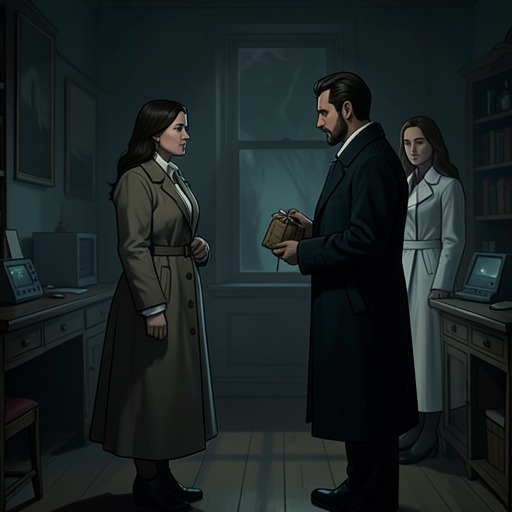
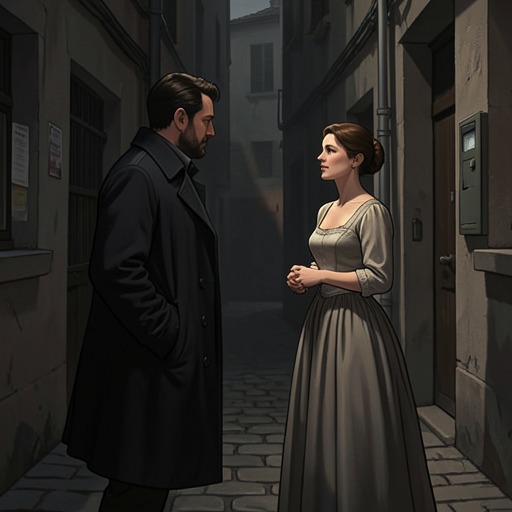
Rosemary Discovers Roman Castevet's Identity
Rosemary's BabyRosemary Woodhouse’s discovery that Roman Castevet is Steven Marcato transforms Edward Hutchins’s ominous warning into a specific, testable identity. Its decisive clue is an anagram, but the recognition gathers force from a marked-up book, the history of the Bramford, and details of Roman’s age and family. The evidence establishes who Roman is; whether he is also like his father remains an open and frightening question for Rosemary.
The Book and Hutchins’s Clue
After Edward Hutchins’s death, a package reaches Rosemary containing All Of Them Witches, a worn black book with nearly faded gold lettering. Hutchins’s signature and the inscription Torquay, 1934 appear on the flyleaf, while a bookseller’s sticker remains inside the cover. The object is not simply a message from him: its familiar underlinings and marginal checkmarks recall books he had lent Rosemary earlier in their friendship, giving her a way to recognize his hand and attend to what he marked.
The book’s contents provide a field of possible warnings rather than an immediate answer. Its chapters cover figures including Gilles de Rais, Jane Wenham, Aleister Crowley, and Thomas Weir, as well as witch practices and Satanism. Rosemary turns to its chapter on Adrian Marcato, whose name is also the subject of a vivid portrait and a photograph of him with his wife, Hessia, and their son, Steven. Hutchins has underlined Steven’s name. Rosemary notices the emphasis but initially cannot tell why it matters.
Other marks connect the book’s historical accounts to the Castevets’ domestic life. Hutchins has highlighted references to fresh blood and black candles; Rosemary recalls the black candles Minnie Castevet brought during a power failure, as well as Minnie’s herbs and Tannis-root charm. The details make the possibility of witchcraft harder for Rosemary to dismiss, but they do not settle it. Her immediate response remains divided between suspicion and disbelief: the markings may be a warning, yet the existence of witches still seems impossible to accept.
Decoding the Names
Hutchins’s message also tells Rosemary that the book’s title is an anagram. She first tries to rearrange the letters in All Of Them Witches, using a Scrabble set, but the combinations she produces do not yield a convincing message. The effort briefly seems like futile wordplay. At the same time, the baby moves inside her as she sits with the tiles, a small bodily interruption to the work of turning a dead friend’s written clue into meaning.
The solution comes from the book rather than from the title. When its pages fall open again to the photograph of Adrian Marcato with Hessia and Steven, Rosemary sees the underlined name. She spells out Steven Marcato with the Scrabble tiles, then rearranges the letters into Roman Castevet. Reversing the arrangement confirms that the two names use precisely the same letters. The repeated transformation makes the connection feel less like an accidental resemblance than a deliberately planted key.
The recognition is anchored in material evidence: Hutchins’s marked page, the family photograph, and the tiles on Rosemary’s board. The pattern also changes the meaning of what she has read. The chapter about Adrian Marcato is no longer a remote account of an occult figure; it contains the identity Roman has concealed. Hutchins’s underlining directs Rosemary toward the link, though his warning reaches her only after he can no longer explain it.
History, Age, and the Bramford
The chapter supplies a history against which Rosemary can test the anagram. Adrian Marcato was born in Glasgow in 1846, was brought to New York soon afterward, and died on Corfu in 1922. The book describes the 1896 tumult in which he claimed to have called forth Satan and was attacked by a mob outside the Bramford. It also recounts similar incidents in Stockholm in 1898 and Paris in 1899. The location of the attack matters: the book places it outside the building, correcting Hutchins’s earlier account that it occurred in the lobby.
The image of Adrian gives the name an unsettling visual association as well. His portrait presents a black-bearded man whose appearance seems fleetingly familiar to Rosemary. But resemblance is not the discovery’s strongest support. Rosemary points out to Guy that Steven Marcato was born in August 1886; at the time of the conversation, that would make him seventy-nine, the age she assigns Roman. She also stresses that Roman lives in the same house where Steven was brought up. The shared address turns the Bramford from background into part of the identity evidence.
That connection acquires additional weight from Rosemary’s experience of the building. She has already found the basement unsettling, recalling Hutchins’s misgivings while passing its dim brick corridors on trips to do laundry. She also knows the story of a dead baby found wrapped in newspaper there, though she has chosen not to investigate it in old newspapers. These earlier details do not prove Roman’s identity or his involvement in any crime. They do show why the discovery lands in a place already shaped, for Rosemary, by concealed histories and unresolved danger.
Telling Guy and the Limits of Recognition
Rosemary brings the discovery to Guy Woodhouse directly, asking whether he knows who Roman really is. Guy first answers as though Roman’s familiar name were sufficient. Rosemary lays out the evidence: Roman is Adrian Marcato’s son, Steven, and Roman Castevet is an anagram of Steven Marcato. She explains that Hutchins supplied the clue and shows Guy the book. He examines its title page and contents, turning through the pages before conceding that the identity is probably genuine.
Guy’s response narrows the meaning of what they have found. He treats the name change as understandable given Adrian’s reputation, calling Roman a poor old man and suggesting that a father like Adrian could explain why the son changed his name. Rosemary does not find that explanation reassuring. She asks whether Roman might be the same as his father, distinguishing the established identity from the still-unanswered question of Roman’s beliefs or powers. The anagram identifies a son and his history; it does not prove that Adrian truly summoned Satan, or that Roman can do what Adrian claimed.
The discovery’s force lies in that difference between recognition and certainty. Rosemary can now connect Roman to the Marcato family and to the Bramford’s past, but she cannot infer from those connections alone what Roman has done or intends to do. Later, as she looks for a way into the Castevets’ apartment, the building’s hidden architecture makes the danger of concealed connections literal: she discovers a passage behind the linen closet, opening into the other apartment. That later discovery does not supply the anagram’s proof, but it gives the earlier recognition a chilling spatial echo. In a house divided into neighboring apartments and joined by a secret route, Roman’s old identity is not merely a forgotten name; it is another concealed passage through the Bramford’s history.