Rosemary Woodhouse
Rosemary's BabyRosemary Woodhouse’s story turns on a brutal contrast: she wants a home and a child, but the household and the people who promise to care for her progressively take control of both. At first she hopes to build a family with Guy Woodhouse; later, when she discovers that he and those around them have concealed the truth about her son, she acts alone. Her final decision to mother the child does not erase what has been done to her. It makes maternal attachment the basis of her resistance.
Identity and the Bramford
Rosemary is twenty-four, married to Guy, and living with him in New York City. Early in their marriage, they have signed a lease on a five-room apartment in a geometric white building when they learn that a four-room apartment has become available at The Bramford. They had waited for an opening there before giving up, and Rosemary is distressed at the prospect of losing it. Her immediate wish to escape the new lease establishes how strongly she wants the old building, with its high ceilings, fireplaces, and Victorian detail, as a home. The desire is understandable: she and Guy have imagined a life there. The Bramford’s domestic promise, however, will become difficult to separate from the dangers concealed within it.
The building’s ordinary spaces acquire a different force as Rosemary lives there. On trips to the basement laundry room, the small service elevator creaks and trembles, and the brick passageways seem eerily deserted. Rosemary recalls that a dead baby wrapped in newspaper had once been found there. She considers looking up the old story, as Edward Hutchins had done, but decides that knowing the details would make the place more frightening. Her partial ignorance is a practical form of self-protection, though it cannot keep the building’s history from becoming relevant to her own pregnancy.
Marriage, children, and openness
Rosemary wants three children, spaced two years apart. Guy says he is not ready to become a father, and she fears that his readiness will keep receding as he pursues acting success. She privately hopes to become pregnant by accident: she dislikes the headaches she associates with contraceptive pills and finds other contraceptive devices repulsive. Guy studies the calendar and avoids the days he considers dangerous, while Rosemary tries to persuade him that a particular day is safe. Their disagreement is not an open negotiation; she experiences it as a contest that Guy believes he is winning without knowing that she considers it a contest at all.
When her period arrives, Rosemary feels disappointed and forlorn. The moment gives her desire for a child a concrete place in their daily life: it is present even in the kitchen, amid coffee and the ordinary morning routine, while Guy is in another room. Later, after a difficult period in their marriage, she asks him to begin again with greater openness. She explains that she had gone to a cabin to understand what was going wrong between them and identifies their lack of candor as a shared problem. Guy agrees that he has been self-centered and promises to make his love clearer. Their exchange shows Rosemary trying to repair the relationship through direct conversation, even as the events around them make trust increasingly dangerous.
Pregnancy and medical doubt
Rosemary sees Dr. Hill for an obstetric appointment on October 28. A friend, Elise Dunstan, recommended him after using his care through two pregnancies. Rosemary likes the younger doctor, who questions and examines her with apparent interest. This first appointment establishes a point of comparison for the medical relationship that follows: she has sought care herself and is capable of evaluating how she is treated.
As the pregnancy progresses, Rosemary experiences persistent pain. At the Seagram Building, where she is waiting to meet Hutch, she takes pleasure in the sunlight, city traffic, and the first snug fit of her dress over her stomach. She considers looking for maternity clothes and resolves to meet the pain with activity rather than remain indoors under the attentive ministrations of Guy, Minnie Castevet, and Roman Castevet. Yet the pain does not yield to her determination. Its persistence gradually changes her from someone trying to manage discomfort to someone who questions the assurances she is receiving.
At a gathering, Rosemary tells Elise that she is afraid the baby will die and that Abraham Sapirstein has given her no medicine or treatment for the pain. Elise urges her to seek another opinion, specifically from Dr. Hill; she regards the continuing pain as a warning that something is wrong. Rosemary has defended Sapirstein as a reputable doctor, but she eventually tells Guy she intends to see Dr. Hill on Monday and asks to be examined. Her decision is a significant act of self-advocacy: she no longer accepts professional standing as a sufficient answer to the evidence of her own suffering.
Confinement and resistance
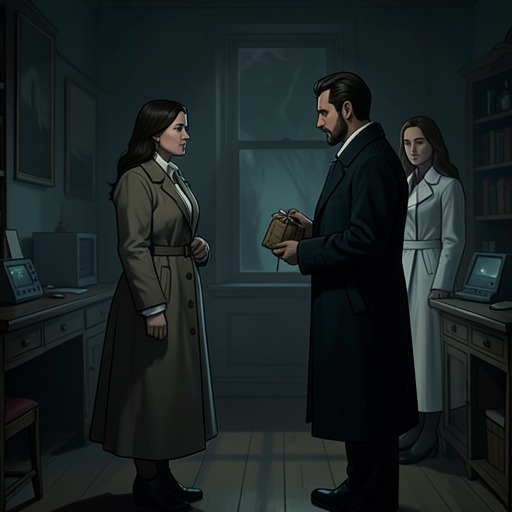
Rosemary’s efforts to obtain help are undercut by the people she has trusted. While she waits for Dr. Hill to call, she concludes that Guy, Abraham Sapirstein, Minnie, and Roman are acting together to use her to produce a baby for them. She fears for the child and resolves to protect him. The conclusion changes her understanding of her marriage and care: the familiar figures surrounding her are no longer merely offering assistance but belong, in her view, to a shared conspiracy.
When Guy and others enter her room with Sapirstein carrying a sedative, they reassure Rosemary that they will not hurt her and say the medicine will help her sleep. She resists their approach and tries to strike Guy with the telephone receiver, but the group restrains her. A severe contraction begins; Sapirstein recognizes that she is in labor and administers the injection. Rosemary had expected to give birth at Doctors Hospital, with its equipment and nurses, not in the circumstances imposed on her at home. The gap between the promised safety of medical care and her actual lack of control marks the crisis of her pregnancy.
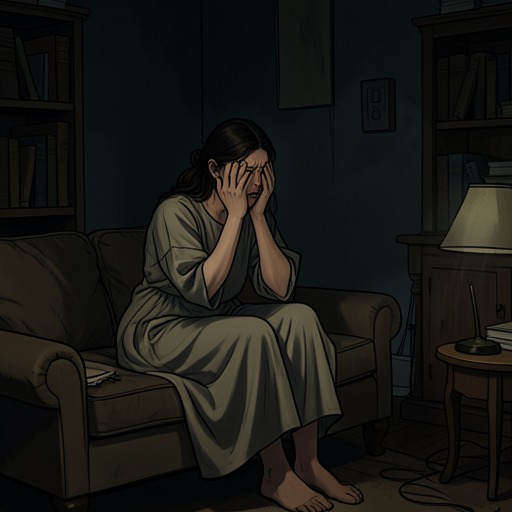
After being told that the baby has died, Rosemary becomes convinced that he is alive and decides not to rely on the police, friends, or another doctor to rescue him. She believes that Guy’s acting ability and Sapirstein’s reputation would lead others to dismiss her as delusional. This time, she plans to find the child herself. Her fear does not simply make her passive: it focuses her attention on the architecture of the apartment and on the possibility that the people she distrusts have used a hidden route.
The hidden passage and Andrew
Rosemary reasons that the chained door between the apartments cannot explain how the others came and went. She suspects the linen closet, which divides the large apartment, and searches it. The arrangement of the towels and blankets seems wrong. After removing the contents and the gingham-covered shelves she had installed, she finds a white panel with a continuous break in the paint. It swings inward to reveal a second closet. Through a keyhole, she can see a curio cabinet in the hallway of Minnie and Roman’s apartment; the door opens into their home.
The passage confirms that the apartment’s boundaries have not protected Rosemary. Once inside the other apartment, she finds no crib in the bedroom and cautiously continues toward the living room. A painting of a church in flames hangs over the curio cabinet, replacing what had previously been an empty space. The changed hallway and the hidden route make private domestic space legible as a place through which others have been moving without her knowledge.
At the black bassinet, Rosemary turns it toward herself. Her son, Andrew, is sleeping under a black blanket, with small black mitts tied at his wrists. When he opens his eyes, she sees that they are entirely golden-yellow, with vertical black pupils. The sight confronts her with the difference she has feared and the reality of the child she has come to retrieve. She turns the knife away from him and looks at him rather than treating him as an enemy.
Motherhood and narrative significance
Rosemary’s response does not depend on denying what she sees. She tells Andrew that he has a room of his own, with white-and-yellow wallpaper and a white crib, and explains that the milk he has been drinking comes from his mother. She identifies herself as that mother and begins making the child’s care, comfort, and place in the household concrete. Though Minnie and the others gather to watch, Rosemary turns back to settling the blanket around him. Her attention is on the baby, not on satisfying the observers.
This ending gives her maternal desire a different meaning from the one it held at the beginning. Rosemary had wanted a family with Guy and had tried, without his knowledge, to bring about a pregnancy. By the end, the people around her have converted pregnancy and care into means of control, but they have not eliminated her ability to choose how she responds to Andrew. The novel’s domestic horror is sharpened by that reversal: rooms, medical authority, and promises of protection have all failed her, while the mother-child bond becomes the ground on which she asserts a claim. Her choice to mother Andrew is neither an endorsement of what happened nor a restoration of the earlier marriage. It is an act of attachment made under terrible circumstances, and the final measure of her independence.