Rosemary’s drugged assault and conception
Rosemary's BabyRosemary’s drugged assault and conception is the pivotal episode in which an ordinary dinner at the Bramford gives way to concealed sexual violence and the beginning of her pregnancy. Rosemary experiences the assault through blurred awareness and dreamlike images; afterward, Guy’s explanations and the marks and soreness she notices do not restore her consent or trust. The event also establishes a pattern that shapes her later pregnancy: her pain and choices are repeatedly subordinated to other people’s assurances and decisions.
Circumstances and Loss of Awareness
Rosemary and Guy Woodhouse live in the Bramford, an old apartment building with a sinister history. Its atmosphere has already unsettled Rosemary: on trips to the basement laundry, she remembers that a dead baby wrapped in newspaper was found there, but avoids learning more because fuller knowledge would make the place still more frightening. The building’s dark reputation forms a background to the night, though Rosemary does not yet understand the danger around her.
During dinner, Minnie arrives at the door with extra mousse. Rosemary would rather not have her enter, but the dessert remains part of the meal. Guy argues that refusing it after accepting it would be unkind. Rosemary eats a spoonful and then another, saying that it tastes good. This domestic exchange matters because Rosemary’s participation is obtained without her knowledge of what the mousse is being used to do.
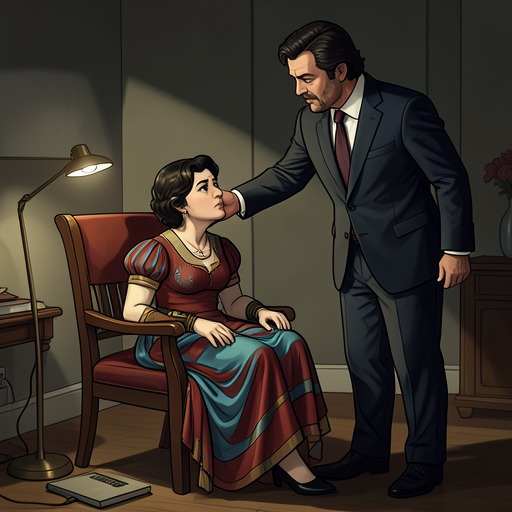
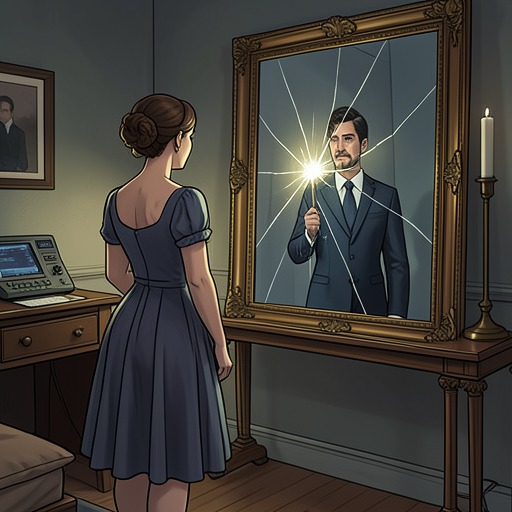
The first wave of dizziness comes as Rosemary clears the table. She tries to continue with the dishes, and Guy attributes her condition to alcohol and not having eaten enough. When her legs buckle, he carries her to bed and tells her to sleep. Her perception soon shifts into a dreamlike sequence: she sees an empty ship, then a ballroom with a burning church, and a gathering that includes Guy, Minnie, Roman, and other people. She understands herself to be at the center of a ceremony, but the scene is filtered through her impaired and altered awareness rather than presented as a clear, conscious observation.
The Assault and Its Concealment
In the dreamlike scene, Rosemary perceives Guy approaching her while she is unable to act freely. She recognizes that the experience is not simply a dream, but cannot make herself heard or stop what is happening. The novel withholds a straightforward account of the assault at this point: her confused perception and the apparent unreality of the ceremony leave her, and initially the reader, uncertain about what took place.
The following morning, details contradict the idea that nothing happened. Rosemary wakes unclothed, while Guy is dressed. He tells her that he had been waiting for the night because he wanted them to conceive, and acknowledges that he had been with her while she was unconscious. He treats the episode lightly, but Rosemary remembers a ceremony involving him, Minnie, and Roman, and describes her experience as an assault by someone inhuman. His casual response does not resolve the discrepancy between his account of a night devoted to making a baby and her experience of being unable to consent.
As she tries to make sense of the night, Rosemary reflects on the physical aftermath and on what Guy’s actions imply about their marriage. Even if he believed the goal was to conceive, she understands that he acted on her body without her knowledge or agreement. The distinction between his stated purpose and her experience is central: she feels treated as a body rather than as a person with a mind and will. Her unease extends beyond the episode itself. Looking back, she wonders whether Guy’s performance as an actor makes it difficult to know when his apparent feelings are genuine.
Pregnancy and Later Consequences
Rosemary wonders whether she is pregnant, and the event becomes the concealed origin of the pregnancy around which the novel’s later conflicts gather. Her subsequent distress is not limited to uncertainty about the assault: she experiences severe pain and fears that the baby may die. When friends ask whether her doctor is giving her medicine or other treatment, she says he is doing nothing. They urge her to seek another opinion, particularly from Dr. Hill, because they believe that pain should be taken seriously.
Instead, the pregnancy unfolds under the authority of Dr. Sapirstein, whose reputation and relationship with the people around Rosemary help sustain their assurances. When labor begins, Rosemary is at the Bramford rather than the hospital she expected. Guy and others restrain her while Dr. Sapirstein approaches with a hypodermic, describing it as a mild sedative. Rosemary tries to resist and call for help; only when Dr. Sapirstein recognizes that she is in labor does he change what he is doing. The episode extends the initial violation into a wider pattern in which her objections, requests for care, and preference for a hospital are overridden.
The building itself reinforces the sense that Rosemary’s domestic world is not secure. Much later, she discovers that a hidden opening in the linen closet connects her apartment to the Castevets’ apartment. The passage helps explain how people could move between the adjoining homes despite the chained door Rosemary remembers. It does not, by itself, establish every detail of the assault’s planning, but it gives physical form to the larger discovery that the apparent boundary between her household and the people around her has been breached.
Narrative Role
The episode is structured around a gap between Rosemary’s awareness and the reader’s knowledge. Dizziness, sleep, and dream imagery obscure the event as it occurs; Guy’s morning explanation and Rosemary’s memories then make the concealment increasingly difficult to sustain. What initially appears to be a confused night is recast as a crime and as the beginning of a pregnancy whose care is controlled by people Rosemary has reason to distrust.
That structure also sharpens the contrast between protective language and actual conduct. Guy says he is helping Rosemary and frames the night around their wish for a child, while she has not knowingly agreed to what happened. Later, medical assurances similarly coexist with untreated pain, restraint, sedation, and a birth arranged at home instead of at the hospital she expected. The event is therefore both the origin of the pregnancy and an early demonstration of how the people around Rosemary can use intimacy and authority to disguise the removal of her choice.