Theresa Gionoffrio
Rosemary's BabyTheresa Gionoffrio is the young guest of Minnie Castevet and Roman Castevet whose brief appearance in Rosemary Woodhouse’s life begins as a story of rescue and ends in sudden death. Her account of being cared for by the couple makes their household seem compassionate, while the circumstances and aftermath of her suicide give that apparent kindness a darker, unresolved edge. Later, Rosemary recalls a detail Theresa shared about the building’s former resident, making Theresa’s small part in the story consequential beyond her own short life.
Identity and Arrival
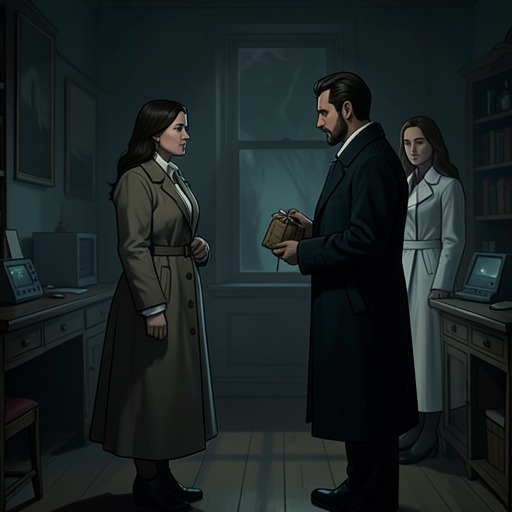
Theresa is staying with Minnie Castevet and Roman Castevet in their seventh-floor apartment, rather than renting a place of her own. When she meets Rosemary in the basement laundry room, she explains that she has been their guest since June. This places her inside the Bramford before Rosemary and Guy Woodhouse begin to know the Castevets, and makes her an early point of contact between the new tenants and their neighbors.
Her introduction is open and informal. She offers her hand, gives her name, and jokes about its spelling. The encounter takes place among the building’s washers, sinks, and laundry cubicles, an ordinary shared space that briefly makes the residents’ lives overlap. Rosemary has recently moved into the Bramford after learning that an apartment there was available, and Theresa’s presence offers her a first personal account of the people upstairs rather than merely an impression of them from a distance.
Life with the Castevets
Theresa describes Minnie Castevet and Roman Castevet as people who found her on Eighth Avenue after she had collapsed and then took her in. She says she had been starving and dependent on drugs, and credits them with helping her recover. In her account, their assistance is practical and sustained: they provide food and clean clothes, offer health foods and vitamins, and arrange regular medical check-ups. She presents their care as a transformation from acute hardship toward a stable, protected life.
She characterizes her place in their household through family comparisons. They have treated her like a daughter, she says, or perhaps like a granddaughter, and she connects the intensity of their attention to their being childless. The relationship is therefore more than a temporary lodging arrangement in the way Theresa describes it: she understands herself as filling a family role for the couple. Her affectionate confidence gives Rosemary a favorable first impression of them and helps establish the Castevets as seemingly generous neighbors.
Theresa also wears a small European charm, which Rosemary admires. The object is part of her presentation of herself as someone under the Castevets’ care, although the exchange does not establish what the charm does or what Theresa believes about it. In a conversation that otherwise emphasizes recovery, food, health, and familial affection, the charm is a concrete sign of the couple’s influence on her daily life without, by itself, proving anything sinister.
Meeting Rosemary and Its Aftermath
The laundry-room conversation creates a brief intimacy between the two women. Theresa speaks readily about her past and her gratitude to the Castevets; Rosemary listens and responds warmly. The scene matters because Theresa’s testimony precedes the couple’s more troubling associations in Rosemary’s experience. At this point, their help appears to be a benevolent explanation for Theresa’s presence, not a reason for suspicion.
That impression is sharply interrupted when Theresa dies by suicide after jumping from a window. Rosemary and Guy Woodhouse come upon the aftermath outside the building. Rosemary makes an automatic sign of the cross and struggles to contain her reaction; Guy is also shaken. A policeman identifies the dead woman as Theresa Gionoffrio. When the police inform Minnie Castevet and Roman Castevet, Minnie first rejects the news, insists that there has been a mistake, and then is asked to look at the covered body. The scene establishes the death as sudden and public, while offering no explanation for why Theresa took her life.
The contrast between Theresa’s hopeful description of recovery and her death remains unresolved. Her earlier words about being rescued cannot be treated as proof that the Castevets caused her death, and the available events do not supply a motive. Instead, the abruptness of the reversal unsettles the apparent security of the household she had praised. The couple’s care for her and her death coexist in the narrative without an easy account that reconciles them.
Later Significance
Theresa’s influence persists through what she told Rosemary about the building. Much later, as Rosemary reasons that there must be a hidden route between her apartment and the Castevets’ home, she recalls Theresa’s claim that Mrs. Gardenia had given Minnie herbs. Rosemary uses that remembered detail to connect the former resident, the herbs, and the possibility of concealed movement through the linen closet. The recollection contributes to Rosemary’s suspicion, but it remains part of her reasoning rather than independent confirmation of every conclusion she draws.
The Bramford’s basement and laundry rooms had already unsettled Rosemary: the service elevator creaks and trembles, and the passageways and laundry facilities feel forbidding. Theresa first appears within that everyday, shared infrastructure, not in a dramatic confrontation. The setting gives her account an ordinary domestic frame, which makes her later absence and the unanswered circumstances of her death more disturbing. She is not present when Rosemary discovers the concealed passage, but a fragment of what she once said helps Rosemary interpret the house.
Theresa’s narrative role is thus both personal and structural. She is a vulnerable young woman who describes receiving care, a neighbor whose death exposes the limits of Rosemary’s early understanding, and an inadvertent source of information that returns when Rosemary tries to act on her suspicions. Her brief story leaves the central question of her death unanswered; its force comes instead from the distance between the rescue she described and the fatal outcome that the novel places beside it.