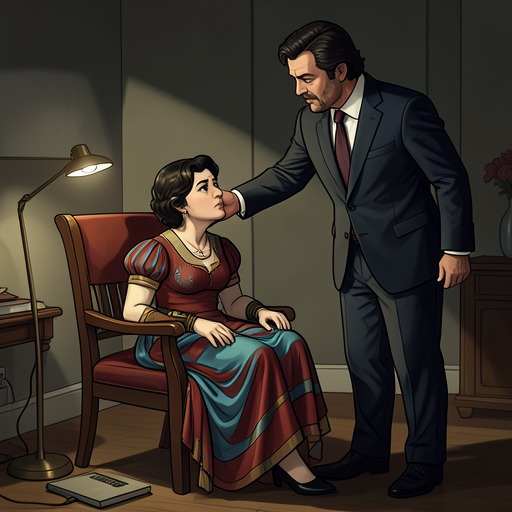
Guy Woodhouse and Andrew John Woodhouse
Rosemary's BabyGuy Woodhouse and Andrew John Woodhouse are father and son, but their relationship is formed under conditions Guy helps create and then misrepresents. Guy initially resists having a child; after Andrew’s birth, he reassures Rosemary with a false account of the baby’s death and speaks of what he and Rosemary have gained. The contrast makes fatherhood inseparable from Guy’s betrayal of Rosemary and from the conspiracy surrounding their child.
A Deferred Fatherhood
Before Rosemary becomes pregnant, she is twenty-four and imagines a family of three children spaced two years apart. Guy says he is not ready. Rosemary fears that he will keep postponing the decision, so she hopes to become pregnant accidentally: she dislikes the headaches she associates with pills and finds other contraceptive devices repellent. Guy monitors the calendar and avoids the days he considers dangerous, while Rosemary tells him that a particular day is safe. Their disagreement is therefore not an abstract difference in timing; it is a quiet contest over whether and when they will become parents, one Guy does not realize Rosemary believes they are having.
When her period begins, Rosemary experiences the result as another month in which Guy has prevailed. The episode establishes an early imbalance that will deepen later: her desire for a child is clear, while his readiness is conditional and managed through precautions. The eventual pregnancy does not resolve that tension by mutual agreement. Instead, it becomes the starting point for a relationship between Guy and Andrew in which Rosemary’s wishes, Guy’s assurances, and the actual circumstances of parenthood increasingly diverge.
Pregnancy and Complicity
During her pregnancy, Rosemary continues to express her desire to have a baby. At one point, she says that they have to make one; Guy puts off the effort until the next day and tells her there is plenty of time. His response recalls his earlier delay, but now it comes after she is already pregnant and speaking from the immediate strain of her condition. The scene keeps the couple’s disagreement about parenthood present even as the pregnancy advances.
As Rosemary’s pain and distrust of her doctor grow, she insists that she will not have an abortion and tells Guy she intends to see Dr. Hill. She wants another examination because she believes the pain may signal that something is wrong. Guy does not answer when she announces her plan. Later, when Rosemary tries to get away, Guy arrives with the group aligned against her. He presents their intervention as protection and repeatedly assures her that she will be all right, even as she resists and the group prevents her from leaving. His reassurances cannot be separated from his actions: he is not merely a prospective father offering comfort but a participant in overriding Rosemary’s attempt to make decisions about her care and delivery.
The False Account of Andrew’s Birth
After Rosemary gives birth, Guy supports the explanation that the baby has died. Dr. Sapirstein calls the outcome a rare mishap, says the baby was healthy, and predicts that Rosemary could try again within months. Guy promises that they can have other children once she has recovered. This promise repeats his earlier postponement in a changed form: the immediate child is presented as lost, while future parenthood is offered as consolation. The reassurance asks Rosemary to accept a story that hides what has happened to Andrew.
Rosemary’s questions about Guy’s exchange of ties with Donald Baumgart connect his behavior as a husband to the deception surrounding their child. She accuses Guy of needing a personal belonging so that a spell could be cast against Donald and make him blind. The episode makes the suspected bargain behind Guy’s acting success part of the same pattern of complicity that governs Andrew’s birth. Guy denies understanding what she means, but Rosemary’s accusation identifies the personal cost she believes lies behind his advancement and the child’s place in the conspiracy.
Andrew and the Broken Paternal Bond
When Rosemary later finds the child alive, Guy stands near the bassinet and tells her that the child will be all right. He also insists that Rosemary has not really been hurt and argues that they are receiving much in return. His language frames Andrew not simply as a son to be welcomed but as part of an exchange whose benefits accrue to Guy and the group around him. The contrast with Rosemary’s earlier longing for a family is stark: the child she wanted has been kept from her through concealment, while Guy speaks as though the arrangement can be justified by what they have gained.
Rosemary answers by spitting at Guy, a direct rejection that makes the breach between them visible. The scene offers no reconciliation between father and mother and no independent account of Guy caring for Andrew. Instead, it places Guy beside the living child while Rosemary confronts the people who have taken control of the situation. Andrew’s relationship with his father is thus defined, in the evidence presented, by Guy’s part in the deception around his birth and by the compromised terms on which he acknowledges the child’s presence.