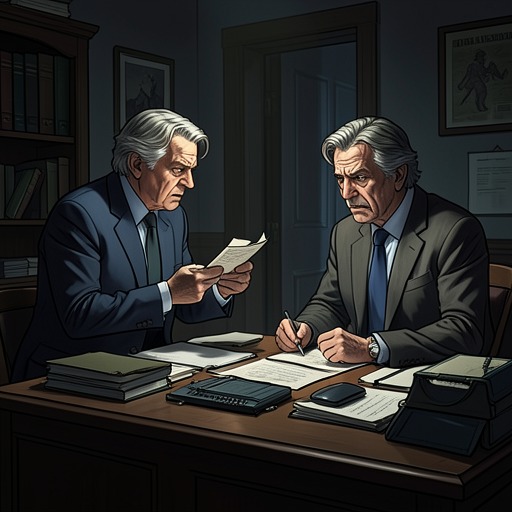
Guy Woodhouse and Donald Baumgart’s competition for a role
Rosemary's BabyGuy Woodhouse and Donald Baumgart’s competition for a role is a professional rivalry defined less by direct confrontation than by a sudden reversal of fortune. Donald first wins the part Guy had nearly secured; after Donald becomes blind, Guy receives it instead. The change brings Guy the career opportunity he wanted, but its cause makes the victory difficult for him and Rosemary Woodhouse to treat as simple good luck.
The Role and the First Setback
Guy learns from his agent that Donald has won the part he had come within a hair of getting. The news leaves him in a bad mood. Rosemary comforts him with a sandwich and beer, but she has little faith in the play: having read the script, she expects it to close out of town and doubts Donald will be heard of again. Her judgment offers Guy a way to regard the loss as temporary and the part itself as a poor prize.
Guy does not share that assessment. Even if the production fails, he believes the role is the kind that attracts notice and could lead to another opportunity. The disagreement reveals what is at stake in the competition: Rosemary evaluates the likely fate of the play, while Guy values the visibility that may come from performing in it. The role matters to him not only as a job but as a possible opening in a precarious acting career.
The Reversal
After the initial disappointment, Guy spends Sunday in unusually sustained activity, building shelves and shoe racks and hosting acquaintances. On Monday he paints the new fittings and stains a bench Rosemary found in a thrift shop. At the same time, his attention remains fixed on the telephone: he cancels an appointment and catches each call before the first ring has finished. His anticipation gives the eventual news a suspenseful build, although the reason for the call is not yet apparent to Rosemary.
When the phone rings again, Guy learns from Mr. Weiss that Donald has gone blind. Donald had woken the previous day unable to see and had tried to hang himself that morning; he is now at Bellevue Hospital under sedation. In the same conversation, Guy agrees to take the part. The position that Donald had won is now Guy’s, and the transfer follows immediately upon the report of Donald’s crisis. The sequence makes the professional reversal unmistakable without depicting the two actors meeting or arguing: the contest is settled by circumstances that have placed one man in acute distress and the other in line for his opportunity.
Success and Unease
Guy tells Rosemary that he has the part, but calls the way he got it a terrible one. He looks at the can of paint remover in his hand, sets it on the night table, and says he needs to walk outside and absorb what has happened. His response holds excitement and discomfort together. He has gained the role he wanted, yet the news that enables his success is Donald’s blindness and suicide attempt. Guy leaves without further explanation, and Rosemary lets him go.
Rosemary remains with both sides of the reversal in view. She thinks of Donald as unfortunate and Guy as lucky, then imagines what the part might bring: attention even if the play closes, further roles, perhaps movies, and a home in Los Angeles. She also pictures traveling out of town with Guy while he rehearses and performs, with time to sightsee and evenings spent meeting people. Her projections enlarge the role into a possible shared future, but they do not erase the circumstances of Guy’s good fortune. The same event that opens those possibilities for the couple confirms Donald’s devastating loss.
Narrative Significance
The competition is presented through contrasting expectations and consequences rather than through a sustained rivalry between the actors. Donald first defeats Guy for the role, and Guy recognizes that Donald must have been good to have beaten him. Yet the story supplies no direct encounter between them in these scenes; their connection is mediated by casting news, an agent’s call, and the abrupt reassignment of opportunity. The absence of a personal contest sharpens the role of chance in the outcome.
The episode also distinguishes winning a part from enjoying an uncomplicated victory. Guy’s earlier confidence that the role could attract notice is borne out when he gets it, and Rosemary immediately imagines the career and domestic prospects it might create. But Guy’s pause, his admission that the circumstances are awful, and his departure to walk prevent the reversal from reading as pure triumph. Donald’s misfortune becomes the condition of Guy’s advancement, leaving the role at once a professional breakthrough and a source of moral unease.