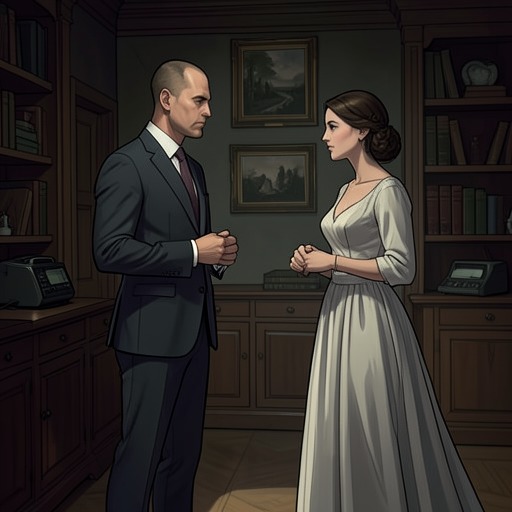
Guy Woodhouse and Roman Castevet
Rosemary's BabyThe relationship between Guy Woodhouse and Roman Castevet turns the familiarity of neighboring life at The Bramford into a hidden alliance with devastating consequences. At first, Roman is part of the world around Guy and Rosemary’s apartment; later, Rosemary identifies him as Steven Marcato, and the pattern of Guy’s career and conduct suggests that he has entered Roman’s circle in exchange for its help. The relationship’s decisive revelation is not simply Roman’s identity but Guy’s part in the bargain: when Rosemary confronts the truth, Guy speaks of what they are getting in return while their child is in Roman’s household.
Neighbors and the Question of Identity
Guy and Rosemary choose The Bramford after learning that a four-room apartment has become available, abandoning the lease they had just signed elsewhere for a building they had wanted since their marriage. Roman and Minnie Castevet are their neighbors in this old, subdivided apartment house. That domestic proximity gives Guy’s later association with Roman an initially ordinary surface: Roman is not introduced as a distant stranger, but as someone embedded in the couple’s home life and the building’s familiar social world.
The relationship changes when Rosemary tells Guy that Roman is Adrian Marcato’s son. She has used Hutch’s book, All Of Them Witches, and its account of the man who claimed to have conjured Satan and was attacked by a mob. The name Steven Marcato, she explains, rearranges into Roman Castevet. She also points to Roman’s age: born in August 1886, he would be seventy-nine, matching Roman’s apparent age. The identity claim joins a name puzzle to a biographical coincidence and to the fact that Roman lives in the same house where Steven Marcato grew up.
Guy does not immediately treat this as proof. He looks through the book and says the match might be a coincidence; after Rosemary presses the age and location together, he concedes that Roman is Steven Marcato. Yet his response makes the discovery less alarming than Rosemary intends. He explains Roman’s changed name as an understandable way to escape the stigma of having a supposedly crazy father. Guy accepts the identity while setting aside its possible implications, a distinction that becomes central to their conflict.
Success and Suspicion
Rosemary’s suspicion of Guy’s connection to Roman grows out of the timing of Guy’s career. She recalls that Donald Baumgart went blind a day or two after Guy had possibly joined the Bramford coven. Guy had been waiting for the news about the role, and Baumgart’s blindness was followed by a sequence of opportunities for Guy: a play, favorable reviews, another play, and a film offer. Rosemary wonders whether Guy’s part in a production in Greenwich Village might otherwise have gone to Baumgart.
The evidence does not make Rosemary’s theory an independently verified account of how the blindness occurred. It shows how she connects the event to the witchcraft described in All Of Them Witches, which says a coven’s united force can take a victim’s sight or hearing and can ultimately kill. Against that possibility, Guy’s success looks less like a private professional triumph than a benefit secured through Roman’s group. Rosemary’s question about what Roman and the others could give Guy is answered, in her mind, by the blindness and its consequences for his career.
Her conclusion extends beyond the role. She believes Guy is giving the coven their baby to use in rituals, and reads his earlier distance from the pregnancy as part of that understanding: he had not wanted a child until after Baumgart went blind, disliked feeling it move, and kept busy rather than engaging with the pregnancy. These are Rosemary’s interpretations of Guy’s behavior, not a confession from him at that point. But the later confrontation gives the suspected exchange a harder shape: Guy tells her that the others promised she would not be hurt and insists that they are getting much in return.
Alliance Revealed in the Household
By the time Rosemary’s labor and confinement bring her back into the care of Guy and Abraham Sapirstein, Guy’s alignment with Roman’s circle is no longer only a theory she has built from coincidences. When the two men enter the examining room, Guy’s face is stony and blank; he looks at the walls rather than at Rosemary. Sapirstein threatens that if she speaks further about witches, she may be taken to a mental hospital, where the facilities for delivery will be worse. Guy’s presence beside him, and his silence as Rosemary is pressured, place him on the side of the people controlling her rather than beside his wife.
Later, in the apartment, Guy explains that the group promised Rosemary would not be hurt and compares her experience to having a baby and losing it. He then presents the return as substantial. Rosemary spits at him. Her gesture makes the breach physical: the man speaking as though a bargain can balance their loss is the husband who had stood by while she was isolated and threatened.
Roman’s role in the same household is both social and authoritative. After Guy speaks, Roman catches him and introduces him to Argyron Stavropoulos. Stavropoulos clasps Guy’s hand and praises him, then asks whether Rosemary is the mother. Roman draws him aside to speak privately. The scene places Guy among Roman’s visitors and associates, while Roman manages the explanation of Rosemary’s presence. Guy is included in the gathering; Rosemary, though its indispensable mother, is treated as an unsettling exception.
A Domestic Alliance Turned Against Rosemary
The apartment building’s layout gives the relationship’s secrecy a material dimension. Rosemary realizes that the apartments once formed the larger front portion of a single dwelling and infers that there must be a hidden way between them: the door had been chained, yet the others had entered. She searches the linen closet, whose shelves she had decorated, and finds that the back is a white-painted panel. It swings inward onto another closet, from which a keyhole looks toward a curio cabinet in Minnie and Roman’s apartment; the door opens into their hallway.
The passage is evidence of concealed movement between the two homes, though the discovery alone does not establish precisely what Guy knew about it. For the relationship between Guy and Roman, its significance lies in how little the apparent separation of neighboring apartments guarantees. Rosemary’s home and Roman’s are physically joined behind an ordinary closet; the domestic boundary that might have seemed to separate a husband from his neighbor’s influence can be crossed unseen. The hidden route also leaves Rosemary to discover the connection and act on it herself, with a kitchen knife, rather than relying on Guy to protect her.
Betrayal and the Meaning of Return
The relation between Guy and Roman is defined by the contrast between Guy’s public, ordinary explanations and the consequences Rosemary sees beneath them. Guy can acknowledge Roman’s identity while dismissing its disturbing history as an old man’s family embarrassment. He can also stand with Sapirstein and describe the promised safety and rewards as a reasonable exchange. Those positions make him not merely a man who knows Roman, but a participant whose professional advancement and family life have become bound to Roman’s circle.
The bargain is most devastating because its currency is not Guy’s own safety alone. Rosemary understands the baby to be what Guy has given them; Guy’s later insistence that they are receiving much in return confirms the language of exchange even as he minimizes the harm to her. Roman remains the figure around whom the group gathers and through whom Guy is introduced to its visitors, while Guy supplies the intimate betrayal that makes the arrangement possible. Their alliance thus transforms the neighborly closeness of The Bramford into a structure of concealment: a successful career on one side, Rosemary’s threatened motherhood on the other.