Religious Faith and Doubt
Rosemary's BabyReligious Faith and Doubt is a recurring tension in Rosemary Woodhouse’s understanding of herself and the people around her. She calls herself an agnostic, yet retains habits of respect and a memory of religious comfort; Guy Woodhouse frames belief as impossible to settle by proof. Meanwhile, the Castevets deride conventional religious ceremony even as their own gatherings and claims take on a ritual character. The resulting contrast is not a simple passage from unbelief to faith: Rosemary continues to weigh competing explanations, while the danger around her is organized through acts and language that resemble a religion.
Agnosticism and Inherited Reverence
At dinner with Roman Castevet and Minnie Castevet, discussion of costumes and ceremonies expands into a criticism of religion as pageantry for the uninformed. Roman asks whether Rosemary is religious. She explains that she was brought up religious but is now agnostic, and insists that the conversation has not offended her. Her answer, however, is more complicated than a clean break with belief. When Minnie points out that Rosemary looked uncomfortable during a joke about the Pope, Rosemary acknowledges that she remains conditioned to respect him, although she no longer regards him as holy. Roman presses the distinction: if she does not believe in the Pope’s holiness, he argues, respect is misplaced. The exchange makes visible a tension Rosemary has not resolved: inherited reverence survives after theological certainty has weakened.
Guy gives agnosticism a more explicitly evidentiary form. Asked whether he shares Rosemary’s position, he says that without absolute proof either way he cannot see how anyone could hold a definite belief. Roman agrees that such proof is absent. Their shared uncertainty appears to place them outside religious commitment, but the conversation also exposes a difference in emphasis. Rosemary’s response retains an emotional and cultural residue of religious upbringing; Guy presents nonbelief as the rational consequence of insufficient evidence. Neither position supplies a settled framework for interpreting the events that follow.
Public Faith and Private Longing
On October 4, the day of Pope Paul’s visit to New York City, Rosemary experiences the public occasion as a moment of shared happiness. She follows the Pope’s movements on television while preparing food, and his address at the United Nations moves her. She hopes its call for an end to war might influence political leaders and ease the situation in Vietnam. The scene links religious speech to a practical hope for peace: although Rosemary does not describe herself as a believer, she is receptive to the possibility that moral language spoken in public may affect events beyond the church.
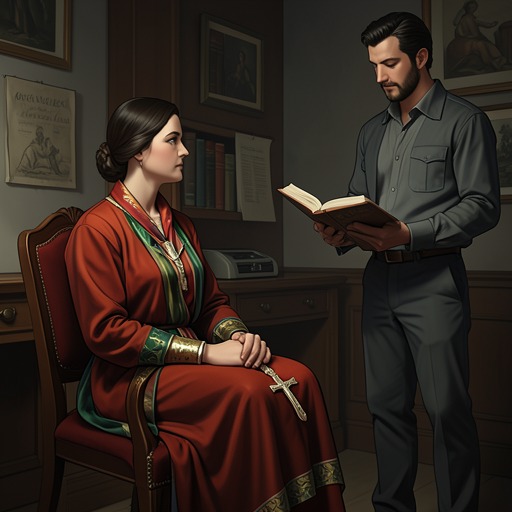
Pregnancy brings the limits of her agnosticism into sharper focus. As she considers the dangers that might threaten the developing child, she wishes that prayer were still possible and imagines the comfort of holding a crucifix and asking God for protection. The wish is not evidence that she has recovered a settled faith; it records her awareness of what disbelief has taken away at a moment of fear. She reaches instead for the Tannis-root charm, retrieving it from its wrapping and placing it around her neck before returning to bed with her hands over her stomach. The charm offers a material form of reassurance where prayer feels inaccessible. The contrast between Christian objects she longs for and the protective object she actually uses gives her uncertainty a concrete shape.
Ritual, Dream, and Ordinary Explanation
An earlier dream complicates the boundary between religious imagery and doubt. In it, a figure resembling the President excludes Edward Hutchins on religious grounds, before the scene shifts into a disturbing ceremony involving Guy, Roman, Minnie, and other participants. The dream is not proof that Rosemary has witnessed an actual rite. Its importance lies in how it gathers religious exclusion, familiar authority, and ritual imagery into an experience she cannot comfortably interpret. When Minnie explains within the dream that Rosemary cannot see or hear because she ate a mouse, the explanation belongs to the dream’s own logic, not to a confirmed account of waking events.
Later, Rosemary’s uncertainty remains active even after she has become suspicious of the Castevets. At a farewell gathering in Laura-Louise’s apartment, she sees people whose conversation and manners remind her of relatives in Omaha. The gathering includes food, neighbors, and talk of ordinary public subjects; its ordinariness makes it hard for her to reconcile these people with her belief that they belong to a witches’ coven. She recalls having seen them in a naked ceremony, then questions whether that experience was only a dream. This hesitation matters: her account does not begin as a simple, unwavering certainty. Everyday sociability and ritual suspicion occupy the same people, and Rosemary must decide how much weight to give her memories and inferences.
Testimony, Authority, and Competing Claims
When Rosemary tells Edward Hutchins that she is in her third month of pregnancy, he questions the diagnosis because she has lost weight rather than gained it. She explains that persistent pain keeps her awake, but minimizes its seriousness. At a later gathering, friends ask whether her doctor has treated her or sought another opinion. Rosemary defends Abraham Sapirstein by pointing to his reputation and a television appearance, even as she says he has done nothing for the pain and has assured her it will stop. Her appeal to professional standing shows how authority can steady her when direct experience is frightening, but it also helps sustain her reliance on a doctor whose decisions her friends challenge.
When she eventually seeks help from Dr. Hill, she carefully recounts the accumulated signs: Adrian Marcato, Roman and Minnie, the pain, the herbal drinks and white cakes, Hutch, the book All Of Them Witches, and the clues involving Guy and Donald Baumgart. She cannot put every piece into perfect sequence. Even so, she distinguishes uncertainty from the claim she considers most important: the Castevets want the baby. She allows that Hutch’s coma and Baumgart’s blindness might have been coincidences, or might have resulted from some unexplained ability, rather than presenting either explanation as proven. Dr. Hill acknowledges that the group’s interest in the baby makes her fear seem plausible. Yet when Guy and Abraham Sapirstein arrive, they tell Rosemary that further talk of witchcraft could lead to a mental hospital and pressure her to return home. Her testimony is thus answered not by an open investigation but by the threat of institutional authority.
The Coven’s Creed and Rosemary’s Naming
At the end, religious language becomes explicit and collective. Rosemary finds the black bassinet and realizes that the baby is alive. Roman declares that Satan is the child’s father and names him Adrian, presenting his birth as vengeance against worshippers of God. The coven’s response turns that claim into a public confession of allegiance: its members repeat a greeting to Satan and then acclaim Rosemary as the child’s mother. This ritualized chorus gives their private belief a visible community and places Rosemary inside a role they have assigned her.
Rosemary does not accept Roman’s religious interpretation of her child. When he calls her the mother of Adrian, she answers that the baby is Andrew John Woodhouse. Her naming neither proves a renewed conventional faith nor resolves the danger around her; it asserts a personal relationship and a claim to motherhood against the coven’s imposed theology. Across the novel, belief is shaped not only by doctrines but by gestures, objects, repeated ceremonies, and competing claims about who can define reality. Rosemary’s path from agnosticism through longing and suspicion ends not in doctrinal certainty, but in her refusal to let Roman’s creed determine her son’s name.