Roman Castevet
Rosemary's BabyRoman Castevet is an elderly resident of the Bramford whose genial hospitality and praise of Guy Woodhouse help make him a trusted neighbor before Rosemary Woodhouse discovers his identity as Steven Marcato, son of the notorious Adrian Marcato. His final appearance overturns the appearance of harmless old age: addressing the gathered coven, Roman proclaims Satan the father of Rosemary’s living child and announces the child as Adrian. The movement from fussy host to commanding spokesman makes Roman a hinge between the building’s buried history and the threat now organized around Rosemary’s motherhood.
Identity and Introduction
Roman lives with Minnie Castevet in the Bramford, the old apartment house that Rosemary and Guy had long hoped to enter. The couple had nearly abandoned their place on its waiting list when a four-room apartment became available; the building’s age and maze-like interior place Roman inside a home already marked by unsettling history. Rosemary later learns that Steven Marcato was raised in the same house. The coincidence of Roman’s residence and the building’s past thus becomes part of the evidence that leads her to investigate him.
When Rosemary and Guy first encounter the Castevets, Roman is presented as a tall, thin, shuffling man, at least seventy-five, dressed in a strikingly colorful seersucker jacket, red slacks, pink bow tie, and gray fedora with a pink band. His elaborate clothes contrast with his frail gait. His bright, small eyes and chalky cheeks give the description a more troubling edge, though his expression initially appears alert and friendly. Minnie supports his forearm as the couple approach, a gesture that reinforces his apparent dependence and age.
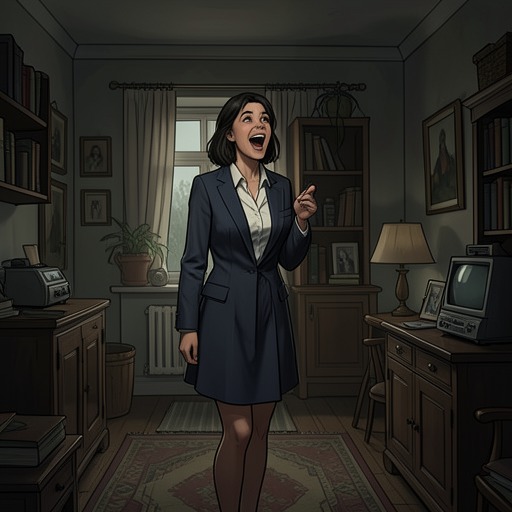
The first domestic visit adds a comic, hospitable version of Roman. He carries a small tray of pink cocktails in both hands, apologizes for overfilling the glasses, and insists that he usually pours with a bartender’s precision. Minnie warns him to watch the carpet. The exchange makes him seem both fussy and endearing: his attention is on the drink, the guests, and the risk of a spill. In retrospect, such scenes establish the ordinary social surface against which his later authority will appear so startling.
The Woodhouses and the Neighborly Mask
Roman singles out Guy’s acting for praise. He says his own father was a theatrical producer and recalls growing up among actors including Mrs. Fiske, Forbes-Robertson, Otis Skinner, and Modjeska. From that background, he claims to recognize something more than competence in Guy, including an inner quality that he believes could carry Guy far if he receives the necessary breaks. Guy is receptive to the compliment, and Rosemary is pleased to see him encouraged. Roman’s flattering attention gives him a place in Guy’s life as an approving older man, not merely a neighbor.
The theatrical background gains a suggestive resonance from Roman’s own conduct. His first impression combines a shuffling, vulnerable body with carefully conspicuous dress; later, his bearing changes and his voice grows louder and prouder as he speaks to the coven. The contrast does not by itself prove that his earlier manner is an act, but it makes performance one of the novel’s recurring ways of framing him. Roman understands how to make an impression, whether by praising an actor or by claiming the room as his audience.
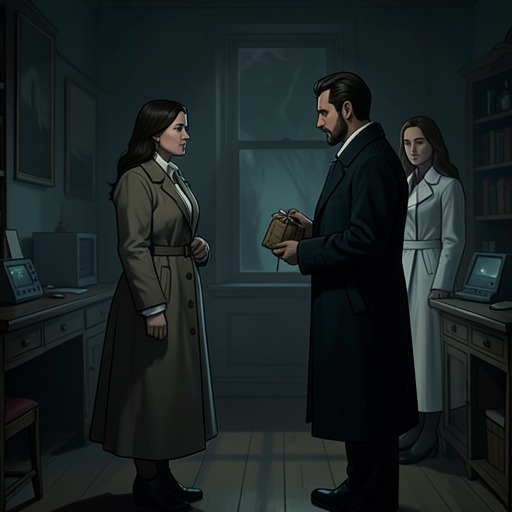
When Rosemary’s pregnancy is announced, Roman arrives with Minnie and Guy, carrying a bottle of 1961 Saint Julien. He offers his best wishes and proposes the wine as a toast in place of champagne. Minnie kisses Rosemary forcefully on the cheek; Roman kisses her other cheek. The welcome makes the couple’s news a shared domestic celebration, with Roman adopting the role of a delighted family friend. Later, while Rosemary is at home with Hutch, Roman comes to her door and asks whether she needs anything from outside. He explains that Minnie will be going down shortly and that their house phone is not working. Rosemary greets him warmly. At that point, the ordinary exchange still belongs to the neighborly world she believes she inhabits.
Rosemary Identifies Steven Marcato
The change in Rosemary’s understanding begins with Hutch’s warning and his book, All Of Them Witches. Working with the letters of Steven Marcato, she rearranges them into Roman Castevet, then back again. The name is not an impression or a resemblance: the same letters produce both identities. She tells Guy that Roman is Adrian Marcato’s son, Steven, and explains that his father had claimed to conjure Satan and was attacked by a mob. The book’s photograph of Adrian Marcato and his family gives her a visual point of comparison as she considers the connection.
Guy initially raises the possibility of coincidence. Rosemary answers with details that make the match more concrete: Steven Marcato was born in August 1886, which would make him seventy-nine, the age she understands Roman to be. Roman also lives in the Bramford, where Steven was brought up. Guy accepts that Roman is Steven Marcato, though he treats the altered name as an understandable response to having a mad father. Rosemary remains less certain that the family history can be dismissed so easily; she asks whether Roman could be the same as his father. The evidence she has found establishes his identity and lineage, but this exchange leaves the deeper question open at that moment.
The revelation changes the meaning of Roman’s apparent intimacy with the Woodhouses. His praise of Guy, his visit after the pregnancy news, and his requests to Rosemary are now seen against a history that the couple did not know when they welcomed him. The domestic threshold has become a point of uncertainty: the man who seemed to enter their lives through neighborly kindness has a name tied to the Bramford’s past and to the book Hutch left behind.
The Hidden Route and the Bramford
The building’s layout gives Roman’s apartment a physical connection to Rosemary’s later search. When she concludes that the conspirators must have entered despite the chained door, she reasons that there must be another route between the apartments. She suspects the linen closet that divides the large apartment into smaller units. This is Rosemary’s deduction, not proof that Roman personally built or operated the route; what she discovers is a concealed passage that opens from the back of her closet into a second closet and onward to the Castevets’ apartment.
The discovery is exact and material. A white-painted panel, framed with narrow molding, has a continuous broken line where the paint meets the frame. Pressing it makes the panel swing inward on scraping hinges. Through a keyhole, Rosemary can see a curio cabinet in the Castevets’ hallway; the door opens into their apartment. The passage turns the apparently separate homes into connected spaces and gives concrete form to her suspicion that appearances inside the Bramford are unreliable.
When Rosemary enters, she finds the hallway empty, with voices distant in the living room. Minnie and Roman’s bedroom lamp is lit, but there is no crib and no baby. Above the curio cabinet hangs a vivid painting of a church in flames, replacing a previously bare space. These details place the absent child and Roman’s household within a larger, ominous domestic setting. They do not make Roman’s presence in the hallway a certainty, but they sharpen the connection between his apartment and the hidden movement that Rosemary is trying to uncover.
The Child Adrian and Roman’s Final Authority
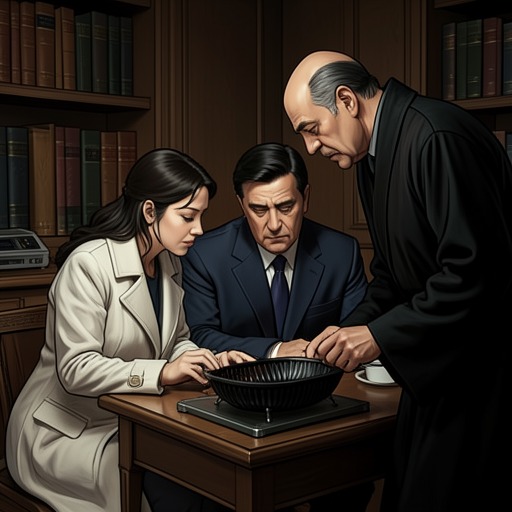
At the confrontation around the black bassinet, Roman gives the coven’s explanation of the child’s parentage. When Rosemary protests that Guy’s eyes are brown and asks what has been done, Roman tells her that Satan, not Guy, is the child’s father. He describes Satan as having come from Hell to beget a son of a mortal woman, and presents the birth as vengeance against those who worship God. His declaration is not a private reassurance or a neighbor’s kindly intervention: it is an announcement of the coven’s belief, delivered before its assembled members.
Roman’s manner changes as he speaks. His voice grows louder and prouder, and his bearing becomes stronger and more forceful than the shuffling figure first introduced to Rosemary. He declares that Satan’s name is Adrian and predicts that the child will overthrow the mighty and lay waste their temples. The coven answers with repeated acclamations to Satan and Adrian. Roman’s statement that the child is named Adrian links the baby to the name already present in Rosemary’s discovery of Adrian Marcato, while his declaration of Satan’s paternity supplies the supernatural claim Rosemary had earlier feared but could not establish from the anagram alone.
Minnie tells Rosemary that Satan chose her from among all women and arranged the chain of events that brought her and Guy to their apartment. She also says that Theresa Gionoffrio’s fear forced a change of plans. Roman’s own contribution is to assert Satan’s power and proclaim the child’s future. The distinction matters: Minnie narrates the supposed design behind Rosemary’s selection, while Roman gives that design its public doctrine and celebratory voice. Together, their words convert the child from the object of Rosemary’s urgent search into the center of a belief system she rejects.
Roman’s role depends on the collapse of several apparent separations: the two apartments are connected by a hidden passage; his adopted name conceals the letters of Steven Marcato; the frail host becomes a forceful speaker; and a baby presented as Guy’s is claimed as Satan’s son. The novel does not resolve every question Rosemary raises about Roman’s relation to his father, but it does reveal him as Steven Marcato and place him at the center of the coven’s final declaration. His transformation from welcoming neighbor to spokesman for the group makes the Bramford’s domestic familiarity inseparable from its menace.