Rosemary’s gathering and the sudden end of her pregnancy pain
Rosemary's BabyRosemary’s gathering and the sudden end of her pregnancy pain turn a social evening into a moment of medical doubt and bodily reprieve. As her guests arrive, Rosemary’s distress makes plain what she has largely kept private: she is suffering, fears for the baby, and has been given no treatment by Abraham Sapirstein. Her friends urge her to consult Dr. Hill as well. She agrees, but before that second opinion can happen, the pain vanishes; shortly afterward, she feels movement and concludes that the baby is alive. The relief is real, but it does not resolve the question of whether her care is trustworthy.
The gathering and its unease
For a while, shortly after half past nine, nobody arrives. Guy adds coal to the fire; Rosemary stands in her brown velvet dress, her hair arranged for the evening, while Renato, the bartender, occupies himself with the drinks and glasses. The party then fills in quickly: among those who come are Ted and Carole Wendell, Elise Dunstan and her husband Hugh, Guy’s agent Allan Stone, and Rain Morgan. The ordinary work of hosting continues around Rosemary’s pain. The guests are welcomed and drinks are served, even as the evening becomes a setting in which her private condition can no longer remain unspoken.
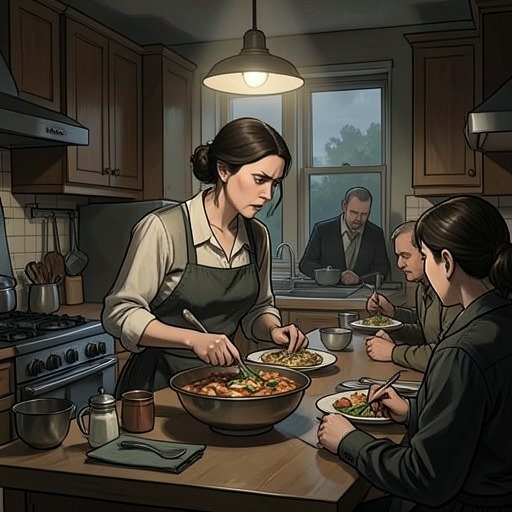
Joan draws Rosemary aside and asks what is wrong. Rosemary answers that she is pregnant. Later, in the kitchen with Tiger, tossing the salad, she is joined by Joan and Elise, who close the door and ask for the name of her doctor. Rosemary identifies Abraham Sapirstein. The change of setting matters: what began as conversation among party guests becomes a more private inquiry into the care she is receiving. The gathering brings concern into view without turning into a formal medical consultation.
Disclosure and the appeal for another opinion
Rosemary tells Elise and Tiger how much it hurts and says she is afraid the baby will die. When asked whether Abraham Sapirstein is giving her medicine or other treatment, she says that he is doing nothing. Her faith in his reputation remains visible: she defends him as a good, well-known doctor, even noting that he had appeared on the television program Open End. The contrast is sharp. His public standing reassures her, but it does not answer the practical question her friends have raised about her continuing pain and lack of treatment.
Elise argues that pain may be a warning that something is wrong and urges Rosemary to see Dr. Hill, explicitly recommending another doctor rather than asking her to abandon her existing physician outright. Tiger also challenges the apparent reasonableness of leaving the pain untreated. Joan makes the proposal immediate, telling Rosemary to seek another opinion first thing Monday morning. Rosemary agrees, and Elise asks her to promise. The exchange gives Rosemary a concrete next step, but it does not establish what is causing the pain or whether the baby is in danger. Its immediate achievement is to make a second opinion thinkable—and to secure Rosemary’s assent to pursuing one.
The pain stops and movement returns
The pain ends abruptly while Rosemary is talking to Guy. The narration compares the relief to a stuck car horn finally being fixed: something that had continued without respite is suddenly silent. Her first response is wonder at the possibility that she might feel well again. When Guy asks how much she is feeling, she notices movement and says that the baby is alive. She places his hand against the side of her stomach; the movement comes again, and he confirms that he felt it.
This change offers reassurance about one immediate fear, but it is not a diagnosis. The pain’s disappearance neither explains why it had been so severe nor confirms that the care Rosemary has received is adequate. The sequence instead moves from distress and uncertainty to sudden bodily relief, then to a shared sign of fetal movement. Guy’s participation briefly makes the pregnancy’s change perceptible to both of them, while Rosemary’s earlier agreement to consult Dr. Hill remains unresolved in the scene.
Reprieve, trust, and what follows
The episode places two forms of authority beside one another. Abraham Sapirstein’s reputation has helped Rosemary trust him, yet her friends focus on the absence of treatment and the persistence of pain. Their advice prompts a promise to seek another opinion; the sudden improvement then offers relief without supplying the explanation that a medical assessment might have provided. The gathering therefore does not settle Rosemary’s conflict between confidence in her doctor and concern about her condition. It exposes that conflict in front of people willing to question the care she accepts.
The later labor sequence sharpens the importance of that unresolved question. Rosemary expects to give birth at Doctors Hospital, with its equipment and nurses, but her labor begins amid the group assembled around her, and Abraham Sapirstein is present. That later scene should not be mistaken for an outcome of the party’s advice: the evidence does not show that Rosemary’s promise led to a visit to Dr. Hill. Rather, the contrast underscores how little the evening’s moment of relief changes the larger circumstances of her care. The pain stops, and movement reassures her that the baby is alive; neither event gives her the independent medical judgment her friends had urged her to seek.